Jun 5, 2006

Indoor Rowing About to Explode In Southern California, LA TIMES

Rowing back to the gym
By Roy M. Wallack, Special to The Times
June 5, 2006

I looked at the rowing machine before me. I looked at the 14 other people sitting down to their rowers. I looked up front at the instructor who promised to take us on a strenuous 50-minute rowing workout that he said would "change the way we think about fitness."

And I suddenly became very afraid.

I wasn't afraid I couldn't hack it. I was afraid my back couldn't hack it.

Ten years earlier, having heard about the great all-body workout and monster calorie burn of rowing, I sat down and attacked a rowing machine at my gym for about 20 minutes. About two weeks later, I was finally able to walk without wrenching pain screaming up and down my spine.

No wonder there's only one or two rowing machines at the gym, I thought — and why no one is ever using them. It seemed obvious why participation in indoor fitness rowing plunged from 14 million to 6 million from 1987 to 2001, according to the Sporting Goods Manufacturers Assn. — and why sales of rowing machines fell from 17% of fitness machines in 1987 to the point where the association no longer kept track.

Who would want to risk rowing when more popular — and more back-friendly — alternatives such as steppers, ellipticals and Spinning classes are now on the scene?

But some say that rowing's relentless decline is set for a U-turn. "It's only down because people don't know how to use the machine," says my instructor, Josh Crosby. "Rowing is a technical skill, like golf. Teach people proper form, crank up the music, get enthusiastic, knowledgeable instructors, and they'll love it. Rowing could be the next Spinning."

Now, comparing a back-busting relic like rowing to a worldwide phenomenon like Spinning might seem a little daffy, but the former Brown University rower, 32, is turning naysayers into believers.

Two years ago, Crosby brought 12 ergometers (rowing machines' official name) and the idea for a group rowing program to the Revolution Fitness studio in Santa Monica and soon was selling out seven classes a week. Building on that success, in March he launched the concept at industry bellwether Sports Club L.A., which purchased 25 ergs for its West L.A. club and watched its newborn "Indo-Row" classes max out almost overnight.

In May, Crosby successfully rolled out Indo-Row at Sports Club's Beverly Hills branch and has begun gearing up for September launches in the Irvine and New York clubs, with Boston, Chicago and Washington, D.C., down the road.

As the fitness world tries to determine if Indo-Row is trend or fad, Crosby meticulously puts instructor trainees through three-month apprenticeships. And he's not alone. Over the last two years, former collegiate rowing coach Angela Hart has taught fully booked rowing classes at two D.C.-area Gold's Gyms and trained dozens of instructors. As the program director for the Indoor Rowing Training and Certification Institute, she has certified 84 instructors around the country, 30 in the last six months.

"We're on the cusp of this thing [rowing] exploding," Hart says. She recently conducted a workshop for CrossFit, a hot new workout program that makes frequent use of rowing, and trained instructors on the reality TV weight-loss show, "The Biggest Loser."

"They will be using rowing machines on shows airing in the fall," she says. "When that hits, the benefits will be too obvious to ignore."

The machines work all the major muscle groups — legs, butt, back, arms, you name it — and can burn 500 to 800 calories in a 50-minute class. Not only is it great cross-training for such activities as cycling and running, it's uniquely democratic. The rowing machine, alone of all machines, is horizontal, so overweight people don't have to support their own weight.

And its appeal crosses age lines. At Revolution, 47-year-old Anna McDowell rows with her teenage son Quinn Harper, and heavy-set Ricardo Navarro proudly keeps pace with the sleeker set.

"Unlike any other classroom workout, it's accessible for everyone — old and young, fit and fat," Hart says. "Low to the ground, low impact, no pounding. The motion is so fluid that I even taught a rowing class the day before I gave birth to my son.

"We just need to get instructors trained so that people can do this right," she added. "It's not like aerobics class, where anything goes. Form is key to rowing."

*

How to do it right

"What happened to you is typical," Hart told me. "People tend to get on an erg and pull like mad with their arms — and hurt their back and shoulders and never try it again. But rowing isn't mainly about arms. You don't need a strong upper body. On the contrary, rowing is 70% legs."


The classic rowing stroke travels from the strongest muscle group to the weakest. It is initiated by the legs, then the torso and finally is finished by the arms.

"It's like lifting a heavy box overhead," says Crosby. "You initially use legs, and then call upon the back, shoulders and arms in the latter part of the movement."

The standard indoor rowing motion has four parts: The Catch, the Drive, the Finish and the Recovery.

• The Catch, the compressed starting position, turns your body into a coiled spring. The legs should be bent, arms extended straight ahead, body leaning forward, with shoulders ahead of hips, heels up, shins vertical.

• The Drive is an explosion, a complex, momentum-generating movement that flows from legs to core to arms. It is easiest to understand as two separate parts:

Drive A (Leg power): The first part of the drive is all legs. Keeping the arms straight and the body tall and angled forward, blast backward by contracting the quads and rapidly extending (straightening) the legs.

Drive B (Torso hinge): The second part of the drive utilizes the body's core. Thinking of the torso as an opening door that hinges, begin to lean backward before the legs fully straighten. Keep the arms straight (and therefore uninvolved in the pulling of the handle) until the legs have straightened and the body is momentarily vertical.

• The Finish: When the legs are done and the torso has hinged most of the way back, the arms take over. As the body leans backward, pull the handlebar toward your chest.

Then, the legs should be straight and the bar touching the chest. Don't bounce your knees at the finish or let your hands pause.

• The Recovery is literally your time to recover. Don't rush it; you will wear yourself out by going back and forth at the same speed. The recovery should be done twice as slowly as the drive, a 2-1 ratio. It is, essentially, the drive in reverse, but slower, with more clearly defined arm, body and leg motion. Hart calls it "reach, rock and roll." "Think of it as being pulled forward by the handle," she says.

Start the recovery by pushing the hands straight away from the body, then bending the knees. Fight the urge to pop the knees up quickly as you slide back into the catch. Bending the knees early wrecks the next stroke; your shoulders won't be positioned ahead of your knees, and you'll pull with too much back too soon, unnecessarily straining it.

Bending early encourages you to over-compress the knees in the catch position, leaving you too upright, with back and hips too far forward.

Anatomically, Hart says, you are strongest when your shoulders are a little bit ahead of your hips.

As a final check, there are two things to keep in mind about mastering the complex rowing stroke:

Don't try to push with the legs and pull with the arms at the same time.

And if your lower back hurts, you're definitely not following the technique.


The lesson learned

The Indo-Row class was hard work — solid cardio that would build to near-gasping when Crosby would have us "race" one another. Muscles of the butt and shoulders especially "felt the burn." But when it was over, nobody looked exhausted. First-timers and veterans alike were remarkably upbeat.

Rookie rower Pam Kraushaar, a 50-year-old Beverly Hills high school administrative assistant, said she enjoyed "the challenge of getting through class."

Newbie Lisa Gerson, an interior designer who runs three days a week and lifts weights, vowed to stick with rowing for its upper-body toning.

But the comment that struck me the most came from 10-week rower zuzu P. Spadaccini, a 53-year-old Hollywood information technology specialist with a tattoo of an unraveled roll of film snaking up both arms and around his shoulders.

"After training twice a week since March, I'm just now getting the technique down," he said enthusiastically. "I feel like I'm just scratching the surface."

So am I. Just as people aren't perfect golfers after one lesson, neither are they perfect rowers after their first time. The movement is complex and not automatically coordinated.

But the fact that my back didn't hurt meant I didn't have to be afraid of rowing anymore, and that I now had this superb all-body workout available to me. But this day was exhilarating for a more basic reason: I learned something new. In 50 minutes, I got noticeably better.

"Hey, you developed a new skill today," Crosby said to me. "A new skill you can keep perfecting."

How often do you get that on the elliptical machine?
Xeno Muller, Olympic gold and silver medalist, indoor rowing, rowing technique.

May 27, 2006

Consider Indoor Rowing conditioning as PRE-hab for joint replacement surgery

A friend of mine with whom I have rowed on the water in the past, paid me a visit yesterday at the Iron Oarsman. We talked about the many benefits of rowing and I told him how quickly one of our rowers recovered from hip replacement surgery. So we came up with the idea of PRE-Hab. Joint surgery replacement patients are often muscularly weak in the area that they get surgery. This makes RE-Hab that much harder. Indoor rowing could be a huge improvement on how fast a post surgery patient could regain full mobility of the repaired limb.
Food for thought, in the mean time I am going to register a couple domain names along those lines.
Have a great weekend everybody.
XENO
Xeno Muller, Olympic gold and silver medalist, indoor rowing, rowing technique.

You are a young high school women? Row hard on the Concept2 machine and become a rower at these schools:

NCAA Grand Final tomorrow Sunday


1:45 36 Div I 1st 8+ grand final GF Ohio State Brown California Princeton Michigan State Washington State
Xeno Muller, Olympic gold and silver medalist, indoor rowing, rowing technique.

May 26, 2006

On to Surf City Huntington Beach Relay 4 Life!!!!

P R E S S R E L E A S E FOR IMMEDIATE RELEASE

Contact: Xeno Muller, Founder
(949) 400-7630 Voice
(949) 743-2570 Fax
xeno@gorow.com
www.gorow.com

Iron Oarsman helped raise $112,000 for the American Cancer Society and goes on for June 3rd Huntington Beach Relay 4 Life

Costa Mesa, CA – May 26, 2006 - Xeno Muller, Gold Medal Olympian and founder of the Iron Oarsman, indoor rowing studio, teamed up with the American Cancer Society.

In Newport Beach, Team Iron Oarsman helped raise $112,000 and rowed a total of 588,000 meters. The top five rowers were Val Stepanchuk (103,456m), Richard Lund (54,693m), Arash Calafi (42,000m), Roman Rukosuyev (40989m) and Matt Ziezer (30873m), congratulations to them.

IRON OARSMAN will tackle the 24 hours Relay 4 Life in Huntington Beach, June 3rd.
http://surfcityusa.com/show/xmlsite/xml-standard.xml/xsl-remind_me.xsl/start_id-nlligmpdhpbmjjfnankopiijpfigjjpligciapbn/surfcity-true/
Xeno’s father passed away from liver cancer in 1992 and Xeno’s friend, Val, lost his mom to cancer in 1996.

Xeno (pronounced Z-ee-no) will row at the Huntington Beach Relay from 5pm to 8pm. Any new members that donate for the cause will receive unlimited access to his indoor rowing studio, the Iron Oarsman, for one week. In addition, Xeno will have several Concept2 rowing machines at the event were team members will row and record their mileage. Muller also added, “We are actively looking for a compassionate, corporate partner or partners that will make a pledge towards the miles that we log. I have a great group that is willing to break a good sweat for this cause.”

The Iron Oarsman was founded by Xeno Muller in 2003 and provides a variety of indoor rowing workouts and techniques that been used by executives and celebrities for years. The workouts are finally becoming mainstream with the general public. While rowing for Switzerland, Xeno won the Gold Medal in men’s single scull in Atlanta (1996) and the Silver Medal in Sydney (2000). Through his business, the Iron Oarsman, Xeno has developed routines using his chosen sport that have helped his clients lose weight, increase cardiac strength, cross-train, and rehabilitate. He has even helped students obtain collegiate scholarships in rowing despite their late introduction to the sport. For more information, Xeno can be contacted at (949) 400-7630.
# # # # # # # #
Xeno Muller, Olympic gold and silver medalist, indoor rowing, rowing technique.

May 24, 2006

Another reason why you should train on the indoor rower at the Iron Oarsman

http://www.ajc.com/search/content/metro/index/blueangels.html

The man passing out in the cockpit of a Blue Angel Jet should have been training at the Iron Oarsman before pulling 7.5 Gs.

ENJOY the video
Xeno Muller, Olympic gold and silver medalist, indoor rowing, rowing technique.

May 21, 2006

We raised US$ 112 000 at the Rowing/Relay for Life for the American Cancer Society

The event took place in Newport Beach at the Newport Harbor High School Football field on May 20 until May 21 for 24 hours.

Thank you Orange Coast College for all the meters that you guys have pulled. That was totally awesome! Thanks to VAL Surf the rowing machine kept going and going. He totaled over 100 000 meters in 24 hours. At 3 AM until 5 AM there was no one to give him a break and he just powered through.
This was also a great opportunity for me to get to know Orange Coast College Oarsman. I would like to extend an invitation to any of you who are interested in being trained to run indoor rowing workouts at the Iron Oarsman. It would be great if one day we could start a second location as an Indoor Rowing COOP. Just give me a call and we will start a once a week training session for future instructors.
XENO
9494007630
Xeno Muller, Olympic gold and silver medalist, indoor rowing, rowing technique.

May 18, 2006

It is a pleasure to coach here is a very kind testimonial

I would like to put in a good word for the merits of a coaching session with Xeno at the Iron Oarsman. I am a fifty-ish recreational rower from Boston who trains moderately most of the year, trains a little harder in the three months before Crash-B's, and barely ekes out a sub-7 2k at Crash-B's every year--at least so far. I've never been on the water, never been coached, and never watched myself in a mirror or on tape. Having been at this for several years, I just assumed that my technique was pretty good.

I visited California a few weeks ago and while there I set up a private coaching session with Xeno at the Iron Oarsman in Costa Mesa, CA. The session took place on slides with a video monitor set up so that I could watch myself as I rowed. I'm guessing that it took about three warmup strokes for Xeno to diagnose my stroke and figure out what needed to be fixed. Wasting no time, Xeno described to me as I rowed exactly what things I was doing well and what things I was doing poorly. I was slightly dismayed to learn--and see on the monitor very clearly--that I had a couple of significant technical flaws that were causing me to lose power. The flaws centered around upper body carriage, upper body angle, and the timing of my upper body lean relative to the bending of my knees at the start of the recovery. Xeno pointed out how these flaws inevitably led to other flaws at the catch and during the drive.

Much of the session was devoted to drills that would address the diagnosed flaws. The drills were meant to suggest what I could do in my training sessions to improve technique, but also to allow me to get a sense of how the stroke should feel at various points. The drills were actually a bit frustrating, as each drill isolated a part of the stroke and highlighted any problems with that part of the stroke. But the drills also highlighted the solutions to the problems. Xeno warned that the drills would cause me to feel a little uncomfortable and disjointed and mechanical. That they did.

When I finished up the drills and tried to apply everything I had learned to the full stroke, I felt really uncomfortable--I just couldn't put all the pieces together except for a few strokes where everything seemed to fall into place. But for those few strokes where everything fit together, it was very apparent that I could generate a lot more power with the new stroke than the old stroke. When I was done, Xeno jumped on the erg and did a quick run-through of the key points with his stroke as the example. I left the Iron Oarsman with a video of the session complete with Xeno's comments, as well as a video of Xeno's 1996 Gold Medal row, which is quite inspiring!

In all honesty, I felt a little discouraged after the session. I knew I was going to have to choose between sticking with my somewhat inefficient but nevertheless comfortable normal technique or undertake the pain in the ass of rehabbing my stroke. I pouted for a couple of days before deciding to get to work on a new stroke.

Now, after a couple of weeks of lots of drills, things are starting to come together. I'm still a little mechanical--partly by design, as I want to avoid reversion to old habits--but there is no doubt that I am able to generate more power per stroke at the same level of effort than with the old stroke. As I am becoming more consistent and comfortable with the new stroke, I find myself also becoming more enthusiastic and energized about my workouts. It's not so bad to be an old dog when you can still learn some new tricks.

Anyway, I heartily recommend a session with Xeno if you get the chance. And thanks, Xeno, if you happen to read this.
Xeno Muller, Olympic gold and silver medalist, indoor rowing, rowing technique.

May 17, 2006

From World Rowing: Diabetes and Rowing and Olympic story

Living and rowing with diabetes


17/05/2006
A pump the size of a pager sits permanently to the waist of Canadian Olympian Chris Jarvis. It enables him to live his life pretty much as regular as possible. But there’s nothing much that’s regular about Jarvis.

Jarvis starts off by talking about how he got into rowing, describing how he began playing American football with the indoor rowing machine being used as off-season training.

“Then,” says Jarvis, “rowing started to take over.”

Jarvis goes on to explain his rapid rise in the sport going to the Canadian high school championships and winning both the pair and the four, gaining a rowing scholarship to college in the United States and going on to become an under-23 medallist before being pulled into Canada’s very successful men’s eight in 2004. Making it to the Athens Olympics, Jarvis raced in a highly favoured pair.

As Jarvis continues to list his rowing achievements he calmly adds, “I’m a diabetic. I have been since I was 14.”

Lifting up his shirt Jarvis reveals his constant companion, an insulin pump. Jarvis can and must regulate the amount of insulin that flows into his body through a needle.

“Do I feel it? Yeah I feel it. It feels like a needle is in me.”

Every second day Jarvis has to move the needle to a new spot to ensure continued flow of the insulin. Mainly it is in his backside, an extra issue in his chosen sit-down sport.

The needle inserts leave scars. “I can’t do any nude modelling,” confesses Jarvis. “The scars heal eventually but sometimes they get infected then I have to find a new spot.”

“But,” says Jarvis putting it into perspective, “it’s a small price to pay for having the right blood sugar level.”

“Yes, it’s affected my rowing. It’s been a challenge almost every day,” says Jarvis as he goes on to explain how he has had to prove himself to coaches. “Team mates see the highs and lows so they wonder if it’s going to happen in racing.”

“My university coach said I was a risk, so I felt like I should step up to a level that no one could lose trust in me.”

How Jarvis got diabetes is not known. He says there are many theories, some based on the pancreas being attacked by white blood cells and killing off the ability to produce insulin. According to the Diabetes Exercise and Sports Association, DESA, athletes who get diabetes usually get it as elite athletes.

Rowing’s most famous diabetic, Sir Steve Redgrave was diagnosed with diabetes while still training. He already had four Olympic golds and can only be described as Olympic fit when he was diagnosed with diabetes. Although a setback, it didn’t stop Redgrave from continuing on to Olympic gold medal number five.

Jarvis is unusual in the earliness of the onset of his case, at just 14 years old, so managing the issue has been an integral part of his rowing career.

The only rower with juvenile diabetes to make the Athens Olympics, Jarvis has received help for his medical costs though an award from the DESA. “I was without medical coverage and needing to beg and borrow for my supplies, reusing needles many times and worse. It was a saving step in my approach to Athens.”

But now support and medical technology has gone one step further.

“An insulin pump was out of my reach before Athens financially, but now with support from a company I have been able to trial a new product which combines continuous glucose monitoring with the already favourable results of an insulin pump. The pump is basically a mechanical pancreas to distribute insulin as programmed along with manual shots whenever food is taken. With the high variability of blood sugars resulting from exercise and stress it has been an awesome step to have a continuous stream of data available right on my pump. I can see glucose levels and trends at the push of a button, which allow me to make a more informed decision.”

Jarvis contrasts this to rowing at Athens. “I was testing 20 times a day to be aware of my sugars. Any time spent out of my zone I would pay for with dehydration, fatigue or lack of coordination.

Currently finishing his chemical engineering degree, Jarvis has every intention of continuing on towards Beijing especially after the disappointment in Athens when his pair was disqualified for crossing into another lane.

“I don’t want to tell the story to my grandchildren that I made it to the Olympics but didn’t get to the finish.”
Xeno Muller, Olympic gold and silver medalist, indoor rowing, rowing technique.

May 16, 2006

For immediate Release

P R E S S R E L E A S E FOR IMMEDIATE RELEASE

Contact: Xeno Muller, Founder
(949) 400-7630 Voice
(949) 743-2570 Fax
muller2000@sbcglobal.net

Iron Oarsman Aims High with American Cancer Society Fundraiser

Newport Beach, CA – May 16, 2006 - Xeno Muller, Gold Medal Olympian and founder of the Iron Oarsman, is teaming up with the American Cancer Society during the 5th Annual Relay for Life Event being held during May 20th – 21st.

This year the Relay’s surfing-related theme is “Wipeout Cancer” and is scheduled to raise awareness and funds for cancer research (www.city.newport-beach.ca.us/relayforlife).
The event includes a 24-hour relay among participating teams, booths, a pancake breakfast, and entertainment.

“Last year the event raised $120,000 and the this year there is a fantastic potential to raise so much more money for such an important cause,” says Xeno whose father passed away from liver cancer in 1992 and whose connection with the community frequently puts him in touch with cancer victims and survivors.

In order to boost proceeds for the event, Xeno (pronounced Z-ee-no) is actively recruiting team members for “Team Iron Oarsman.” Any new member that joins the team for the event will receive unlimited access to his indoor rowing studio, the Iron Oarsman, for one week. No previous rowing experience is necessary. In addition, Xeno will have several Concept2 rowing machines at the event were team members will row and record their mileage. Muller also added, “We are actively looking for a compassionate, corporate partner or partners that will make a pledge towards the miles that we log. I have a great group that is willing to break a good sweat for this cause.”

The Iron Oarsman was founded by Xeno Muller in 2003 and provides a variety of indoor rowing workouts and techniques that been used by executives and celebrities for years. The workouts are finally becoming mainstream with the general public. While rowing for Switzerland, Xeno won the Gold Medal in men’s single scull in Atlanta (1996) and the Silver Medal in Sydney (2000). Through his business, the Iron Oarsman, Xeno has developed routines using his chosen sport that have helped his clients lose weight, increase cardiac strength, cross-train, and rehabilitate. He has even helped students obtain collegiate scholarships in rowing despite their late introduction to the sport. Contact Xeno at (949) 400-7630 for further information.
# # # # # # # #
Xeno Muller, Olympic gold and silver medalist, indoor rowing, rowing technique.

May 11, 2006

I need your help!

No body is able to do everything. I was taught how to row the single scull and now I am pulling the chain and motivating people to do the same. Where I am really lacking is spreading the word about the IRON OARSMAN. I have been really lucky to meet a new friend, RON!
Ron is going to help me market the Iron Oarsman. For this we are looking for subjects/reasons why rowing is good for us humans.
So I thank you all in advance for your input!
Sincerely,
XENO
Xeno Muller, Olympic gold and silver medalist, indoor rowing, rowing technique.

May 10, 2006

Indoor Rowing, Diabetes, and hip replacement surgery

At the Iron Oarsman we have a rower who has type 2 diabetes. He carries an insuline pump on his waist. He told me that on the days he works out he reduces his insuline intake by 30%. This is of course great news. I asked him to write a testimonial. So stay tuned.

In addition we learned at the Iron Oarsman that the motion of rowing is good rehab for hip replacement surgery. I can imagine that knee replacement patients would greatly benefit from rowing too.

I do want to stress that the rowing machines that we use at the IRON OARSMAN are ON SLIDES and are not stationary on the ground.

Do visit our website www.gorow.com or call me at 949-400-7630

All the very best,
sincerely,

XENO
Xeno Muller, Olympic gold and silver medalist, indoor rowing, rowing technique.

May 9, 2006

Latest Indoor Rowing Newsletter can be found following the link below.

http://www.gorow.com/Newsletter%2520May%25202006.htm
Xeno Muller, Olympic gold and silver medalist, indoor rowing, rowing technique.

May 7, 2006

I am starring in a VIDEO made by my friend and rower Shaggy!

This video is rated G.
It has absolutely nothing to do with rowing, indoor rowing, or Concept2/rowperfect. The only items that show that rowers are at the helm of this academy award winning display are a couple of oars and a rowing jacket worn by one of the DANCERS!
follow the link and leave me comments: THE GREAT VIDEO

XENO
Xeno Muller, Olympic gold and silver medalist, indoor rowing, rowing technique.

May 6, 2006

Great new Seat addition to the Concept2 Rowing Machine

I have tested the Core-perform seat attachement for Concept2 rowing machines model C & D. It is great.
Follow the link, I made a video showing how it works:
http://web.mac.com/xenoralfmuller/iWeb/Site/Core-perform.html
Xeno Muller, Olympic gold and silver medalist, indoor rowing, rowing technique.

May 5, 2006

Ratio and Torque in Rowing a question answered:

Dear Xeno:

Please know how much I appreciate your Web site and Blog. Your dedication to rowing and love of the sport is truly inspirational (You are a stud!). I just started training on the Concept 2 for the first time about 2 months ago and I am already obsessed! If you would be so kind, I have a quick question. . .

OK, here goes. . .

I am following a level 3, 16-week, 2,000 meter, 4X per week training program that I downloaded off the www.concept.co.uk/training site. The chart says at the UT1 training level my stroke rate should be 22 – 24 SPM; however, I find that to row at my 2:00/500 meter UT1 pace I need to row 33 – 34 SPM. My entire training group has the same problem (i.e., our SPM is 10 SPM higher than the SPM indicated in our training chart), regardless of their UT1 pace. Are we nuts or just missing something?

Thanks in advance; peace and all good things for you and your family,

S.

Hi S.

In rowing there is much emphasis on RATIO and TORQUE
per stroke.

The recovery is roughly twice as long than the drive.

Torque is how much you can accelerate the flywheel in
one acceleration.

To learn torque see how much you can accelerate the
flywheel by keeping the stroke rate VERY low like 16.
You will notice that the recovery takes a long time
whereas the drive is fast. Make sure that on the recovery you get the
forward body angle BEFORE you raise the knees.

You should get my indoor workout DVDs because the
ratio and torque are clearly shown.

All the best and I hope this helped.

Kindest regards,

XENO
Xeno Muller, Olympic gold and silver medalist, indoor rowing, rowing technique.

May 4, 2006

Let's fight cancer together please follow the link

On May 20, Iron Oarsman will take part in the fifth annual fund raiser in Newport Beach to fight cancer. Please follow this link:
https://www.kintera.org/faf/donorReg/donorPledge.asp?ievent=152619&lis=1&kntae152619=3E5540ABD418499A
AE0FCFC5DE60A165&supId=0&team=1283951&cj=Y
Xeno Muller, Olympic gold and silver medalist, indoor rowing, rowing technique.

Here is a nice piece on Rowing and Fighting Cancer

Colleen Carey

By Ashley Lerch

Each year over 1.3 million people are newly diagnosed with cancer, according to the American Cancer Society. The rowing community is full of people who have battled cancer, and our rowing friends are also among the millions of people who also die from the disease.
Interested in rowing since college, it was a fight with breast cancer that finally guided Colleen Carey into the boat. After recovering from the treatments to battle her cancer, she found rowing was the perfect exercise to help her body and mind to recover from the drain that the cancer had put on her body.

“It’s fairly impossible for me to separate my cancer recovery from rowing.” Carey said. “Cancer is very good at teaching you to accept things that are out of your control. You have to accept that your body will never be the same, which was a hard lesson for me to learn at age 27.”

According to the National Cancer Institute, “Physical activity improves quality of life among cancer patients and survivors. Studies are beginning to explore the potential for physical activity to improve cancer survival.”

Colleen enrolled in a learn-to-row program at the Albany Rowing Center, in Albany, New York on her 29th birthday. She found rowing to be a wonderful exercise on her weakened body, but provided her with the full body workout she needed to gradually regain her strength.

“Rowing was crucial in giving me my body back. I eventually had new proof, proof that my body was strong and flexible and capable of doing something pretty special.” She said.

A year later, Colleen has enrolled in the adult competitive rowing program at Albany Rowing. She intends on participating in many regattas in the 2006 rowing season, especially the 2006 FISA World Rowing Masters Regatta, in Princeton, NJ.

Colleen is one of the many rowers who attribute rowing to helping them overcome illnesses. The rowing community is full of amazing people who have greatly benefited from the health advantages that rowing exercise provides.


Aside from rowing, Colleen is an active volunteer for the Susan G. Komen Foundation. Last year she participated in the Boston Breast Cancer 3-Day Walk, and she is fundraising once again this year for the San Diego 3-Day Walk. For more information on Colleen, her battle with cancer, and her 3-Day Walk fundraising efforts, please visit her site at http://www.colleencarey.com/3day/boston/.

Also she has designed rowing themed merchandise to aid her fundraising efforts, and you may purchase these items at http://www.cafepress.com/crewclothing.
Xeno Muller, Olympic gold and silver medalist, indoor rowing, rowing technique.

May 2, 2006

Cool indoor rowing picture


Concept2 Indoor Rowing Machine

After looking a little on google I found this pretty nice picture
Xeno Muller, Olympic gold and silver medalist, indoor rowing, rowing technique.

Stating what is not obvious to everyone:


Indoor rowing is a sport that can be practiced by many many different people of different ages and physical ability.

My phrase to explain how accessible rowing is to people who think they can not do it:

"If you can sit in the coach without pain, then you can row."

We have now been in business for three years. The diversity of the rowers at the Iron Oarsman is remarkable. Young and old, limber and not so limber, all enjoy the zero impact motion of indoor rowing and the great cardio vascular exercise they get out of it.

You don't need to pull hard to enjoy rowing.

If you want to workout harder then all you need to do is pull harder.

So come on down to the Iron Oarsman and check it out for yourself.

We use Concept2 rowing machines.

You can look at our website:

www.gorow.com for information and indoor rowing DVDs.

Call me if you have questions:

9494007630

Sincerely and all the best,
XENO
Xeno Muller, Olympic gold and silver medalist, indoor rowing, rowing technique.

Apr 29, 2006

This is from Concept2 U.K.

If this newsletter is not displaying properly, you can read it on our website at http://www.concept2.co.uk/email/newsletter.htm.


Steve Redgrave and the Flora London Marathon
If you watched the Flora London Marathon last Saturday you may have noticed several things. Firstly, how excellent the Men's race was. Can't fault any race that takes place over 26 miles, 285 yards and ends up in a sprint finish. Secondly, how gutted James Cracknell looked when he realised that he finished ten seconds the wrong side of the three-hour mark and thirdly, his former rower-in-arms Steve Redgrave running the course in a slightly more relaxed fashion, but garbed at several points in a Concept2 t-shirt. Concept2 were proud to be one of the corporate sponsors for Sir Steve during his attempt to break the world record for the most amount of money ever raised at a marathon.

Although the final amount has yet to come in, it looks like Sir Steve has easily broken his £1.2 million target and we'll let you know what the final figure was when it comes in. Of course, it's still not too late to give, and if you haven't yet done so, visit http://www.justgiving.com/sponsorsirsteve.

Finally, spare a thought for Lloyd Scott. Lloyd was the man a couple of years ago who ran the race in a deep-sea diver's suit. Now he's helping Sir Steve out by "running" it in a full suit of armour while towing a ten foot dragon around the course. So far, Lloyd has covered just over 15 miles of the course, and you can follow his progress here: http://www.steveredgrave.com/marathon/week14a.htm.

top

Cartoon By Rog


top

Readers' Stories: Rod Wark
Rod Wark's wake up call came whilst on holiday in Belgium during August 2004. His wife is a regular gym goer and had recently taken up running. When she said she was going for a training work out through the woods by their hotel, Rod said he'd go along too and keep her company. He thought the run would be a breeze but it turned out to be more of a wheeze, with his lungs bursting for air and his legs calling for a time out (Rod, right, before his holiday).

There are many who could tell a similar story. We're active at school, lean, fit and trim. Next we start work and follow a career. The years slide by. You've guessed what happens next. you've got the picture. Responsibilities kick in; activity takes a tumble and the weight piles on and on. But when Rod Wark reached his mid forties and his weight was 22 stone (141 kilos) he decided that enough was enough and was determined there and then to do something about it.

Rod left Leeds University in 1980 and he weighed a trim and fit 13.5 stone (86 kilos). He was an active sportsman especially enjoying competitive table tennis, representing his college in a local league, captaining his rugby team at school and has always enjoyed playing badminton. Rising through the ranks of the West Yorkshire Police Force to become a Chief Inspector his weight increased. In 2000 he first decided to make a change to his lifestyle. Rod takes up the story:

"At the gym I tried rowing and had a half decent technique. I even competed in the 2001 British Indoor Rowing Championship, finishing seventh in a time of 6:24. But I stopped training - I needed a focus and the weight piled back on. Then in December 2003 I bought my own Indoor Rower. I didn't have a routine or follow a programme so progress with shifting the weight that had returned was very limited."

Back to August 2004. Still on holiday after his failed run, Rod had some free time to plan. So when he returned home he was determined to follow a training programme on his Indoor Rower together with joining Weight Watchers. This brought him face to face with planning daily routines for training and recording his progress. It also gave him the chance to look at his eating habits, including portion size, when and where he ate his meals and the number of times each day he'd be snacking. And when it came to preparing his menus his wife was with him trying out new recipes made from freshly bought food rather than ready-made convenience food. Weight Watchers' weight loss plan is based on a set number of points individually calculated for you each day, matched to your height, weight, body type and daily level of activity. Food by type and weight is given a points value.

This dual approach of exercise and monitoring food intake gave him the incentive to begin in September 2004.

"Healthy sensible eating together with Indoor Rowing saw the fat drop off. I had regular rewards when I reached weight loss milestones. I bought a new pair of trainers and a half-day visit to Harrogate Spa. There I enjoyed massage, a session on a flotation bed and hydrotherapy treatment. Next was the purchase of a new bike. This is for my next fitness venture, which will be cycling from Land's End to John O'Groats for charity."

"Also I marked every kilo shed with a similar amount collected in bags of sugar as a visual incentive to maintain the onslaught on my waistline. On the table in my office the bags of sugar increased over the months. Every day I was reminded what had been achieved. Things got to a head when the cleaners found that sugar was spilling from the pile. They said they couldn't manage to clean any longer so when I had a sugar mountain of 46 one-kilo bags (100lbs) I decided to donate this to a charity. When I had colleagues visiting my office they were interested to know what was happening. They also noted that I was drinking much more water. I'm certain over a dozen people have decided to follow me and lose weight the same way."

Rod has brought his weight down by 42 kilos (six and a half stones) in nine months from September 2004 to the summer of 2005. Throughout he achieved a sensible weekly weight loss of ¾ kilo (1½ lbs) so overall this reduction is within safe limits. In November 2005 he weighed 92 kilos (203 lbs). Mid-January 2006 he was down to 88 kilos (194 lbs) so he's close to reaching his target weight of 86 kilos (189 lbs) in April.

This staggering weight loss enabled him to achieve a remarkable 2,000m time. At the 2005 British Indoor Rowing Championships he was in the lead for the first 1,000 metres of the race but came in seventh in a time of 6:32.2, just 18 seconds behind the gold medal winner.

Setting goals is behind this successful weight loss and increase of energy. So Rod raised the bar and gave himself more challenges. He completed a sponsored 26 mile marathon row (2hours 57 minutes) at the Caring For Life Open Day at Crag House Farm in June and made £1,400 plus a further £100 on the day from well wishers who paid £1 to guess the time it would take him to row the distance. Visit www.caringforlife.co.uk to find out more about this charity that has really helped people in Leeds. And also for this charity, last summer Rod and some biking friends completed the 136-mile Coast to Coast (C2C) cycle ride in three days from Whitehaven to St Bees, Sunderland.

So what's next? The immediate plans are to continue with the controlled weight loss in the run up to his target weight in the spring - and along the way he is inspiring others to try. He is totally committed with his Indoor Rowing and there's a strong chance he'll be racing for a medal at the 2006 BIRC. His sponsored fundraising activity this year is to raise money for additional facilities at Crag House Farm, the headquarters and Day Care Centre of Caring For Life. A cycle ride is planned from Land's End to John O'Groats. This works out at 80 miles a day for thirteen days. And for this marathon ride, Rod builds up the mileage by cycling to and from his home in Burley in Wharfedale to work in Wakefield, which is a round trip of 44 miles.

"If some one as badly out of shape and overweight as me can be successful, then I honestly believe that with appropriate levels of support and determination anyone can do it.

"I now view my purchase of a Concept 2 Rower as one of the best investments I have ever made. I have to say that having it conveniently available in the garage at home meant that there was never any genuine excuse not to climb aboard and compete with the likes of Steve Redgrave and Matthew Pinsent!

"Logging my times and distances on the Concept 2 website enabled me to monitor my progress and watch the metres build up. Achieving my first million metres just before Christmas was a fantastic milestone for me to reach ... now I'm already well on my way to my second million".

Rod has also supported an initiative in West Yorkshire, which promotes activity programmes at Leisure Centres across the region. Tim Quirke, Deputy Marketing Manager for Leeds City Council Leisure Services says that Rod has been an inspiration for many people. If you live in the area or want to find out more information about the Smarten Up! and Get Off The Couch! health campaigns visit http://www.smartenupleeds.com.

Rod Wark's Land's End to John O'Groats Sponsored Cycle on 18-31 May 2006 supports two worthy charities:

Caring For Life www.caringforlife.co.uk The Multiple Sclerosis Society www.mssociety.org.uk

If anyone is interested in supporting Rod with sponsorship, or wants help with starting out on a weight loss programme, he can be contacted by e-mail: RWark21065@aol.com

top

Ripper's Row
The weekend of March 25th & 26th was the annual TCR Triathlon show at Sandown Park, Surrey, which also provided the venue for the Ripley Relays. As mentioned in the last newsletter, the Ripley Relays were staged to help raise money and awareness for the Prostate Cancer Charity as rugby star and indoor rowing legend Andy Ripley was diagnosed last year with Prostate Cancer. The following report on the day comes from organiser Jon Goodall:

"In all there was a 24-hour relay team, 3x50k relay teams, an attempt at the Men's Team Marathon record and a 50k Treadmill World Record attempt.

"Saturday the 25th had Martyn Low, Andy Burrows, Megan Brown, Brian Garner, Niall Williams, Kelly Sapsford, Kay Hughes, John Davies, Gary Blackman and Chris Heth start the 24-hour relay at 12 noon, all set to finish at 1pm BST on Sunday 26th. The team were given a huge boost when the great man himself Andy Ripley turned up to meet the team on Saturday evening and ended up spending over an hour with them.

"Going into the night, staying awake was always going to be difficult, so a series of games/dares were staged to keep things lively. Martyn did a "Star's In Their Eyes" special, singing along to Johnny Cash! Games of Twister were played in-between rowing. You name it and it was probably done in the name of keeping awake and rowing for 24 hours! Oh, and a fair bit of alcohol was consumed as well! It was then down to Martyn to row the final minute of the 24 hours in Biggles style helmet and flashing glasses (that he wore for most of the time) and cross the finish line while Queen's We Are The Champions played over the PA system. The team rowed over 360,000m between them.

"Sunday morning at 10am, Hywel Davies made an attempt on the 50k treadmill record. Running at 16kph for the whole distance, he went through the London Marathon distance (26.2mile/42,195m) in 2 hours 37 minutes and carried on to the 50k mark and even winding it up to 20kph for the last 800m and set a new World Record of 3 hours, 7 minutes and 21 seconds.

"1pm and the Countrywide MAD Team were set to attempt to beat the current Men's Team Marathon record held by Team Oarsome. The day started badly with Andy Sangster having to withdraw with a back injury, but Nik Fleming, Tony Larkman and Stuart Williams made the brave decision to row with just the three of them which meant 7x2000+m - 13min rest per person instead of the planned 5x2100+m - 20min rest. It paid off with the guys taking over two minutes off the old record. The new record stands at 2 hours 15 minutes 51.5 seconds, an average 500m pace of 1:36.5.

"2pm and the 50k mixed teams got underway. The ALL-STARS team had 6 members from the 24-hour team who clearly felt they wanted more action. Countrywide MAD Team submitted a mixed team while FIBRA Rowing Team came all the way from Italy especially to take part! All three teams rowed above expectations with FIBRA setting an Italian National Record, just a short distance behind MAD who also set a UK record while the ALL-STARS Team were not too far behind despite being mostly lightweights and having six members who had been rowing close to 27 hours!

"MAD Team IRC: 2:23:39.3s - 1:26.1 ave/500m. - Kev Peebles, Rob Smith, Graham Parker, Jon Goodall, Pete Marston, Chris Barker, Kelly Sapsford, Siobhan Woodcock, Shelly Wilkins and Kara Wirt.

"FIBRA Rowing Team: 2:29:45.7 - 1:29.8 ave/500m. - Antonello Cantera, Luigi Manes, Claudio Varamo, Diego Rivieri, Sabrina Gasperat, Gianmaria Grassi, Maria Grazia Giampa, Alex Etzi and Angela Price.

"ALL-STARS (Oarsome Old Taff Flyers): 2:38:30.6 - 1:35.1 ave/500m - Dave Speed, Xavier Disley, Kerry Loan, Dougie Lawson, Niall Williams, Gary Blackman, Andy Burrows, Megan Brown, Brian Garner & Kay Hughes.

"Andy Ripley was bowled over with the success of the event and in his typical modest self, had this to say: 'Although I have no right to, I'd like to, on behalf of the Prostate Cancer Charity, to those who organised, participated, donated or even just gave their time to read about what went on in Esher, two weeks ago, just to say thanks.'

"To date donations stand at £4896 including gift aid which is the third largest ever private contribution to the Prostate Cancer Charity. Donations can still be made at http://www.justgiving.com/rippersrow

"Special thanks must go to Roscoe Nash (http://www.netfit.co.uk) who gave the rowers free use of the NetFit arena to compete. Janice and Pete Marston for all their time and effort in providing all the food for everyone. Adam and Laura for the countless hours of Sports Massage provided, and a very special thanks to TAUT (http://www.taut.co.uk) who gave all the rowers free use of their sports drinks and paid for the 24 hour row to be staged at Sandown Park. Without Roscoe Nash and TAUT, this event would never have happened!"

top

Reader's Letters: Using The PM3
Nick Lawman: "I think your magazine is terrific and most informative. I wonder if you could possibly run a series of pieces about the PM3 and how to both understand the information and more importantly how to get the most out of it."

We've been meaning to publish such a series of articles for a while, but unfortunately have been prevented by our endemic incompetence. Fortunately, however, the Concept2 Education Team are afflicted by the same malaise and have recently come up with the ICT Training Guide.

ICT stands for Information and Communication Technology, and the Guide was originally designed to help schools use the computer side of the Indoor Rower effectively. What it mean is that the Guide is useful for anybody who wants to find out more about using the PM3.

The Guide provides a step by step guide to getting the most out of your PM3 and LogCard. It includes sections on using the PM3; setting up and using the LogCard; downloading the information from the LogCard and manipulating the data (this is especially useful for schools); updating the firmware (software on the monitor) and running races between machines.

The ICT Guide can be downloaded from http://www.concept2.co.uk/schools/ict_guide.php

top

Neil Rhodes: Arctic Monkey
Neil Rhodes: "It was your average day when I read about the North Pole Marathon and thought, "that's a wheeze". So a few months later I was on my way. Of course if one is going to travel all that way, you want to make the most of your trip, so I naturally thought, 'take an erg', as I'm sure any dedicated ergonaut would do.

"The first stage of the journey is to get to Longyearbyen, on the island of Spitsbergen. This is the most Northerly, full service airport, one can fly to, and the launch point for our trip. Thanks to the excellent services of UPS, my erg was waiting for me when I arrived.

"From Spitsbergen we flew on a small Antonov cargo plane, to the Pole. It was a delight to see the look on the face of the plane's Russian loadmaster, as I walked across the tarmac to his plane carrying a small coffin (my erg). Even better, the look as he tilted his head sideways at the box to discover it was a rowing machine. I think he is still scratching his head in bewilderment.

"On landing at the Pole, 4:30 am, my erg and I swiftly headed for a tent and bed. Doesn't everyone sleep with their erg? Cutting this long story short, I ran the marathon the next day, my first marathon, finishing 12th out of 53 runners.

"The next day I got the erg out in the snow, to set the new world record, 'The Most Northerly Row ever carried out, Outdoors, on an Indoor Rower'. Once the photographer was done, I was taking the erg back inside, when cries of "Non, non, un moment". This was fellow runner and good friend, Phillippe Moreau, desperate for the photo opportunity, to show his rower friends at home.

"There was also another point to the row. I have seen some water rowers, wearing t-shirts that state 'Ergs don't float'. Well, my erg was happily sat on water, with no floatation aids whatsoever. Let's get this right, an erg on top of 12,000ft of water, nothing but water for miles…HELLO, BREAKING NEWS...THE ERG FLOATS. I'll be having t-shirts made shortly.

"More plans for trips with my erg, so watch this space. Talking of space, does anyone have a number for NASA?"

top

Indoor Rowing and Osteoporosis
An estimated 3 million people in the UK suffer from osteoporosis
One in two women and one in five men will suffer a fracture after the age of 50
The lifetime risk of fracture in women at age 50 years is greater than the risk of breast cancer or cardiovascular disease
On the basis of current trends, hip fracture rates in the UK will increase from approximately 46,000 per year in 1985 to 117,000 per year in 2016
Hip fractures cause more than 1150 premature deaths each month
A woman who sustains one or more vertebral fractures will have a 4.4 fold higher mortality rate than a woman who has no vertebral fractures
Indoor rowing is known as a superb method of building cardiovascular fitness and all round muscular endurance, which is great news for anybody wishing to get and stay fit. However, as we become an increasingly ageing population, it's more important than ever that the exercise we do confers us with health as well as fitness benefits. The bad news is that modern Western societies are facing an unprecedented epidemic of osteoporosis, a bone disease that wreaks havoc in the lives of those it affects. The good news is that the latest research shows that indoor rowing could also be the perfect way to maintain bone health, contrary to previous thinking that held that weight-bearing exercise was the best way to combat osteoporosis.

Andrew Hamilton has written a long article examining the latest scientific thinking on the subject, which can be downloaded from http://www.concept2.co.uk/rowing/osteoperosis.php.

top

Charity 24-Hour Row
Three men from Windsor raised over £1,000 for charity last month in a 24-hour rowathon, inspired by five-year old Daisy Halfacre and her need for a life-saving liver transplant.

The gruelling challenge was taken up by three staff members at Daisy's school, Dedworth Green First School in Windsor on 31st of March, rowing on machines set up at the school.

Teaching assistants Peter Banks and Stuart White took turns rowing in 20-minute shifts with Stuart's 17-year-old stepson and the school's artist, Sam Medhurst.

According to Stuart, "I didn't think it would be this hard.

"You don't appreciate what rowers go through, but it is well worth it. This is nothing compared to what children like Daisy go through every day of their life."

At the end of the challenge the three of them had rowed hundreds of miles without sleep for the best part of two days.

Peter spent 16 years in the Army with the Royal Artillery based in Yorkshire, but said it was pretty tough going especially through the night.

"We've had lots of caffeine, but it's definitely worth it," he said.

Daisy's mum Lynn said: "They told me they put a picture of Daisy up near the rowing machine and every time they felt too exhausted to continue they looked at it and thought 'we can't let her down'."

The money is going to charities close to Daisy and her mum's heart, the Children's Liver Disease Foundation and the King's Paediatric Liver Centre's Starfish Appeal.

For more information on Daisy Halfacre, and Daisy Day, visit http://www.daisy-day.co.uk/.

top

Health Club Games
News from The Fix UK, organisers of the Annual Health Club Games:

"We are pleased to announce this event is back again for its third year. From rowing to running, take part, have chances of winning UK fitness awards and you could even win a rower just for signing up! Concept 2 are once again supporting this event, so all rowers, to register your place now, visit www.healthclubgames.com

"We are also excited to be running The Oracle Team Challenge. This new team fitness challenge is sponsored by Oracle and in support of ChildLine.

"The event is made up of six gym based events with three team members each completing 2 of the six. Points are scored per event with all teams competing against one another. Any team can win as points are allocated depending on male/female combinations. "Places are extremely limited, so to secure your team, support ChildLine and represent your company, go to www.oracleteamchallenge.com now."

top

Upcoming Races and Events
If you've got an event you'd like adding to the Event Calendar, the full version of which can be seen at http://www.concept2.co.uk/racing/calendar.php, then e-mail editor@concept2.co.uk.

Name: Evesham Golden Mile
Date: 08/07/06
Venue: Evesham Rowing Club
Distance: 1,609m
Organiser: Eddie Fletcher
E: eddie@fletchersportscience.co.uk
Other: Entry Form available from http://www.concept2.co.uk/racing/calendar_uk.php?id=180
Name: Castle Combe 1 Rowathlon
Date: 23/07/06
Venue: Castle Combe
Distance: 5km row, 30km cycle, 7km run or 2km row, 16km cycle, 3km run
Organiser: Rowing Triathlon
E: info@rowingtriathlon.com
W: http://www.concept2.co.uk/rowathlon/
top
Xeno Muller, Olympic gold and silver medalist, indoor rowing, rowing technique.

Apr 27, 2006

Conditioning Camp at the Iron Oarsman this summer!

Hello Team

We have a few spots left in the August conditioning camp. If you want to read the details check out www.gorow.com and click on "summer camp".

The goals of the camp is to teach rowers how to train right and to coach themselves.

The camp will mirror a week of my own Olympic training days.

XENO
Xeno Muller, Olympic gold and silver medalist, indoor rowing, rowing technique.

Apr 21, 2006

My friend Alberto who rowed for Orange Coast College found this on the internet

XENO: What you are reading below has been known to the East German sports machine in the late 1970ies. The article is a good recap, explaining why lactic acid is part of training. What the text does not talk about is how to build more mitochondria. We know it is done through long endurance training slightly below the aerobic threshold.


If you "feel the burn," you need to bulk up your mitochondria

By Robert Sanders, Media Relations | 19 April 2006

BERKELEY – In the lore of marathoners and extreme athletes, lactic acid is poison, a waste product that builds up in the muscles and leads to muscle fatigue, reduced performance and pain.

Some 30 years of research at the University of California, Berkeley, however, tells a different story: Lactic acid can be your friend.

A student volunteers does interval training for a study of lactate metabolism during intense exercise. (George Brooks photo)

Coaches and athletes don't realize it, says exercise physiologist George Brooks, UC Berkeley professor of integrative biology, but endurance training teaches the body to efficiently use lactic acid as a source of fuel on par with the carbohydrates stored in muscle tissue and the sugar in blood. Efficient use of lactic acid, or lactate, not only prevents lactate build-up, but ekes out more energy from the body's fuel.

In a paper in press for the American Journal of Physiology - Endocrinology and Metabolism, published online in January, Brooks and colleagues Takeshi Hashimoto and Rajaa Hussien in UC Berkeley's Exercise Physiology Laboratory add one of the last puzzle pieces to the lactate story and also link for the first time two metabolic cycles - oxygen-based aerobic metabolism and oxygen-free anaerobic metabolism - previously thought distinct.

"This is a fundamental change in how people think about metabolism," Brooks said. "This shows us how lactate is the link between oxidative and glycolytic, or anaerobic, metabolism."

He and his UC Berkeley colleagues found that muscle cells use carbohydrates anaerobically for energy, producing lactate as a byproduct, but then burn the lactate with oxygen to create far more energy. The first process, called the glycolytic pathway, dominates during normal exertion, and the lactate seeps out of the muscle cells into the blood to be used elsewhere. During intense exercise, however, the second ramps up to oxidatively remove the rapidly accumulating lactate and create more energy.

Training helps people get rid of the lactic acid before it can build to the point where it causes muscle fatigue, and at the cellular level, Brooks said, training means growing the mitochondria in muscle cells. The mitochondria - often called the powerhouse of the cell - is where lactate is burned for energy.

"The world's best athletes stay competitive by interval training," Brooks said, referring to repeated short, but intense, bouts of exercise. "The intense exercise generates big lactate loads, and the body adapts by building up mitochondria to clear lactic acid quickly. If you use it up, it doesn't accumulate."

To move, muscles need energy in the form of ATP, adenosine triphosphate. Most people think glucose, a sugar, supplies this energy, but during intense exercise, it's too little and too slow as an energy source, forcing muscles to rely on glycogen, a carbohydrate stored inside muscle cells. For both fuels, the basic chemical reactions producing ATP and generating lactate comprise the glycolytic pathway, often called anaerobic metabolism because no oxygen is needed. This pathway was thought to be separate from the oxygen-based oxidative pathway, sometimes called aerobic metabolism, used to burn lactate and other fuels in the body's tissues.

Experiments with dead frogs in the 1920s seemed to show that lactate build-up eventually causes muscles to stop working. But Brooks in the 1980s and '90s showed that in living, breathing animals, the lactate moves out of muscle cells into the blood and travels to various organs, including the liver, where it is burned with oxygen to make ATP. The heart even prefers lactate as a fuel, Brooks found.

Brooks always suspected, however, that the muscle cell itself could reuse lactate, and in experiments over the past 10 years he found evidence that lactate is burned inside the mitochondria, an interconnected network of tubes, like a plumbing system, that reaches throughout the cell cytoplasm.

In 1999, for example, he showed that endurance training reduces blood levels of lactate, even while cells continue to produce the same amount of lactate. This implied that, somehow, cells adapt during training to put out less waste product. He postulated an "intracellular lactate shuttle" that transports lactate from the cytoplasm, where lactate is produced, through the mitochondrial membrane into the interior of the mitochondria, where lactate is burned. In 2000, he showed that endurance training increased the number of lactate transporter molecules in mitochondria, evidently to speed uptake of lactate from the cytoplasm into the mitochondria for burning.

The new paper and a second paper to appear soon finally provide direct evidence for the hypothesized connection between the transporter molecules - the lactate shuttle - and the enzymes that burn lactate. In fact, the cellular mitochondrial network, or reticulum, has a complex of proteins that allow the uptake and oxidation, or burning, of lactic acid.

"This experiment is the clincher, proving that lactate is the link between glycolytic metabolism, which breaks down carbohydrates, and oxidative metabolism, which uses oxygen to break down various fuels," Brooks said.

Post-doctoral researcher Takeshi Hashimoto and staff research associate Rajaa Hussien established this by labeling and showing colocalization of three critical pieces of the lactate pathway: the lactate transporter protein; the enzyme lactate dehydrogenase, which catalyzes the first step in the conversion of lactate into energy; and mitochondrial cytochrome oxidase, the protein complex where oxygen is used. Peering at skeletal muscle cells through a confocal microscope, the two scientists saw these proteins sitting together inside the mitochondria, attached to the mitochondrial membrane, proving that the "intracellular lactate shuttle" is directly connected to the enzymes in the mitochondria that burn lactate with oxygen.

"Our findings can help athletes and trainers design training regimens and also avoid overtraining, which can kill muscle cells," Brooks said. "Athletes may instinctively train in a way that builds up mitochondria, but if you never know the mechanism, you never know whether what you do is the right thing. These discoveries reshape fundamental thinking on the organization, function and regulation of major pathways of metabolism."

Brooks' research is supported by the National Institutes of Health
Xeno Muller, Olympic gold and silver medalist, indoor rowing, rowing technique.

Apr 9, 2006

Indoor Rowing in the Orange County Register


By KATHERINE NGUYEN The Orange County Register

ROW, ROW, ROW: Indoor rowing is the name of the game at Iron Oarsman Rowing in Costa Mesa.

Sang H. Park, for the Register

The exercise gods are punishing me.

At the grocery store checkout, I'm taunted by magazine covers boasting, "Get your bikini-hot bod in 8 simple steps!"

At the mall, shops are stocking tight leggings and skinny jeans.

At home this past month, my fitness-minded Jiminy Cricket has been sitting on my shoulder while I've been sitting on my lazy derriere:

"Now, Kat, you know you could have awakened an hour early and gone for a jog before work!"

"Oh dear, was that wise of you to eat four giant cookies?"

"No, Kat, no! Put down that fifth cookie. Right now!"

Cookie issues aside, I'm not the only one who has trouble with regular exercise. According to a study by the President's Council on Physical Fitness and Sports, only 23 percent of American adults report exercising for 20 minutes or longer three or more days a week, and only 15 percent of adults reported physical activity of 30 minutes or longer for five days or more a week. Forty percent don't exercise at all.

After falling off the gym-workout wagon, I told myself that I would try as many different exercise options as necessary to find one I could stick to.

My curiosity led me to try the ever-trendy pole fitness classes, "pole fitness" being the gentle way to phrase pole dancing. Stacy Rae, the instructor who e-mailed me, sold me on the concept with her promise, "You won't feel like you're working out at all!"

This definitely called for the buddy system. So I took my roommate Nate, who recently declared that she had fitness ADD and needed to vary her workouts.

"Is the instructor a real stripper?" Nate wondered on the way there. "I mean, she'd have to be in order to be qualified to teach such a class, right?"

On the contrary. A 41-year-old mother of three boys, Rae looks more like the head of the PTA than an exotic dancer. That turned out to be deceptive, as Rae proved to be ridiculously limber and graceful. The class was held inside Rae's private Body Techniques studio in Huntington Beach. The candles in the darkened room gave off a forgiving glow. Four poles were erected in the small room, to be shared by nine women.

The class started with a half hour's worth of stretching that involved bicycle legwork, rolling the hips in circles and lifting the hips up and down, all the while suggestively tossing our hair about. I had to keep from bursting into laughter several times when Rae would utter phrases like, "Oh yesss, ladies, that's it, let your inner goddesses come out!" and "Let your hands glide along your body's beautiful curves!"

When it finally came time to learn some pole "tricks," I got really nervous but figured, how hard could it be to swing around a pole?

Rae tried to teach us how to walk sexily to the pole, but I just ended up stumbling over my feet. Once, while reaching out for the pole, my arm fell two inches short and I wound up grabbing air. And instead of twirling my body elegantly around the pole, I ran into it. Several times. I had bruises in places that I didn't think I could.

After spinning around and down the pole, one was supposed to grab the pole with both hands and then snap the booty back up in one swift movement, but my bottom kept smacking the ground before my feet could hit the floor to bounce back up.

Surprisingly, my ineptitude with the pole worked in my favor. It made me work harder. You try lifting and pulling and propelling your body around that pole for 30 minutes and tell me that's not a workout. And a fun one at that! The hour was up before I knew it, and I was pumped, if not already sore.

At the end of class, Rae asked for a volunteer to show off her newly acquired skills. One shy-looking but lithe woman was so good that after she completed her steamy moves (we're talking flips and sliding down the pole upside down and stuff here!), I felt like I had to tip her. Turns out she had been taking classes for three years and even had a pole built in her home.

I thoroughly enjoyed the pole workouts. But at $20 a session, they're pricey, especially since I should take the class at least twice a week in addition to other workouts to see any real results.

Next, I tried an indoor rowing class that Nate has been raving about, although I think the "hot guys" who train at the Iron Oarsman Rowing studio in Costa Mesa provide good motivation for her, too. The first class was free and, better yet, it's a five-minute walk from home.

The instructor, Xeno M?ller, is a hulking two-time Olympian rower who won gold in 1996 and silver in 2000. The small studio has about 15 rowing machines. Strap your feet in, pull the handle in front of you and slide back and forth, using your arms to pull and legs to push.

Apparently I am more uncoordinated than I thought. I was totally off rhythm with the rest of the class. While they were pushing, I was pulling.

Instantly, M?ller zeroed in on the newbie in the class. "So Kaaht, seet up straight, chest owt!" he bellowed with his endearing Swiss accent.

"You need to engage the stroke!"

"Don't forget to hinge!"

Wha?

I might as well have been taking astrophysics. I'm sure I was out of sync the entire 45 minutes, but I really enjoyed myself, sweat and all. I think I might have found a workout worth sticking with. My favorite part? I get to sit the entire time.

More information:

Iron Oarsman Rowing

www.gorow.com or (949) 400-7630

Body Techniques

(714) 965-5767 CONTACT
Xeno Muller, Olympic gold and silver medalist, indoor rowing, rowing technique.

Apr 6, 2006

BMR: Base metabolic rate

Here's a formula you can use:

66 + (6.23 times your weight in pounds) + (12.7 times your height in
inches)
- (6.8 times your age in years) which equals your BMR (the minimum
amount of
calories you need each day just to live healthy). Since you exercise
alot,
you can multiply this number (your BMR) by1.4 to add more calories to
compensate for your exercising (if you exercise lightly, you would use
1.2
and if strenuously 1.6). After you do this calculation compare that
with the
number of calories you are eating each day.

So in my case (XENO) at present:

66 + (6.23 X 260) + (12.7 X 75) - (6.8 X 33)= XENO'S BMR

66 + 1619.8 + 952.5 - 224.4 = 2414 CAL

With exercise running the IRON OARSMAN

2414 X 1.4 = 3379 CAL

In order to lose weight I should reduce calorie intake by 20%

Sincerely, XENO

Over and out
Xeno Muller, Olympic gold and silver medalist, indoor rowing, rowing technique.

Apr 4, 2006

News from ROW2K.COM about Indoor Rowing in Britain


Celebrities pull out all the stops against Olympic champion


April 4, 2006


To celebrate the 152nd Boat Race on Sunday, double Olympic gold medal winner James Cracknell battled it out with a team of sporting heroes on the Concept 2 Indoor Rower. The four sport stars challenging Cracknell over 2,000m - the Olympic regatta distance - on Concept 2 Indoor Rowers were all ITV sports pundits and consisted of former boxing world champions Barry McGuigan and Duke McKenzie, former Wimbledon and Jamaican footballer Robbie Earle and former McLaren Formula 1 driver Mark Blundell.


The aim of the race, which was broadcast as part of ITV's build up to the Boat Race, was to illustrate the extreme levels of fitness and training that are required to become a rower at the highest level.


Not surprisingly rowing legend James Cracknell, who has just completed a cross-Atlantic rowing voyage, comfortably won the race. However, the battle for second and third places was a hard fought affair as boxings Barry McGuigan pushed football's Robbie Earle right to the line before Mark Blundell and Duke McKenzie brought up the rear.


Concept 2's Marketing Manager, John Wilson who is a former Boat Race coach for both Oxford and Cambridge, commented: The celebrity boat race highlighted just how addictive indoor rowing can be.


"It started off as a light-hearted race against James Cracknell but there was a real fight to the end between Barry McGuigan and Robbie Earle. They really pushed themselves to the limit as the machine brought out their deeply engrained competitive spirit."


Concept 2 is the world's leading manufacturer of rowing machines and has been producing the Concept 2 Indoor Rower for 25 years. The Indoor Rower can now be found in more than 80% of health clubs and gyms across the UK and is used by a wide cross-section of sportsmen and women from F1 drivers to triathletes.


The Indoor Rower is also popular with the home market as the PM3 monitor allows you to save your times and race against yourself eliminating the need for a training partner.


Indoor rowing as a sport is growing in popularity year on year and much of this growth is attributed to the many regional, national and international indoor rowing championships that take place each year.


The finishing times for the celebrity rowers for the 2,000m race were:


James Cracknell 6:21.4

Robbie Earl 7:05.7

Barry McGuigan 7:10.3

Mark Blundell 8:04.0

Duke McKenzie 8:31.3
Xeno Muller, Olympic gold and silver medalist, indoor rowing, rowing technique.

Apr 2, 2006

Hello with a report from our visit to Crew Classic today April 2, 2006

Even though we lost one hour of sleep due to daylight savings on Saturday night, we still managed to leave our home early enough on Sunday morning to see a bunch of races in San Diego.

As we boarded the parking shuttle we met Frank Augustus Frye. I introduced myself when I noticed that he was wearing a million meter club shirt from Concept2. I told him about the Iron Oarsman team which is part of the world ranking. We had a great time exchanging rowing information AND FRANK will be joining our group. He told us that he has rowed one million meters. So to you Frank, WELCOME to TEAM IRON OARSMAN.

We also met Alfred Czerner he is in his seventies and is capapble to race in the 730ies for 2000 meters. His website is www.allrowing.ws

We watched how Cal Berkley lost to Stanford. Cal's loss will bring great motivation to the team to rectify that mishap, or was it not?

Greg Springer came to say hello. He is an old friend of ours who used to live in Orange County. He won an Olympic silver medal in 1984 in the men's coxed four.

Larry Moore from the Orange Coast college is also a friend of ours and my parents in law. He had a great day today with the first freshman boat coming in a close thrid in the final to Cal and Stanford. The Orange Coast College varsity competed in the Junior Varsity Cup and W O N. We should not forget that OCC is a 2 year Junior College. In my opinion it is all the coach's fault if four year schools are not capable to beat Orange Coast College.

Long Beach Master C women's eight won with two hundred boat lengths.

There was a very nice video screen which made it fun to follow the races today.

Our children had fun palying on the palyground.

We met up with Peter Dreissigacker who showed me the FISH GAME on the rowing machine. Fun game which I will add to the elementary school rowing machines where I volunteer coaching time.
Xeno Muller, Olympic gold and silver medalist, indoor rowing, rowing technique.

A good workout from the Concept2.com site

ROW 5 X 4 MIN INTENSE LOW STROKE RATE, 1 MIN EASY PADDLE
Pre-set work time of 4:00 and rest time of 1:00. Monitor will count down each work and rest time and will keep track of the number of intervals you have done. After warming up for about 5 minutes, do 5 intervals of 4 minutes of work with one minute of rest, rowing at 16-20 spm (that’s a low, slow stroke rate) on the high side of the intensity level. Allow some easy rowing after the last interval for warm down. Variations: # of intervals may be reduced to 3 or increased to 7 depending on your level of experience and the time available.
Xeno Muller, Olympic gold and silver medalist, indoor rowing, rowing technique.

Mar 31, 2006

Fotos from the Junior Blind Olympics in Los Angeles

Hello,
I enjoyed every second at the Blind Olympics. I hope to raise funds to start an indoor rowing program.
Sincerely, XENO


Xeno Muller, Olympic gold and silver medalist, indoor rowing, rowing technique.

Aerobic conditioning and anaerobic conditioning.

Here is what we know today.

The main source of power for a 2K sprint comes from the anaerobic capacity. By pushing hard we accumulate lactic acid which makes us weaker farther into our atheltic performance to a point to have to ease up or stop completely.

The aerobic capacity is NOT the main source of power for a 2k sprint race. B U T in order to complete the aerobic cycle, lactic acid is required. It is therefore crucial that training should be geared toward developing the aerobic capacity to FILTER the blood from lactic acid. The larger the aerobic capacity the slower the rise of lactic acid in the body, the longer an athlete can push hard.

This should be a law that US ROWING should propagate througout the USA.

"Anaerobic capacity requires less time to develop. Aerobic capcity requires years. Aerobic capacity is developed below 2 mmols. The aerobic capacity relieves the cardio vascular system from lactic acid, thus enabling the rower to go farther and faster."
Xeno Muller, Olympic gold and silver medalist, indoor rowing, rowing technique.

Mar 26, 2006

This summer we have 2 6-day indoor rowing camps at the IRON OARSMAN

Hello All,

I am planning two six-day training camps this summer. It will be open to all ages, who look to be HIGHLY competitive on the Concept2 rowing machines. The training requirement will be four hours per day and bring a heart rate monitor.

The dates are: July 3-8, and August 1-6, 2006

Indoor rowing technique will be drilled, filmed and analyzed.

The rowers will learn how to administer lactate tests and use the results to tailor their own future training program. Microsoft Excel program will be used to graph the results.

We will train in the weight room and carefully coach lifting technique which is necessary for better rowing performance and injury prevention. This too, will be filmed and analyzed.

We will work on stretching which enhances better rowing technique and injury prevention.

We will use cross training workouts to spice up and complete the conditioning week.

In order to keep the coaching top notch, each week will have a limit of ten participants.

I have not advertised these camps on row2k.com yet. I am presenting this to you first.

If you want to be part of the camp, email me your intention and send me a check to Iron Oarsman, Summer Camp, 440 East 17th Street #5, Costa Mesa, CA 92627. Lodging is not included, if you would like I can provide accomodation information.

The cost is $995.

All the very best and sincerely,
XENO
_________________
Olympic Gold and Silver medalist, 1996 & 2000 men's single scull.
www.cafepress.com/gorow
www.indoor-rowing.blogspot.com
and our official website is www.GOROW.com.
You can call me at 949-400-7630.
5:53 for 2k.
Xeno Muller, Olympic gold and silver medalist, indoor rowing, rowing technique.

What resistance to pick on the Concept2 Rowing machine

Using the Concept2 Indoor Rowing Machine

>Dear Xeno,
> I saw your advice on a rowing forum (and you
> recommended looking at your
> gorow.com site) and wondered if, with your
> experience, you might give me
> some tips. I am 17 yrs old, female and 5' tall with
> kind of short legs for
> my height, so I don't have a natural body type for
> rowing. I am strong and
> aerobically fit, but can't seem to improve my ERG
> times much. The tips I
> get from coaches seem to work much better for the
> taller rowers than they do
> for me. As a matter of fact, when I do what they
> tell me, my times just go
> way up. My best time is only 8:40. I can only even
> get that by rowing with
> a vent setting of between 8 and 10 with a stroke
> rate of around 32 or 33.
> If I drop the vent setting even to 7, I have to keep
> a stroke rate of 36 or
> 38 to even keep a time of 8:40. You mentioned in
> your post to increase the
> torque. I'm not sure what that is, or how one does
> that.
>
> Thanks for any advice that you can give me.
>
> K.

Hello K.
I don't race a 2k at lower than six or seven.
Anything less I do not get enough "torque". The
computer of the rowing machine calculates the change
in speed of the flywheel.
Your strength will always be torque. However, whether
you are five feet or seven feet tall, the technique
does not change.
With speed work you will be able to rate higher. Your
base cadence of 33 is good.
Your choice of resistance is therefore good.
XENO
Xeno Muller, Olympic gold and silver medalist, indoor rowing, rowing technique.

Mar 22, 2006

Visit with rowing machine at the JUNIOR BLIND OLYMPICS in Los Angeles


This is Aerial with Hedda her guide dog.


Aerial Gilbert whom I met in November of 2004 is a blind rower. Two months ago she asked me if I were interested in joining the Junior Blind Olympics in L.A. I said "yes, of course." My family drove the rowing machine to the blind school's campus on Friday night so that the children were able to row until I could free myself from my duty at the Iron Oarsman on Saturday. Aerial was helping the children to row and once me and my family arrived she told me how much the kids LOVED rowing. The experience I got from joining the event was one of kind. I felt very humbeled by the childrens ability to cope and do a superb job running, jumping, rowing, AND having fun doing so. It was very rewarding to be there and give a hand showing an additional activity which blind people can enjoy to the fullest. I was asked to help out during a summer camp in Malibu for older visually impaired teenagers. I had no problem saying yes and I look forward to working with such an enthusiastic group. My family also enjoyed petting the lovely guide dogs who were so attentive to their masters. Count me in for next year!
Thank you Aerial from the Mullers.

Below is more about Aerial:

Director of Volunteers Aerial Gilbert

Aerial Gilbert is the director of volunteers for Guide Dogs for the Blind. She manages a vibrant staff of 500 dedicated volunteers who tackle a variety of jobs from giving campus tours to caring for the organization’s dogs and puppies.

Her own dog, a 3-year-old German Shepherd Guide Dog named “Hedda,” assists her in her daily travels. As a team, they demonstrate the enhanced mobility that is the essence of guide dog use.

Aerial is also an avid athlete. She rows regularly on San Francisco Bay and has competed successfully in the Sausalito Open Water Regatta, the Tahoe Regatta and the 33-mile Annual Catalina Crossing across open ocean. In September 2002, she competed in the first-ever Adaptive Division of the World Rowing Championships in Seville, Spain; her team took home the bronze medal. In August 2003, she competed in the adaptive division of the World Rowing Championships in Milan; her team came in fourth. In Summer 2004, Aerial will again compete with the United States Rowing Team in the World Championships in Banyoles, Spain. If enough teams participate, rowing will be sanctioned as an official Para Olympic sport in the 2008 Olympics in Beijing.

She is a member of the Board of Directors of Sonoma County’s Earle Baum Center of the Blind, a member the Volunteer Center of Marin, the Association for Volunteer Administration, and the American Council of the Blind and Guide Dog Users, Inc. She is a registered nurse with a Bachelor of Science degree in biology.

Through her work with Guide Dogs for the Blind, her personal courage and spirited enthusiasm for life, Aerial has helped many others understand blindness. She shares her personal experiences in public presentations to fraternal organizations, businesses, schools and other groups. She has been featured in numerous publications, including Sunset, Outside and Family Circle as well as on the website: www.incrediblepeople.com.
Xeno Muller, Olympic gold and silver medalist, indoor rowing, rowing technique.

Mar 10, 2006

Thank you Bob for the nice compliments about our Concept2 Indoor Rowing DVDs


I got the DVDs as much for instructional purposes as for
"entertainment" when I'm on the erg.
On both scores I think they are terrific. From an instruction
standpoint for my high school rowers, the indoor rowing workout DVD is worth
the price of the complete set of the four. You talk your way through all
of the fundamentals and the moments where you illustrate some faults
really got my kids attention. I'm sure I'm not the first to tell you
you've fabulous technique and upper body control, and I want my rowers to
emulate you when it comes to upper body control and sequence on the
recovery, keeping the body perfectly quiet on the catch, letting the hands
rise slightly when they approach the catch, keeping the body forward on
the start of the drive, hanging your weight on the oar, bringing on the
upper body swing about 2/3 to 3/4 down the drive, the conveyor belt
concept with the hands down and away (a great image!), etc, etc. It's
interesting when you and Lucas are doing the workout together - your catch
technique seems slightly different. He seems to initiate the drive
quite gently whereas I can see a pronounced "snap" on your shoulders as
you start the drive. I actually prefer the latter with my rowers (girls)
because I think it helps them to get their seats moving fast and their
legs down quicker. The down side is that for novices, this "snappy"
turn-around at the catch causes some of them to shoot their slides, so I
do a fair amount of legs only rowing (well illustrated in your video)
to teach them how to prepare their lower backs as they approach the
catch.

All in all, really good stuff, Xeno. Did you think of the DVD's when
you made them as the kind of instructional tools I'm finding extremely
useful? And thanks for getting #4 in the mail.

Bob
Xeno Muller, Olympic gold and silver medalist, indoor rowing, rowing technique.

Here in the US, high school students can get rowing university scholarships SIMPLY by pulling hard on a Concept2 Rowing Machine.

SPORTS DESK

COLLEGES; Never Rowed? Take a Free Ride

By JULIET MACUR (NYT) 1763 words
Published: May 28, 2004

On the day Ohio State freshmen signed up for extracurricular activities like sororities, paintball and recreational badminton, Amanda Purcell heard a sales pitch. Two women on the university's varsity rowing team begged her to join.
Purcell, a 5-foot-9, 250-pound French horn player and music major who had never played a sport before, said no, but the women persisted. Finally, she decided to give it a try.


Suddenly, she had a new hobby -- and a new way to pay her college education.

A junior now, 60 pounds lighter and physically fit, Purcell has been on scholarship for more than a year and is competing in Ohio State's top varsity boat at this weekend's N.C.A.A. women's rowing championships in Sacramento. She is even thinking of the Olympics.

''I'm still shocked,'' Jim Purcell, Amanda's father, said. ''She was always afraid to touch any sport, but look at her now.''

Purcell and her family quickly learned a fact of life in the 21st century Title IX world: women are getting scholarships in sports they have never tried, perhaps never even heard of.

As an effort to satisfy Title IX legal requirements for gender equity in federally funded institutions, many colleges have added nontraditional sports for women, like rowing. It is a phenomenon particularly true of universities like Ohio State, an institution with a major football program that skews the balance of sports participation and scholarships in the men's favor.

Ohio State elevated its women's rowing program to varsity status nine years ago. Now, as the men's club team runs programs such as Rent-a-Rower ($50 for four hours of chores like raking leaves, cleaning garages or moving furniture to raise money for equipment and travel), the women are fully funded.

The team has an N.C.A.A. maximum 20 scholarships, and 16 women receive full rides. The remaining money is divvied up among other rowers. The team's annual budget is nearly $900,000.

''In the fall, rowing is a sport that you carry 70 to 80 people, then in the spring at least 46 kids get out and race,'' Ohio State's athletic director, Andy Geiger, said. ''It's an expensive sport, but it's worth it. It really does help offset football.''

Rowing has become a popular way to equalize any imbalance between men's and women's sports because it requires high numbers of athletes. A single varsity eight boat requires nine people: eight rowers and a coxswain, a small but vocal person who steers the boat and shouts commands.

Most teams have at least two eight-person boats on varsity and two more on the novice team. Many crews also have four-person boats, which carry four rowers and a coxswain.

It isn't easy, however, to keep rowers on the team. Rowing is a year-round activity, with fall and spring seasons, and weekly races from March through May. Many women who try the sport don't make it through the winter.

Though the National Collegiate Athletic Association puts limits on the number of practice hours, the time commitment is still daunting. Many teams practice twice a day, with a predawn workout on the water that could last several hours. In the afternoon, rowers head to the gym to lift weights or train on the rowing machine.

Blisters form on hands because of friction against oar handles. Pain and soreness develop in nearly every muscle because rowing uses the upper and lower body.

''Sure, you might get a scholarship,'' Geiger said. ''But it's not going to be easy.''

Eighty-five Division I colleges this year had women's rowing teams, a 55 percent jump from 1997, the year women's crew became an N.C.A.A. sport. And now the top teams aren't only the traditional rowing powers like the Ivy League universities and, say, the University of Washington.

Michigan, Virginia and Tennessee are all in the top 10. Ohio State is ranked third going into the championships. Cal is ranked No. 1.

''When we beat Princeton and Brown this year at Princeton, the silence was deafening,'' Ohio State Coach Andy Teitelbaum said. ''But these changes haven't happened overnight. It's taken awhile for us to build our programs.''

With so many programs offering rowing scholarships, recruiting has become instrumental in keeping new programs on top. The problem is that there aren't enough high school rowers to go around.

''We'd be recruiting a kid who'd already have three scholarship offers from Louisville, Texas and Michigan, and we'd be like, 'O.K., this isn't how it used to be,''' said Mike Zimmer, coach of the women's crew at Columbia, which, as an Ivy League university, does not give athletic scholarships but can offer grants and need-based financial aid.

''Now even the women who are on the middle of our list are being chased by a lot of different schools.''

And recruits aren't coming strictly from New England prep schools anymore. They are coming from high schools across the nation, even parts of the country with no history of rowing.

They are also coming from overseas. Ohio State's top varsity boat has rowers from schools called College of Olympic Reserve, Gymnasium Grosse Stadtschule and Red October. Seven of the nine people in the boat are international rowers: five from Germany, one from Russia, one from the Netherlands.

''Rowing has grown so unbelievably fast -- it is where soccer was 10 or 15 years ago -- so the supply and demand is unbelievably off,'' Mark Rothstein, coach of Michigan's women's crew, said. ''But the idea that there aren't enough rowers to go around is changing pretty quickly.''

Still, Rothstein sends a letter to all of Michigan's incoming female freshmen, trying to lure them to the first rowing practice. (He purposely fails to mention that varsity practice begins at 5:45 a.m.)

And at Cal, as at most universities, coaches scour high school rosters for athletes of all kinds who may not want to continue their sport in college. If a woman is tall, aerobically strong and willing to work hard, says Cal Coach Dave O'Neill, chances are she can be a good rower.

''It's not necessarily an easy sport to learn because you have to have certain genetic variables, but it does reward people with a strong work ethic,'' O'Neill said. ''Someone who is a 6-1 swimmer who blew out her shoulder or is sick of being in the pool, now that's the perfect scenario. It's more of a gamble, but it's something that we just have to do.''

Heather Mandoli, a 5-foot-10 athlete who played basketball, soccer and rugby in high school, fits into that category. She scarcely had one month's rowing experience when she was flooded with scholarship offers and wound up at Michigan.

''I thought, a scholarship?'' she said. ''O.K., for basketball, maybe.''

As a high school senior in a small town in British Columbia three hours inland from Vancouver, she won a week's worth of rowing lessons at a start-up rowing club. She didn't actually get on the water in a boat, but she learned her technique on a rowing machine. The machine -- called an ergometer, or erg -- generates a computerized score when set for a specific time or distance.

A few weeks later, Mandoli sent her ergometer score to Canada's national team, and soon she was fielding calls from colleges throughout Canada and the United States, including Michigan, Princeton and Washington.

''After Michigan offered me a scholarship, the first thing I said was, 'You know I can't row, right?''' said Mandoli, who this month was chosen the Big Ten Conference women's rowing athlete of the year. ''They just said, 'We're recruiting you on potential.' That was enough for me.''

Such stories have been enough to promote the growth of high school and recreational rowing programs. In Oakland, Calif., for example, a local water-sports facility started a rowing program this year strictly for public school girls. None of the 21 who signed up could pass the swimming test, and 16 didn't even have bathing suits. Still, DeDe Birch, executive director of the Jack London Aquatic Center, pushed forward.

''Whatever we can do to get these girls a scholarship, we'll do,'' she said. ''Hey, if colleges gave kayaking scholarships, we'd start that team, too.''

None of the talk about scholarship opportunities in rowing had reached Purcell before she signed up for crew that day at Ohio State. She knew nothing about the sport until she showed up for the first practice. But she quickly learned one thing: she was good, particularly on the erg, where her scores were among the best on the team.

But she could not juggle the time commitment with her music studies and her job as a waitress. So she quit the varsity program and joined the club team.

A year later, seeing her potential, her club coach took her to an international rowing machine competition in Boston. Purcell pulled the second-best score of 293 women in the competition and the top collegiate score -- 6 minutes 48.9 seconds for 2,000 meters.

Later that day, she had voicemails and e-mail messages offering scholarships to Fordham, Michigan and San Diego State. She chose to stay at Ohio State, and now the university not only pays her tuition, but it also sends her a monthly check for about $900 for room, board and books.

Purcell's erg scores were so good that she was invited to a national team training camp last summer. There, she realized how far she could go in rowing. Now she wants to make the 2008 Olympic team.

''In the second grade, I tried the viola, but the teachers said I had no musical talent,'' Purcell said. ''Now look at me. I'm a music major. Rowing has kind of been the same thing. Nobody ever knew I'd be good at it. I guess I can thank Title IX for that.''

The testing is done on a CONCEPT2 rowing machine
Xeno Muller, Olympic gold and silver medalist, indoor rowing, rowing technique.

Mar 9, 2006

Indoor Rowing Gloves for Rowperfect and Concept2 rowing machines


If you want soft hands and still want row many kilometers check out the address below.

http://www.newgrip.com/rowing.html
Xeno Muller, Olympic gold and silver medalist, indoor rowing, rowing technique.

Concept2 Rowing machines are in use in the U.K.


North Wales

School rowers claim indoor record Mar 8 2006
By Antony Stone, Daily Post

A JUBILANT secondary school rowing team claimed an indoor world rowing record yesterday after a gruelling 24-hour charity drive.

A team of 10 pupils at Monmouth Comprehensive School Junior Rowing Club clocked up a staggering 215 miles without ever laying eyes on water.

The team, whose members are all under 17, worked in six hour shifts with five minute intensive rowing bouts followed by a 20 minute rest.

Now their 24 hour charitable exploits on a school rowing machine are being checked by the Guinness Book of Records.

The marathon event at the weekend raised cash for the boat club, and more than £6,000 for the trust set up by five times Olympic gold medalist Steve Redgrave.
Xeno Muller, Olympic gold and silver medalist, indoor rowing, rowing technique.

Jun 5, 2006

Indoor Rowing About to Explode In Southern California, LA TIMES

Rowing back to the gym
By Roy M. Wallack, Special to The Times
June 5, 2006

I looked at the rowing machine before me. I looked at the 14 other people sitting down to their rowers. I looked up front at the instructor who promised to take us on a strenuous 50-minute rowing workout that he said would "change the way we think about fitness."

And I suddenly became very afraid.

I wasn't afraid I couldn't hack it. I was afraid my back couldn't hack it.

Ten years earlier, having heard about the great all-body workout and monster calorie burn of rowing, I sat down and attacked a rowing machine at my gym for about 20 minutes. About two weeks later, I was finally able to walk without wrenching pain screaming up and down my spine.

No wonder there's only one or two rowing machines at the gym, I thought — and why no one is ever using them. It seemed obvious why participation in indoor fitness rowing plunged from 14 million to 6 million from 1987 to 2001, according to the Sporting Goods Manufacturers Assn. — and why sales of rowing machines fell from 17% of fitness machines in 1987 to the point where the association no longer kept track.

Who would want to risk rowing when more popular — and more back-friendly — alternatives such as steppers, ellipticals and Spinning classes are now on the scene?

But some say that rowing's relentless decline is set for a U-turn. "It's only down because people don't know how to use the machine," says my instructor, Josh Crosby. "Rowing is a technical skill, like golf. Teach people proper form, crank up the music, get enthusiastic, knowledgeable instructors, and they'll love it. Rowing could be the next Spinning."

Now, comparing a back-busting relic like rowing to a worldwide phenomenon like Spinning might seem a little daffy, but the former Brown University rower, 32, is turning naysayers into believers.

Two years ago, Crosby brought 12 ergometers (rowing machines' official name) and the idea for a group rowing program to the Revolution Fitness studio in Santa Monica and soon was selling out seven classes a week. Building on that success, in March he launched the concept at industry bellwether Sports Club L.A., which purchased 25 ergs for its West L.A. club and watched its newborn "Indo-Row" classes max out almost overnight.

In May, Crosby successfully rolled out Indo-Row at Sports Club's Beverly Hills branch and has begun gearing up for September launches in the Irvine and New York clubs, with Boston, Chicago and Washington, D.C., down the road.

As the fitness world tries to determine if Indo-Row is trend or fad, Crosby meticulously puts instructor trainees through three-month apprenticeships. And he's not alone. Over the last two years, former collegiate rowing coach Angela Hart has taught fully booked rowing classes at two D.C.-area Gold's Gyms and trained dozens of instructors. As the program director for the Indoor Rowing Training and Certification Institute, she has certified 84 instructors around the country, 30 in the last six months.

"We're on the cusp of this thing [rowing] exploding," Hart says. She recently conducted a workshop for CrossFit, a hot new workout program that makes frequent use of rowing, and trained instructors on the reality TV weight-loss show, "The Biggest Loser."

"They will be using rowing machines on shows airing in the fall," she says. "When that hits, the benefits will be too obvious to ignore."

The machines work all the major muscle groups — legs, butt, back, arms, you name it — and can burn 500 to 800 calories in a 50-minute class. Not only is it great cross-training for such activities as cycling and running, it's uniquely democratic. The rowing machine, alone of all machines, is horizontal, so overweight people don't have to support their own weight.

And its appeal crosses age lines. At Revolution, 47-year-old Anna McDowell rows with her teenage son Quinn Harper, and heavy-set Ricardo Navarro proudly keeps pace with the sleeker set.

"Unlike any other classroom workout, it's accessible for everyone — old and young, fit and fat," Hart says. "Low to the ground, low impact, no pounding. The motion is so fluid that I even taught a rowing class the day before I gave birth to my son.

"We just need to get instructors trained so that people can do this right," she added. "It's not like aerobics class, where anything goes. Form is key to rowing."

*

How to do it right

"What happened to you is typical," Hart told me. "People tend to get on an erg and pull like mad with their arms — and hurt their back and shoulders and never try it again. But rowing isn't mainly about arms. You don't need a strong upper body. On the contrary, rowing is 70% legs."


The classic rowing stroke travels from the strongest muscle group to the weakest. It is initiated by the legs, then the torso and finally is finished by the arms.

"It's like lifting a heavy box overhead," says Crosby. "You initially use legs, and then call upon the back, shoulders and arms in the latter part of the movement."

The standard indoor rowing motion has four parts: The Catch, the Drive, the Finish and the Recovery.

• The Catch, the compressed starting position, turns your body into a coiled spring. The legs should be bent, arms extended straight ahead, body leaning forward, with shoulders ahead of hips, heels up, shins vertical.

• The Drive is an explosion, a complex, momentum-generating movement that flows from legs to core to arms. It is easiest to understand as two separate parts:

Drive A (Leg power): The first part of the drive is all legs. Keeping the arms straight and the body tall and angled forward, blast backward by contracting the quads and rapidly extending (straightening) the legs.

Drive B (Torso hinge): The second part of the drive utilizes the body's core. Thinking of the torso as an opening door that hinges, begin to lean backward before the legs fully straighten. Keep the arms straight (and therefore uninvolved in the pulling of the handle) until the legs have straightened and the body is momentarily vertical.

• The Finish: When the legs are done and the torso has hinged most of the way back, the arms take over. As the body leans backward, pull the handlebar toward your chest.

Then, the legs should be straight and the bar touching the chest. Don't bounce your knees at the finish or let your hands pause.

• The Recovery is literally your time to recover. Don't rush it; you will wear yourself out by going back and forth at the same speed. The recovery should be done twice as slowly as the drive, a 2-1 ratio. It is, essentially, the drive in reverse, but slower, with more clearly defined arm, body and leg motion. Hart calls it "reach, rock and roll." "Think of it as being pulled forward by the handle," she says.

Start the recovery by pushing the hands straight away from the body, then bending the knees. Fight the urge to pop the knees up quickly as you slide back into the catch. Bending the knees early wrecks the next stroke; your shoulders won't be positioned ahead of your knees, and you'll pull with too much back too soon, unnecessarily straining it.

Bending early encourages you to over-compress the knees in the catch position, leaving you too upright, with back and hips too far forward.

Anatomically, Hart says, you are strongest when your shoulders are a little bit ahead of your hips.

As a final check, there are two things to keep in mind about mastering the complex rowing stroke:

Don't try to push with the legs and pull with the arms at the same time.

And if your lower back hurts, you're definitely not following the technique.


The lesson learned

The Indo-Row class was hard work — solid cardio that would build to near-gasping when Crosby would have us "race" one another. Muscles of the butt and shoulders especially "felt the burn." But when it was over, nobody looked exhausted. First-timers and veterans alike were remarkably upbeat.

Rookie rower Pam Kraushaar, a 50-year-old Beverly Hills high school administrative assistant, said she enjoyed "the challenge of getting through class."

Newbie Lisa Gerson, an interior designer who runs three days a week and lifts weights, vowed to stick with rowing for its upper-body toning.

But the comment that struck me the most came from 10-week rower zuzu P. Spadaccini, a 53-year-old Hollywood information technology specialist with a tattoo of an unraveled roll of film snaking up both arms and around his shoulders.

"After training twice a week since March, I'm just now getting the technique down," he said enthusiastically. "I feel like I'm just scratching the surface."

So am I. Just as people aren't perfect golfers after one lesson, neither are they perfect rowers after their first time. The movement is complex and not automatically coordinated.

But the fact that my back didn't hurt meant I didn't have to be afraid of rowing anymore, and that I now had this superb all-body workout available to me. But this day was exhilarating for a more basic reason: I learned something new. In 50 minutes, I got noticeably better.

"Hey, you developed a new skill today," Crosby said to me. "A new skill you can keep perfecting."

How often do you get that on the elliptical machine?
Xeno Muller, Olympic gold and silver medalist, indoor rowing, rowing technique.

May 27, 2006

Consider Indoor Rowing conditioning as PRE-hab for joint replacement surgery

A friend of mine with whom I have rowed on the water in the past, paid me a visit yesterday at the Iron Oarsman. We talked about the many benefits of rowing and I told him how quickly one of our rowers recovered from hip replacement surgery. So we came up with the idea of PRE-Hab. Joint surgery replacement patients are often muscularly weak in the area that they get surgery. This makes RE-Hab that much harder. Indoor rowing could be a huge improvement on how fast a post surgery patient could regain full mobility of the repaired limb.
Food for thought, in the mean time I am going to register a couple domain names along those lines.
Have a great weekend everybody.
XENO
Xeno Muller, Olympic gold and silver medalist, indoor rowing, rowing technique.

You are a young high school women? Row hard on the Concept2 machine and become a rower at these schools:

NCAA Grand Final tomorrow Sunday


1:45 36 Div I 1st 8+ grand final GF Ohio State Brown California Princeton Michigan State Washington State
Xeno Muller, Olympic gold and silver medalist, indoor rowing, rowing technique.

May 26, 2006

On to Surf City Huntington Beach Relay 4 Life!!!!

P R E S S R E L E A S E FOR IMMEDIATE RELEASE

Contact: Xeno Muller, Founder
(949) 400-7630 Voice
(949) 743-2570 Fax
xeno@gorow.com
www.gorow.com

Iron Oarsman helped raise $112,000 for the American Cancer Society and goes on for June 3rd Huntington Beach Relay 4 Life

Costa Mesa, CA – May 26, 2006 - Xeno Muller, Gold Medal Olympian and founder of the Iron Oarsman, indoor rowing studio, teamed up with the American Cancer Society.

In Newport Beach, Team Iron Oarsman helped raise $112,000 and rowed a total of 588,000 meters. The top five rowers were Val Stepanchuk (103,456m), Richard Lund (54,693m), Arash Calafi (42,000m), Roman Rukosuyev (40989m) and Matt Ziezer (30873m), congratulations to them.

IRON OARSMAN will tackle the 24 hours Relay 4 Life in Huntington Beach, June 3rd.
http://surfcityusa.com/show/xmlsite/xml-standard.xml/xsl-remind_me.xsl/start_id-nlligmpdhpbmjjfnankopiijpfigjjpligciapbn/surfcity-true/
Xeno’s father passed away from liver cancer in 1992 and Xeno’s friend, Val, lost his mom to cancer in 1996.

Xeno (pronounced Z-ee-no) will row at the Huntington Beach Relay from 5pm to 8pm. Any new members that donate for the cause will receive unlimited access to his indoor rowing studio, the Iron Oarsman, for one week. In addition, Xeno will have several Concept2 rowing machines at the event were team members will row and record their mileage. Muller also added, “We are actively looking for a compassionate, corporate partner or partners that will make a pledge towards the miles that we log. I have a great group that is willing to break a good sweat for this cause.”

The Iron Oarsman was founded by Xeno Muller in 2003 and provides a variety of indoor rowing workouts and techniques that been used by executives and celebrities for years. The workouts are finally becoming mainstream with the general public. While rowing for Switzerland, Xeno won the Gold Medal in men’s single scull in Atlanta (1996) and the Silver Medal in Sydney (2000). Through his business, the Iron Oarsman, Xeno has developed routines using his chosen sport that have helped his clients lose weight, increase cardiac strength, cross-train, and rehabilitate. He has even helped students obtain collegiate scholarships in rowing despite their late introduction to the sport. For more information, Xeno can be contacted at (949) 400-7630.
# # # # # # # #
Xeno Muller, Olympic gold and silver medalist, indoor rowing, rowing technique.

May 24, 2006

Another reason why you should train on the indoor rower at the Iron Oarsman

http://www.ajc.com/search/content/metro/index/blueangels.html

The man passing out in the cockpit of a Blue Angel Jet should have been training at the Iron Oarsman before pulling 7.5 Gs.

ENJOY the video
Xeno Muller, Olympic gold and silver medalist, indoor rowing, rowing technique.

May 21, 2006

We raised US$ 112 000 at the Rowing/Relay for Life for the American Cancer Society

The event took place in Newport Beach at the Newport Harbor High School Football field on May 20 until May 21 for 24 hours.

Thank you Orange Coast College for all the meters that you guys have pulled. That was totally awesome! Thanks to VAL Surf the rowing machine kept going and going. He totaled over 100 000 meters in 24 hours. At 3 AM until 5 AM there was no one to give him a break and he just powered through.
This was also a great opportunity for me to get to know Orange Coast College Oarsman. I would like to extend an invitation to any of you who are interested in being trained to run indoor rowing workouts at the Iron Oarsman. It would be great if one day we could start a second location as an Indoor Rowing COOP. Just give me a call and we will start a once a week training session for future instructors.
XENO
9494007630
Xeno Muller, Olympic gold and silver medalist, indoor rowing, rowing technique.

May 18, 2006

It is a pleasure to coach here is a very kind testimonial

I would like to put in a good word for the merits of a coaching session with Xeno at the Iron Oarsman. I am a fifty-ish recreational rower from Boston who trains moderately most of the year, trains a little harder in the three months before Crash-B's, and barely ekes out a sub-7 2k at Crash-B's every year--at least so far. I've never been on the water, never been coached, and never watched myself in a mirror or on tape. Having been at this for several years, I just assumed that my technique was pretty good.

I visited California a few weeks ago and while there I set up a private coaching session with Xeno at the Iron Oarsman in Costa Mesa, CA. The session took place on slides with a video monitor set up so that I could watch myself as I rowed. I'm guessing that it took about three warmup strokes for Xeno to diagnose my stroke and figure out what needed to be fixed. Wasting no time, Xeno described to me as I rowed exactly what things I was doing well and what things I was doing poorly. I was slightly dismayed to learn--and see on the monitor very clearly--that I had a couple of significant technical flaws that were causing me to lose power. The flaws centered around upper body carriage, upper body angle, and the timing of my upper body lean relative to the bending of my knees at the start of the recovery. Xeno pointed out how these flaws inevitably led to other flaws at the catch and during the drive.

Much of the session was devoted to drills that would address the diagnosed flaws. The drills were meant to suggest what I could do in my training sessions to improve technique, but also to allow me to get a sense of how the stroke should feel at various points. The drills were actually a bit frustrating, as each drill isolated a part of the stroke and highlighted any problems with that part of the stroke. But the drills also highlighted the solutions to the problems. Xeno warned that the drills would cause me to feel a little uncomfortable and disjointed and mechanical. That they did.

When I finished up the drills and tried to apply everything I had learned to the full stroke, I felt really uncomfortable--I just couldn't put all the pieces together except for a few strokes where everything seemed to fall into place. But for those few strokes where everything fit together, it was very apparent that I could generate a lot more power with the new stroke than the old stroke. When I was done, Xeno jumped on the erg and did a quick run-through of the key points with his stroke as the example. I left the Iron Oarsman with a video of the session complete with Xeno's comments, as well as a video of Xeno's 1996 Gold Medal row, which is quite inspiring!

In all honesty, I felt a little discouraged after the session. I knew I was going to have to choose between sticking with my somewhat inefficient but nevertheless comfortable normal technique or undertake the pain in the ass of rehabbing my stroke. I pouted for a couple of days before deciding to get to work on a new stroke.

Now, after a couple of weeks of lots of drills, things are starting to come together. I'm still a little mechanical--partly by design, as I want to avoid reversion to old habits--but there is no doubt that I am able to generate more power per stroke at the same level of effort than with the old stroke. As I am becoming more consistent and comfortable with the new stroke, I find myself also becoming more enthusiastic and energized about my workouts. It's not so bad to be an old dog when you can still learn some new tricks.

Anyway, I heartily recommend a session with Xeno if you get the chance. And thanks, Xeno, if you happen to read this.
Xeno Muller, Olympic gold and silver medalist, indoor rowing, rowing technique.

May 17, 2006

From World Rowing: Diabetes and Rowing and Olympic story

Living and rowing with diabetes


17/05/2006
A pump the size of a pager sits permanently to the waist of Canadian Olympian Chris Jarvis. It enables him to live his life pretty much as regular as possible. But there’s nothing much that’s regular about Jarvis.

Jarvis starts off by talking about how he got into rowing, describing how he began playing American football with the indoor rowing machine being used as off-season training.

“Then,” says Jarvis, “rowing started to take over.”

Jarvis goes on to explain his rapid rise in the sport going to the Canadian high school championships and winning both the pair and the four, gaining a rowing scholarship to college in the United States and going on to become an under-23 medallist before being pulled into Canada’s very successful men’s eight in 2004. Making it to the Athens Olympics, Jarvis raced in a highly favoured pair.

As Jarvis continues to list his rowing achievements he calmly adds, “I’m a diabetic. I have been since I was 14.”

Lifting up his shirt Jarvis reveals his constant companion, an insulin pump. Jarvis can and must regulate the amount of insulin that flows into his body through a needle.

“Do I feel it? Yeah I feel it. It feels like a needle is in me.”

Every second day Jarvis has to move the needle to a new spot to ensure continued flow of the insulin. Mainly it is in his backside, an extra issue in his chosen sit-down sport.

The needle inserts leave scars. “I can’t do any nude modelling,” confesses Jarvis. “The scars heal eventually but sometimes they get infected then I have to find a new spot.”

“But,” says Jarvis putting it into perspective, “it’s a small price to pay for having the right blood sugar level.”

“Yes, it’s affected my rowing. It’s been a challenge almost every day,” says Jarvis as he goes on to explain how he has had to prove himself to coaches. “Team mates see the highs and lows so they wonder if it’s going to happen in racing.”

“My university coach said I was a risk, so I felt like I should step up to a level that no one could lose trust in me.”

How Jarvis got diabetes is not known. He says there are many theories, some based on the pancreas being attacked by white blood cells and killing off the ability to produce insulin. According to the Diabetes Exercise and Sports Association, DESA, athletes who get diabetes usually get it as elite athletes.

Rowing’s most famous diabetic, Sir Steve Redgrave was diagnosed with diabetes while still training. He already had four Olympic golds and can only be described as Olympic fit when he was diagnosed with diabetes. Although a setback, it didn’t stop Redgrave from continuing on to Olympic gold medal number five.

Jarvis is unusual in the earliness of the onset of his case, at just 14 years old, so managing the issue has been an integral part of his rowing career.

The only rower with juvenile diabetes to make the Athens Olympics, Jarvis has received help for his medical costs though an award from the DESA. “I was without medical coverage and needing to beg and borrow for my supplies, reusing needles many times and worse. It was a saving step in my approach to Athens.”

But now support and medical technology has gone one step further.

“An insulin pump was out of my reach before Athens financially, but now with support from a company I have been able to trial a new product which combines continuous glucose monitoring with the already favourable results of an insulin pump. The pump is basically a mechanical pancreas to distribute insulin as programmed along with manual shots whenever food is taken. With the high variability of blood sugars resulting from exercise and stress it has been an awesome step to have a continuous stream of data available right on my pump. I can see glucose levels and trends at the push of a button, which allow me to make a more informed decision.”

Jarvis contrasts this to rowing at Athens. “I was testing 20 times a day to be aware of my sugars. Any time spent out of my zone I would pay for with dehydration, fatigue or lack of coordination.

Currently finishing his chemical engineering degree, Jarvis has every intention of continuing on towards Beijing especially after the disappointment in Athens when his pair was disqualified for crossing into another lane.

“I don’t want to tell the story to my grandchildren that I made it to the Olympics but didn’t get to the finish.”
Xeno Muller, Olympic gold and silver medalist, indoor rowing, rowing technique.

May 16, 2006

For immediate Release

P R E S S R E L E A S E FOR IMMEDIATE RELEASE

Contact: Xeno Muller, Founder
(949) 400-7630 Voice
(949) 743-2570 Fax
muller2000@sbcglobal.net

Iron Oarsman Aims High with American Cancer Society Fundraiser

Newport Beach, CA – May 16, 2006 - Xeno Muller, Gold Medal Olympian and founder of the Iron Oarsman, is teaming up with the American Cancer Society during the 5th Annual Relay for Life Event being held during May 20th – 21st.

This year the Relay’s surfing-related theme is “Wipeout Cancer” and is scheduled to raise awareness and funds for cancer research (www.city.newport-beach.ca.us/relayforlife).
The event includes a 24-hour relay among participating teams, booths, a pancake breakfast, and entertainment.

“Last year the event raised $120,000 and the this year there is a fantastic potential to raise so much more money for such an important cause,” says Xeno whose father passed away from liver cancer in 1992 and whose connection with the community frequently puts him in touch with cancer victims and survivors.

In order to boost proceeds for the event, Xeno (pronounced Z-ee-no) is actively recruiting team members for “Team Iron Oarsman.” Any new member that joins the team for the event will receive unlimited access to his indoor rowing studio, the Iron Oarsman, for one week. No previous rowing experience is necessary. In addition, Xeno will have several Concept2 rowing machines at the event were team members will row and record their mileage. Muller also added, “We are actively looking for a compassionate, corporate partner or partners that will make a pledge towards the miles that we log. I have a great group that is willing to break a good sweat for this cause.”

The Iron Oarsman was founded by Xeno Muller in 2003 and provides a variety of indoor rowing workouts and techniques that been used by executives and celebrities for years. The workouts are finally becoming mainstream with the general public. While rowing for Switzerland, Xeno won the Gold Medal in men’s single scull in Atlanta (1996) and the Silver Medal in Sydney (2000). Through his business, the Iron Oarsman, Xeno has developed routines using his chosen sport that have helped his clients lose weight, increase cardiac strength, cross-train, and rehabilitate. He has even helped students obtain collegiate scholarships in rowing despite their late introduction to the sport. Contact Xeno at (949) 400-7630 for further information.
# # # # # # # #
Xeno Muller, Olympic gold and silver medalist, indoor rowing, rowing technique.

May 11, 2006

I need your help!

No body is able to do everything. I was taught how to row the single scull and now I am pulling the chain and motivating people to do the same. Where I am really lacking is spreading the word about the IRON OARSMAN. I have been really lucky to meet a new friend, RON!
Ron is going to help me market the Iron Oarsman. For this we are looking for subjects/reasons why rowing is good for us humans.
So I thank you all in advance for your input!
Sincerely,
XENO
Xeno Muller, Olympic gold and silver medalist, indoor rowing, rowing technique.

May 10, 2006

Indoor Rowing, Diabetes, and hip replacement surgery

At the Iron Oarsman we have a rower who has type 2 diabetes. He carries an insuline pump on his waist. He told me that on the days he works out he reduces his insuline intake by 30%. This is of course great news. I asked him to write a testimonial. So stay tuned.

In addition we learned at the Iron Oarsman that the motion of rowing is good rehab for hip replacement surgery. I can imagine that knee replacement patients would greatly benefit from rowing too.

I do want to stress that the rowing machines that we use at the IRON OARSMAN are ON SLIDES and are not stationary on the ground.

Do visit our website www.gorow.com or call me at 949-400-7630

All the very best,
sincerely,

XENO
Xeno Muller, Olympic gold and silver medalist, indoor rowing, rowing technique.

May 9, 2006

Latest Indoor Rowing Newsletter can be found following the link below.

http://www.gorow.com/Newsletter%2520May%25202006.htm
Xeno Muller, Olympic gold and silver medalist, indoor rowing, rowing technique.

May 7, 2006

I am starring in a VIDEO made by my friend and rower Shaggy!

This video is rated G.
It has absolutely nothing to do with rowing, indoor rowing, or Concept2/rowperfect. The only items that show that rowers are at the helm of this academy award winning display are a couple of oars and a rowing jacket worn by one of the DANCERS!
follow the link and leave me comments: THE GREAT VIDEO

XENO
Xeno Muller, Olympic gold and silver medalist, indoor rowing, rowing technique.

May 6, 2006

Great new Seat addition to the Concept2 Rowing Machine

I have tested the Core-perform seat attachement for Concept2 rowing machines model C & D. It is great.
Follow the link, I made a video showing how it works:
http://web.mac.com/xenoralfmuller/iWeb/Site/Core-perform.html
Xeno Muller, Olympic gold and silver medalist, indoor rowing, rowing technique.

May 5, 2006

Ratio and Torque in Rowing a question answered:

Dear Xeno:

Please know how much I appreciate your Web site and Blog. Your dedication to rowing and love of the sport is truly inspirational (You are a stud!). I just started training on the Concept 2 for the first time about 2 months ago and I am already obsessed! If you would be so kind, I have a quick question. . .

OK, here goes. . .

I am following a level 3, 16-week, 2,000 meter, 4X per week training program that I downloaded off the www.concept.co.uk/training site. The chart says at the UT1 training level my stroke rate should be 22 – 24 SPM; however, I find that to row at my 2:00/500 meter UT1 pace I need to row 33 – 34 SPM. My entire training group has the same problem (i.e., our SPM is 10 SPM higher than the SPM indicated in our training chart), regardless of their UT1 pace. Are we nuts or just missing something?

Thanks in advance; peace and all good things for you and your family,

S.

Hi S.

In rowing there is much emphasis on RATIO and TORQUE
per stroke.

The recovery is roughly twice as long than the drive.

Torque is how much you can accelerate the flywheel in
one acceleration.

To learn torque see how much you can accelerate the
flywheel by keeping the stroke rate VERY low like 16.
You will notice that the recovery takes a long time
whereas the drive is fast. Make sure that on the recovery you get the
forward body angle BEFORE you raise the knees.

You should get my indoor workout DVDs because the
ratio and torque are clearly shown.

All the best and I hope this helped.

Kindest regards,

XENO
Xeno Muller, Olympic gold and silver medalist, indoor rowing, rowing technique.

May 4, 2006

Let's fight cancer together please follow the link

On May 20, Iron Oarsman will take part in the fifth annual fund raiser in Newport Beach to fight cancer. Please follow this link:
https://www.kintera.org/faf/donorReg/donorPledge.asp?ievent=152619&lis=1&kntae152619=3E5540ABD418499A
AE0FCFC5DE60A165&supId=0&team=1283951&cj=Y
Xeno Muller, Olympic gold and silver medalist, indoor rowing, rowing technique.

Here is a nice piece on Rowing and Fighting Cancer

Colleen Carey

By Ashley Lerch

Each year over 1.3 million people are newly diagnosed with cancer, according to the American Cancer Society. The rowing community is full of people who have battled cancer, and our rowing friends are also among the millions of people who also die from the disease.
Interested in rowing since college, it was a fight with breast cancer that finally guided Colleen Carey into the boat. After recovering from the treatments to battle her cancer, she found rowing was the perfect exercise to help her body and mind to recover from the drain that the cancer had put on her body.

“It’s fairly impossible for me to separate my cancer recovery from rowing.” Carey said. “Cancer is very good at teaching you to accept things that are out of your control. You have to accept that your body will never be the same, which was a hard lesson for me to learn at age 27.”

According to the National Cancer Institute, “Physical activity improves quality of life among cancer patients and survivors. Studies are beginning to explore the potential for physical activity to improve cancer survival.”

Colleen enrolled in a learn-to-row program at the Albany Rowing Center, in Albany, New York on her 29th birthday. She found rowing to be a wonderful exercise on her weakened body, but provided her with the full body workout she needed to gradually regain her strength.

“Rowing was crucial in giving me my body back. I eventually had new proof, proof that my body was strong and flexible and capable of doing something pretty special.” She said.

A year later, Colleen has enrolled in the adult competitive rowing program at Albany Rowing. She intends on participating in many regattas in the 2006 rowing season, especially the 2006 FISA World Rowing Masters Regatta, in Princeton, NJ.

Colleen is one of the many rowers who attribute rowing to helping them overcome illnesses. The rowing community is full of amazing people who have greatly benefited from the health advantages that rowing exercise provides.


Aside from rowing, Colleen is an active volunteer for the Susan G. Komen Foundation. Last year she participated in the Boston Breast Cancer 3-Day Walk, and she is fundraising once again this year for the San Diego 3-Day Walk. For more information on Colleen, her battle with cancer, and her 3-Day Walk fundraising efforts, please visit her site at http://www.colleencarey.com/3day/boston/.

Also she has designed rowing themed merchandise to aid her fundraising efforts, and you may purchase these items at http://www.cafepress.com/crewclothing.
Xeno Muller, Olympic gold and silver medalist, indoor rowing, rowing technique.

May 2, 2006

Cool indoor rowing picture


Concept2 Indoor Rowing Machine

After looking a little on google I found this pretty nice picture
Xeno Muller, Olympic gold and silver medalist, indoor rowing, rowing technique.

Stating what is not obvious to everyone:


Indoor rowing is a sport that can be practiced by many many different people of different ages and physical ability.

My phrase to explain how accessible rowing is to people who think they can not do it:

"If you can sit in the coach without pain, then you can row."

We have now been in business for three years. The diversity of the rowers at the Iron Oarsman is remarkable. Young and old, limber and not so limber, all enjoy the zero impact motion of indoor rowing and the great cardio vascular exercise they get out of it.

You don't need to pull hard to enjoy rowing.

If you want to workout harder then all you need to do is pull harder.

So come on down to the Iron Oarsman and check it out for yourself.

We use Concept2 rowing machines.

You can look at our website:

www.gorow.com for information and indoor rowing DVDs.

Call me if you have questions:

9494007630

Sincerely and all the best,
XENO
Xeno Muller, Olympic gold and silver medalist, indoor rowing, rowing technique.

Apr 29, 2006

This is from Concept2 U.K.

If this newsletter is not displaying properly, you can read it on our website at http://www.concept2.co.uk/email/newsletter.htm.


Steve Redgrave and the Flora London Marathon
If you watched the Flora London Marathon last Saturday you may have noticed several things. Firstly, how excellent the Men's race was. Can't fault any race that takes place over 26 miles, 285 yards and ends up in a sprint finish. Secondly, how gutted James Cracknell looked when he realised that he finished ten seconds the wrong side of the three-hour mark and thirdly, his former rower-in-arms Steve Redgrave running the course in a slightly more relaxed fashion, but garbed at several points in a Concept2 t-shirt. Concept2 were proud to be one of the corporate sponsors for Sir Steve during his attempt to break the world record for the most amount of money ever raised at a marathon.

Although the final amount has yet to come in, it looks like Sir Steve has easily broken his £1.2 million target and we'll let you know what the final figure was when it comes in. Of course, it's still not too late to give, and if you haven't yet done so, visit http://www.justgiving.com/sponsorsirsteve.

Finally, spare a thought for Lloyd Scott. Lloyd was the man a couple of years ago who ran the race in a deep-sea diver's suit. Now he's helping Sir Steve out by "running" it in a full suit of armour while towing a ten foot dragon around the course. So far, Lloyd has covered just over 15 miles of the course, and you can follow his progress here: http://www.steveredgrave.com/marathon/week14a.htm.

top

Cartoon By Rog


top

Readers' Stories: Rod Wark
Rod Wark's wake up call came whilst on holiday in Belgium during August 2004. His wife is a regular gym goer and had recently taken up running. When she said she was going for a training work out through the woods by their hotel, Rod said he'd go along too and keep her company. He thought the run would be a breeze but it turned out to be more of a wheeze, with his lungs bursting for air and his legs calling for a time out (Rod, right, before his holiday).

There are many who could tell a similar story. We're active at school, lean, fit and trim. Next we start work and follow a career. The years slide by. You've guessed what happens next. you've got the picture. Responsibilities kick in; activity takes a tumble and the weight piles on and on. But when Rod Wark reached his mid forties and his weight was 22 stone (141 kilos) he decided that enough was enough and was determined there and then to do something about it.

Rod left Leeds University in 1980 and he weighed a trim and fit 13.5 stone (86 kilos). He was an active sportsman especially enjoying competitive table tennis, representing his college in a local league, captaining his rugby team at school and has always enjoyed playing badminton. Rising through the ranks of the West Yorkshire Police Force to become a Chief Inspector his weight increased. In 2000 he first decided to make a change to his lifestyle. Rod takes up the story:

"At the gym I tried rowing and had a half decent technique. I even competed in the 2001 British Indoor Rowing Championship, finishing seventh in a time of 6:24. But I stopped training - I needed a focus and the weight piled back on. Then in December 2003 I bought my own Indoor Rower. I didn't have a routine or follow a programme so progress with shifting the weight that had returned was very limited."

Back to August 2004. Still on holiday after his failed run, Rod had some free time to plan. So when he returned home he was determined to follow a training programme on his Indoor Rower together with joining Weight Watchers. This brought him face to face with planning daily routines for training and recording his progress. It also gave him the chance to look at his eating habits, including portion size, when and where he ate his meals and the number of times each day he'd be snacking. And when it came to preparing his menus his wife was with him trying out new recipes made from freshly bought food rather than ready-made convenience food. Weight Watchers' weight loss plan is based on a set number of points individually calculated for you each day, matched to your height, weight, body type and daily level of activity. Food by type and weight is given a points value.

This dual approach of exercise and monitoring food intake gave him the incentive to begin in September 2004.

"Healthy sensible eating together with Indoor Rowing saw the fat drop off. I had regular rewards when I reached weight loss milestones. I bought a new pair of trainers and a half-day visit to Harrogate Spa. There I enjoyed massage, a session on a flotation bed and hydrotherapy treatment. Next was the purchase of a new bike. This is for my next fitness venture, which will be cycling from Land's End to John O'Groats for charity."

"Also I marked every kilo shed with a similar amount collected in bags of sugar as a visual incentive to maintain the onslaught on my waistline. On the table in my office the bags of sugar increased over the months. Every day I was reminded what had been achieved. Things got to a head when the cleaners found that sugar was spilling from the pile. They said they couldn't manage to clean any longer so when I had a sugar mountain of 46 one-kilo bags (100lbs) I decided to donate this to a charity. When I had colleagues visiting my office they were interested to know what was happening. They also noted that I was drinking much more water. I'm certain over a dozen people have decided to follow me and lose weight the same way."

Rod has brought his weight down by 42 kilos (six and a half stones) in nine months from September 2004 to the summer of 2005. Throughout he achieved a sensible weekly weight loss of ¾ kilo (1½ lbs) so overall this reduction is within safe limits. In November 2005 he weighed 92 kilos (203 lbs). Mid-January 2006 he was down to 88 kilos (194 lbs) so he's close to reaching his target weight of 86 kilos (189 lbs) in April.

This staggering weight loss enabled him to achieve a remarkable 2,000m time. At the 2005 British Indoor Rowing Championships he was in the lead for the first 1,000 metres of the race but came in seventh in a time of 6:32.2, just 18 seconds behind the gold medal winner.

Setting goals is behind this successful weight loss and increase of energy. So Rod raised the bar and gave himself more challenges. He completed a sponsored 26 mile marathon row (2hours 57 minutes) at the Caring For Life Open Day at Crag House Farm in June and made £1,400 plus a further £100 on the day from well wishers who paid £1 to guess the time it would take him to row the distance. Visit www.caringforlife.co.uk to find out more about this charity that has really helped people in Leeds. And also for this charity, last summer Rod and some biking friends completed the 136-mile Coast to Coast (C2C) cycle ride in three days from Whitehaven to St Bees, Sunderland.

So what's next? The immediate plans are to continue with the controlled weight loss in the run up to his target weight in the spring - and along the way he is inspiring others to try. He is totally committed with his Indoor Rowing and there's a strong chance he'll be racing for a medal at the 2006 BIRC. His sponsored fundraising activity this year is to raise money for additional facilities at Crag House Farm, the headquarters and Day Care Centre of Caring For Life. A cycle ride is planned from Land's End to John O'Groats. This works out at 80 miles a day for thirteen days. And for this marathon ride, Rod builds up the mileage by cycling to and from his home in Burley in Wharfedale to work in Wakefield, which is a round trip of 44 miles.

"If some one as badly out of shape and overweight as me can be successful, then I honestly believe that with appropriate levels of support and determination anyone can do it.

"I now view my purchase of a Concept 2 Rower as one of the best investments I have ever made. I have to say that having it conveniently available in the garage at home meant that there was never any genuine excuse not to climb aboard and compete with the likes of Steve Redgrave and Matthew Pinsent!

"Logging my times and distances on the Concept 2 website enabled me to monitor my progress and watch the metres build up. Achieving my first million metres just before Christmas was a fantastic milestone for me to reach ... now I'm already well on my way to my second million".

Rod has also supported an initiative in West Yorkshire, which promotes activity programmes at Leisure Centres across the region. Tim Quirke, Deputy Marketing Manager for Leeds City Council Leisure Services says that Rod has been an inspiration for many people. If you live in the area or want to find out more information about the Smarten Up! and Get Off The Couch! health campaigns visit http://www.smartenupleeds.com.

Rod Wark's Land's End to John O'Groats Sponsored Cycle on 18-31 May 2006 supports two worthy charities:

Caring For Life www.caringforlife.co.uk The Multiple Sclerosis Society www.mssociety.org.uk

If anyone is interested in supporting Rod with sponsorship, or wants help with starting out on a weight loss programme, he can be contacted by e-mail: RWark21065@aol.com

top

Ripper's Row
The weekend of March 25th & 26th was the annual TCR Triathlon show at Sandown Park, Surrey, which also provided the venue for the Ripley Relays. As mentioned in the last newsletter, the Ripley Relays were staged to help raise money and awareness for the Prostate Cancer Charity as rugby star and indoor rowing legend Andy Ripley was diagnosed last year with Prostate Cancer. The following report on the day comes from organiser Jon Goodall:

"In all there was a 24-hour relay team, 3x50k relay teams, an attempt at the Men's Team Marathon record and a 50k Treadmill World Record attempt.

"Saturday the 25th had Martyn Low, Andy Burrows, Megan Brown, Brian Garner, Niall Williams, Kelly Sapsford, Kay Hughes, John Davies, Gary Blackman and Chris Heth start the 24-hour relay at 12 noon, all set to finish at 1pm BST on Sunday 26th. The team were given a huge boost when the great man himself Andy Ripley turned up to meet the team on Saturday evening and ended up spending over an hour with them.

"Going into the night, staying awake was always going to be difficult, so a series of games/dares were staged to keep things lively. Martyn did a "Star's In Their Eyes" special, singing along to Johnny Cash! Games of Twister were played in-between rowing. You name it and it was probably done in the name of keeping awake and rowing for 24 hours! Oh, and a fair bit of alcohol was consumed as well! It was then down to Martyn to row the final minute of the 24 hours in Biggles style helmet and flashing glasses (that he wore for most of the time) and cross the finish line while Queen's We Are The Champions played over the PA system. The team rowed over 360,000m between them.

"Sunday morning at 10am, Hywel Davies made an attempt on the 50k treadmill record. Running at 16kph for the whole distance, he went through the London Marathon distance (26.2mile/42,195m) in 2 hours 37 minutes and carried on to the 50k mark and even winding it up to 20kph for the last 800m and set a new World Record of 3 hours, 7 minutes and 21 seconds.

"1pm and the Countrywide MAD Team were set to attempt to beat the current Men's Team Marathon record held by Team Oarsome. The day started badly with Andy Sangster having to withdraw with a back injury, but Nik Fleming, Tony Larkman and Stuart Williams made the brave decision to row with just the three of them which meant 7x2000+m - 13min rest per person instead of the planned 5x2100+m - 20min rest. It paid off with the guys taking over two minutes off the old record. The new record stands at 2 hours 15 minutes 51.5 seconds, an average 500m pace of 1:36.5.

"2pm and the 50k mixed teams got underway. The ALL-STARS team had 6 members from the 24-hour team who clearly felt they wanted more action. Countrywide MAD Team submitted a mixed team while FIBRA Rowing Team came all the way from Italy especially to take part! All three teams rowed above expectations with FIBRA setting an Italian National Record, just a short distance behind MAD who also set a UK record while the ALL-STARS Team were not too far behind despite being mostly lightweights and having six members who had been rowing close to 27 hours!

"MAD Team IRC: 2:23:39.3s - 1:26.1 ave/500m. - Kev Peebles, Rob Smith, Graham Parker, Jon Goodall, Pete Marston, Chris Barker, Kelly Sapsford, Siobhan Woodcock, Shelly Wilkins and Kara Wirt.

"FIBRA Rowing Team: 2:29:45.7 - 1:29.8 ave/500m. - Antonello Cantera, Luigi Manes, Claudio Varamo, Diego Rivieri, Sabrina Gasperat, Gianmaria Grassi, Maria Grazia Giampa, Alex Etzi and Angela Price.

"ALL-STARS (Oarsome Old Taff Flyers): 2:38:30.6 - 1:35.1 ave/500m - Dave Speed, Xavier Disley, Kerry Loan, Dougie Lawson, Niall Williams, Gary Blackman, Andy Burrows, Megan Brown, Brian Garner & Kay Hughes.

"Andy Ripley was bowled over with the success of the event and in his typical modest self, had this to say: 'Although I have no right to, I'd like to, on behalf of the Prostate Cancer Charity, to those who organised, participated, donated or even just gave their time to read about what went on in Esher, two weeks ago, just to say thanks.'

"To date donations stand at £4896 including gift aid which is the third largest ever private contribution to the Prostate Cancer Charity. Donations can still be made at http://www.justgiving.com/rippersrow

"Special thanks must go to Roscoe Nash (http://www.netfit.co.uk) who gave the rowers free use of the NetFit arena to compete. Janice and Pete Marston for all their time and effort in providing all the food for everyone. Adam and Laura for the countless hours of Sports Massage provided, and a very special thanks to TAUT (http://www.taut.co.uk) who gave all the rowers free use of their sports drinks and paid for the 24 hour row to be staged at Sandown Park. Without Roscoe Nash and TAUT, this event would never have happened!"

top

Reader's Letters: Using The PM3
Nick Lawman: "I think your magazine is terrific and most informative. I wonder if you could possibly run a series of pieces about the PM3 and how to both understand the information and more importantly how to get the most out of it."

We've been meaning to publish such a series of articles for a while, but unfortunately have been prevented by our endemic incompetence. Fortunately, however, the Concept2 Education Team are afflicted by the same malaise and have recently come up with the ICT Training Guide.

ICT stands for Information and Communication Technology, and the Guide was originally designed to help schools use the computer side of the Indoor Rower effectively. What it mean is that the Guide is useful for anybody who wants to find out more about using the PM3.

The Guide provides a step by step guide to getting the most out of your PM3 and LogCard. It includes sections on using the PM3; setting up and using the LogCard; downloading the information from the LogCard and manipulating the data (this is especially useful for schools); updating the firmware (software on the monitor) and running races between machines.

The ICT Guide can be downloaded from http://www.concept2.co.uk/schools/ict_guide.php

top

Neil Rhodes: Arctic Monkey
Neil Rhodes: "It was your average day when I read about the North Pole Marathon and thought, "that's a wheeze". So a few months later I was on my way. Of course if one is going to travel all that way, you want to make the most of your trip, so I naturally thought, 'take an erg', as I'm sure any dedicated ergonaut would do.

"The first stage of the journey is to get to Longyearbyen, on the island of Spitsbergen. This is the most Northerly, full service airport, one can fly to, and the launch point for our trip. Thanks to the excellent services of UPS, my erg was waiting for me when I arrived.

"From Spitsbergen we flew on a small Antonov cargo plane, to the Pole. It was a delight to see the look on the face of the plane's Russian loadmaster, as I walked across the tarmac to his plane carrying a small coffin (my erg). Even better, the look as he tilted his head sideways at the box to discover it was a rowing machine. I think he is still scratching his head in bewilderment.

"On landing at the Pole, 4:30 am, my erg and I swiftly headed for a tent and bed. Doesn't everyone sleep with their erg? Cutting this long story short, I ran the marathon the next day, my first marathon, finishing 12th out of 53 runners.

"The next day I got the erg out in the snow, to set the new world record, 'The Most Northerly Row ever carried out, Outdoors, on an Indoor Rower'. Once the photographer was done, I was taking the erg back inside, when cries of "Non, non, un moment". This was fellow runner and good friend, Phillippe Moreau, desperate for the photo opportunity, to show his rower friends at home.

"There was also another point to the row. I have seen some water rowers, wearing t-shirts that state 'Ergs don't float'. Well, my erg was happily sat on water, with no floatation aids whatsoever. Let's get this right, an erg on top of 12,000ft of water, nothing but water for miles…HELLO, BREAKING NEWS...THE ERG FLOATS. I'll be having t-shirts made shortly.

"More plans for trips with my erg, so watch this space. Talking of space, does anyone have a number for NASA?"

top

Indoor Rowing and Osteoporosis
An estimated 3 million people in the UK suffer from osteoporosis
One in two women and one in five men will suffer a fracture after the age of 50
The lifetime risk of fracture in women at age 50 years is greater than the risk of breast cancer or cardiovascular disease
On the basis of current trends, hip fracture rates in the UK will increase from approximately 46,000 per year in 1985 to 117,000 per year in 2016
Hip fractures cause more than 1150 premature deaths each month
A woman who sustains one or more vertebral fractures will have a 4.4 fold higher mortality rate than a woman who has no vertebral fractures
Indoor rowing is known as a superb method of building cardiovascular fitness and all round muscular endurance, which is great news for anybody wishing to get and stay fit. However, as we become an increasingly ageing population, it's more important than ever that the exercise we do confers us with health as well as fitness benefits. The bad news is that modern Western societies are facing an unprecedented epidemic of osteoporosis, a bone disease that wreaks havoc in the lives of those it affects. The good news is that the latest research shows that indoor rowing could also be the perfect way to maintain bone health, contrary to previous thinking that held that weight-bearing exercise was the best way to combat osteoporosis.

Andrew Hamilton has written a long article examining the latest scientific thinking on the subject, which can be downloaded from http://www.concept2.co.uk/rowing/osteoperosis.php.

top

Charity 24-Hour Row
Three men from Windsor raised over £1,000 for charity last month in a 24-hour rowathon, inspired by five-year old Daisy Halfacre and her need for a life-saving liver transplant.

The gruelling challenge was taken up by three staff members at Daisy's school, Dedworth Green First School in Windsor on 31st of March, rowing on machines set up at the school.

Teaching assistants Peter Banks and Stuart White took turns rowing in 20-minute shifts with Stuart's 17-year-old stepson and the school's artist, Sam Medhurst.

According to Stuart, "I didn't think it would be this hard.

"You don't appreciate what rowers go through, but it is well worth it. This is nothing compared to what children like Daisy go through every day of their life."

At the end of the challenge the three of them had rowed hundreds of miles without sleep for the best part of two days.

Peter spent 16 years in the Army with the Royal Artillery based in Yorkshire, but said it was pretty tough going especially through the night.

"We've had lots of caffeine, but it's definitely worth it," he said.

Daisy's mum Lynn said: "They told me they put a picture of Daisy up near the rowing machine and every time they felt too exhausted to continue they looked at it and thought 'we can't let her down'."

The money is going to charities close to Daisy and her mum's heart, the Children's Liver Disease Foundation and the King's Paediatric Liver Centre's Starfish Appeal.

For more information on Daisy Halfacre, and Daisy Day, visit http://www.daisy-day.co.uk/.

top

Health Club Games
News from The Fix UK, organisers of the Annual Health Club Games:

"We are pleased to announce this event is back again for its third year. From rowing to running, take part, have chances of winning UK fitness awards and you could even win a rower just for signing up! Concept 2 are once again supporting this event, so all rowers, to register your place now, visit www.healthclubgames.com

"We are also excited to be running The Oracle Team Challenge. This new team fitness challenge is sponsored by Oracle and in support of ChildLine.

"The event is made up of six gym based events with three team members each completing 2 of the six. Points are scored per event with all teams competing against one another. Any team can win as points are allocated depending on male/female combinations. "Places are extremely limited, so to secure your team, support ChildLine and represent your company, go to www.oracleteamchallenge.com now."

top

Upcoming Races and Events
If you've got an event you'd like adding to the Event Calendar, the full version of which can be seen at http://www.concept2.co.uk/racing/calendar.php, then e-mail editor@concept2.co.uk.

Name: Evesham Golden Mile
Date: 08/07/06
Venue: Evesham Rowing Club
Distance: 1,609m
Organiser: Eddie Fletcher
E: eddie@fletchersportscience.co.uk
Other: Entry Form available from http://www.concept2.co.uk/racing/calendar_uk.php?id=180
Name: Castle Combe 1 Rowathlon
Date: 23/07/06
Venue: Castle Combe
Distance: 5km row, 30km cycle, 7km run or 2km row, 16km cycle, 3km run
Organiser: Rowing Triathlon
E: info@rowingtriathlon.com
W: http://www.concept2.co.uk/rowathlon/
top
Xeno Muller, Olympic gold and silver medalist, indoor rowing, rowing technique.

Apr 27, 2006

Conditioning Camp at the Iron Oarsman this summer!

Hello Team

We have a few spots left in the August conditioning camp. If you want to read the details check out www.gorow.com and click on "summer camp".

The goals of the camp is to teach rowers how to train right and to coach themselves.

The camp will mirror a week of my own Olympic training days.

XENO
Xeno Muller, Olympic gold and silver medalist, indoor rowing, rowing technique.

Apr 21, 2006

My friend Alberto who rowed for Orange Coast College found this on the internet

XENO: What you are reading below has been known to the East German sports machine in the late 1970ies. The article is a good recap, explaining why lactic acid is part of training. What the text does not talk about is how to build more mitochondria. We know it is done through long endurance training slightly below the aerobic threshold.


If you "feel the burn," you need to bulk up your mitochondria

By Robert Sanders, Media Relations | 19 April 2006

BERKELEY – In the lore of marathoners and extreme athletes, lactic acid is poison, a waste product that builds up in the muscles and leads to muscle fatigue, reduced performance and pain.

Some 30 years of research at the University of California, Berkeley, however, tells a different story: Lactic acid can be your friend.

A student volunteers does interval training for a study of lactate metabolism during intense exercise. (George Brooks photo)

Coaches and athletes don't realize it, says exercise physiologist George Brooks, UC Berkeley professor of integrative biology, but endurance training teaches the body to efficiently use lactic acid as a source of fuel on par with the carbohydrates stored in muscle tissue and the sugar in blood. Efficient use of lactic acid, or lactate, not only prevents lactate build-up, but ekes out more energy from the body's fuel.

In a paper in press for the American Journal of Physiology - Endocrinology and Metabolism, published online in January, Brooks and colleagues Takeshi Hashimoto and Rajaa Hussien in UC Berkeley's Exercise Physiology Laboratory add one of the last puzzle pieces to the lactate story and also link for the first time two metabolic cycles - oxygen-based aerobic metabolism and oxygen-free anaerobic metabolism - previously thought distinct.

"This is a fundamental change in how people think about metabolism," Brooks said. "This shows us how lactate is the link between oxidative and glycolytic, or anaerobic, metabolism."

He and his UC Berkeley colleagues found that muscle cells use carbohydrates anaerobically for energy, producing lactate as a byproduct, but then burn the lactate with oxygen to create far more energy. The first process, called the glycolytic pathway, dominates during normal exertion, and the lactate seeps out of the muscle cells into the blood to be used elsewhere. During intense exercise, however, the second ramps up to oxidatively remove the rapidly accumulating lactate and create more energy.

Training helps people get rid of the lactic acid before it can build to the point where it causes muscle fatigue, and at the cellular level, Brooks said, training means growing the mitochondria in muscle cells. The mitochondria - often called the powerhouse of the cell - is where lactate is burned for energy.

"The world's best athletes stay competitive by interval training," Brooks said, referring to repeated short, but intense, bouts of exercise. "The intense exercise generates big lactate loads, and the body adapts by building up mitochondria to clear lactic acid quickly. If you use it up, it doesn't accumulate."

To move, muscles need energy in the form of ATP, adenosine triphosphate. Most people think glucose, a sugar, supplies this energy, but during intense exercise, it's too little and too slow as an energy source, forcing muscles to rely on glycogen, a carbohydrate stored inside muscle cells. For both fuels, the basic chemical reactions producing ATP and generating lactate comprise the glycolytic pathway, often called anaerobic metabolism because no oxygen is needed. This pathway was thought to be separate from the oxygen-based oxidative pathway, sometimes called aerobic metabolism, used to burn lactate and other fuels in the body's tissues.

Experiments with dead frogs in the 1920s seemed to show that lactate build-up eventually causes muscles to stop working. But Brooks in the 1980s and '90s showed that in living, breathing animals, the lactate moves out of muscle cells into the blood and travels to various organs, including the liver, where it is burned with oxygen to make ATP. The heart even prefers lactate as a fuel, Brooks found.

Brooks always suspected, however, that the muscle cell itself could reuse lactate, and in experiments over the past 10 years he found evidence that lactate is burned inside the mitochondria, an interconnected network of tubes, like a plumbing system, that reaches throughout the cell cytoplasm.

In 1999, for example, he showed that endurance training reduces blood levels of lactate, even while cells continue to produce the same amount of lactate. This implied that, somehow, cells adapt during training to put out less waste product. He postulated an "intracellular lactate shuttle" that transports lactate from the cytoplasm, where lactate is produced, through the mitochondrial membrane into the interior of the mitochondria, where lactate is burned. In 2000, he showed that endurance training increased the number of lactate transporter molecules in mitochondria, evidently to speed uptake of lactate from the cytoplasm into the mitochondria for burning.

The new paper and a second paper to appear soon finally provide direct evidence for the hypothesized connection between the transporter molecules - the lactate shuttle - and the enzymes that burn lactate. In fact, the cellular mitochondrial network, or reticulum, has a complex of proteins that allow the uptake and oxidation, or burning, of lactic acid.

"This experiment is the clincher, proving that lactate is the link between glycolytic metabolism, which breaks down carbohydrates, and oxidative metabolism, which uses oxygen to break down various fuels," Brooks said.

Post-doctoral researcher Takeshi Hashimoto and staff research associate Rajaa Hussien established this by labeling and showing colocalization of three critical pieces of the lactate pathway: the lactate transporter protein; the enzyme lactate dehydrogenase, which catalyzes the first step in the conversion of lactate into energy; and mitochondrial cytochrome oxidase, the protein complex where oxygen is used. Peering at skeletal muscle cells through a confocal microscope, the two scientists saw these proteins sitting together inside the mitochondria, attached to the mitochondrial membrane, proving that the "intracellular lactate shuttle" is directly connected to the enzymes in the mitochondria that burn lactate with oxygen.

"Our findings can help athletes and trainers design training regimens and also avoid overtraining, which can kill muscle cells," Brooks said. "Athletes may instinctively train in a way that builds up mitochondria, but if you never know the mechanism, you never know whether what you do is the right thing. These discoveries reshape fundamental thinking on the organization, function and regulation of major pathways of metabolism."

Brooks' research is supported by the National Institutes of Health
Xeno Muller, Olympic gold and silver medalist, indoor rowing, rowing technique.

Apr 9, 2006

Indoor Rowing in the Orange County Register


By KATHERINE NGUYEN The Orange County Register

ROW, ROW, ROW: Indoor rowing is the name of the game at Iron Oarsman Rowing in Costa Mesa.

Sang H. Park, for the Register

The exercise gods are punishing me.

At the grocery store checkout, I'm taunted by magazine covers boasting, "Get your bikini-hot bod in 8 simple steps!"

At the mall, shops are stocking tight leggings and skinny jeans.

At home this past month, my fitness-minded Jiminy Cricket has been sitting on my shoulder while I've been sitting on my lazy derriere:

"Now, Kat, you know you could have awakened an hour early and gone for a jog before work!"

"Oh dear, was that wise of you to eat four giant cookies?"

"No, Kat, no! Put down that fifth cookie. Right now!"

Cookie issues aside, I'm not the only one who has trouble with regular exercise. According to a study by the President's Council on Physical Fitness and Sports, only 23 percent of American adults report exercising for 20 minutes or longer three or more days a week, and only 15 percent of adults reported physical activity of 30 minutes or longer for five days or more a week. Forty percent don't exercise at all.

After falling off the gym-workout wagon, I told myself that I would try as many different exercise options as necessary to find one I could stick to.

My curiosity led me to try the ever-trendy pole fitness classes, "pole fitness" being the gentle way to phrase pole dancing. Stacy Rae, the instructor who e-mailed me, sold me on the concept with her promise, "You won't feel like you're working out at all!"

This definitely called for the buddy system. So I took my roommate Nate, who recently declared that she had fitness ADD and needed to vary her workouts.

"Is the instructor a real stripper?" Nate wondered on the way there. "I mean, she'd have to be in order to be qualified to teach such a class, right?"

On the contrary. A 41-year-old mother of three boys, Rae looks more like the head of the PTA than an exotic dancer. That turned out to be deceptive, as Rae proved to be ridiculously limber and graceful. The class was held inside Rae's private Body Techniques studio in Huntington Beach. The candles in the darkened room gave off a forgiving glow. Four poles were erected in the small room, to be shared by nine women.

The class started with a half hour's worth of stretching that involved bicycle legwork, rolling the hips in circles and lifting the hips up and down, all the while suggestively tossing our hair about. I had to keep from bursting into laughter several times when Rae would utter phrases like, "Oh yesss, ladies, that's it, let your inner goddesses come out!" and "Let your hands glide along your body's beautiful curves!"

When it finally came time to learn some pole "tricks," I got really nervous but figured, how hard could it be to swing around a pole?

Rae tried to teach us how to walk sexily to the pole, but I just ended up stumbling over my feet. Once, while reaching out for the pole, my arm fell two inches short and I wound up grabbing air. And instead of twirling my body elegantly around the pole, I ran into it. Several times. I had bruises in places that I didn't think I could.

After spinning around and down the pole, one was supposed to grab the pole with both hands and then snap the booty back up in one swift movement, but my bottom kept smacking the ground before my feet could hit the floor to bounce back up.

Surprisingly, my ineptitude with the pole worked in my favor. It made me work harder. You try lifting and pulling and propelling your body around that pole for 30 minutes and tell me that's not a workout. And a fun one at that! The hour was up before I knew it, and I was pumped, if not already sore.

At the end of class, Rae asked for a volunteer to show off her newly acquired skills. One shy-looking but lithe woman was so good that after she completed her steamy moves (we're talking flips and sliding down the pole upside down and stuff here!), I felt like I had to tip her. Turns out she had been taking classes for three years and even had a pole built in her home.

I thoroughly enjoyed the pole workouts. But at $20 a session, they're pricey, especially since I should take the class at least twice a week in addition to other workouts to see any real results.

Next, I tried an indoor rowing class that Nate has been raving about, although I think the "hot guys" who train at the Iron Oarsman Rowing studio in Costa Mesa provide good motivation for her, too. The first class was free and, better yet, it's a five-minute walk from home.

The instructor, Xeno M?ller, is a hulking two-time Olympian rower who won gold in 1996 and silver in 2000. The small studio has about 15 rowing machines. Strap your feet in, pull the handle in front of you and slide back and forth, using your arms to pull and legs to push.

Apparently I am more uncoordinated than I thought. I was totally off rhythm with the rest of the class. While they were pushing, I was pulling.

Instantly, M?ller zeroed in on the newbie in the class. "So Kaaht, seet up straight, chest owt!" he bellowed with his endearing Swiss accent.

"You need to engage the stroke!"

"Don't forget to hinge!"

Wha?

I might as well have been taking astrophysics. I'm sure I was out of sync the entire 45 minutes, but I really enjoyed myself, sweat and all. I think I might have found a workout worth sticking with. My favorite part? I get to sit the entire time.

More information:

Iron Oarsman Rowing

www.gorow.com or (949) 400-7630

Body Techniques

(714) 965-5767 CONTACT
Xeno Muller, Olympic gold and silver medalist, indoor rowing, rowing technique.

Apr 6, 2006

BMR: Base metabolic rate

Here's a formula you can use:

66 + (6.23 times your weight in pounds) + (12.7 times your height in
inches)
- (6.8 times your age in years) which equals your BMR (the minimum
amount of
calories you need each day just to live healthy). Since you exercise
alot,
you can multiply this number (your BMR) by1.4 to add more calories to
compensate for your exercising (if you exercise lightly, you would use
1.2
and if strenuously 1.6). After you do this calculation compare that
with the
number of calories you are eating each day.

So in my case (XENO) at present:

66 + (6.23 X 260) + (12.7 X 75) - (6.8 X 33)= XENO'S BMR

66 + 1619.8 + 952.5 - 224.4 = 2414 CAL

With exercise running the IRON OARSMAN

2414 X 1.4 = 3379 CAL

In order to lose weight I should reduce calorie intake by 20%

Sincerely, XENO

Over and out
Xeno Muller, Olympic gold and silver medalist, indoor rowing, rowing technique.

Apr 4, 2006

News from ROW2K.COM about Indoor Rowing in Britain


Celebrities pull out all the stops against Olympic champion


April 4, 2006


To celebrate the 152nd Boat Race on Sunday, double Olympic gold medal winner James Cracknell battled it out with a team of sporting heroes on the Concept 2 Indoor Rower. The four sport stars challenging Cracknell over 2,000m - the Olympic regatta distance - on Concept 2 Indoor Rowers were all ITV sports pundits and consisted of former boxing world champions Barry McGuigan and Duke McKenzie, former Wimbledon and Jamaican footballer Robbie Earle and former McLaren Formula 1 driver Mark Blundell.


The aim of the race, which was broadcast as part of ITV's build up to the Boat Race, was to illustrate the extreme levels of fitness and training that are required to become a rower at the highest level.


Not surprisingly rowing legend James Cracknell, who has just completed a cross-Atlantic rowing voyage, comfortably won the race. However, the battle for second and third places was a hard fought affair as boxings Barry McGuigan pushed football's Robbie Earle right to the line before Mark Blundell and Duke McKenzie brought up the rear.


Concept 2's Marketing Manager, John Wilson who is a former Boat Race coach for both Oxford and Cambridge, commented: The celebrity boat race highlighted just how addictive indoor rowing can be.


"It started off as a light-hearted race against James Cracknell but there was a real fight to the end between Barry McGuigan and Robbie Earle. They really pushed themselves to the limit as the machine brought out their deeply engrained competitive spirit."


Concept 2 is the world's leading manufacturer of rowing machines and has been producing the Concept 2 Indoor Rower for 25 years. The Indoor Rower can now be found in more than 80% of health clubs and gyms across the UK and is used by a wide cross-section of sportsmen and women from F1 drivers to triathletes.


The Indoor Rower is also popular with the home market as the PM3 monitor allows you to save your times and race against yourself eliminating the need for a training partner.


Indoor rowing as a sport is growing in popularity year on year and much of this growth is attributed to the many regional, national and international indoor rowing championships that take place each year.


The finishing times for the celebrity rowers for the 2,000m race were:


James Cracknell 6:21.4

Robbie Earl 7:05.7

Barry McGuigan 7:10.3

Mark Blundell 8:04.0

Duke McKenzie 8:31.3
Xeno Muller, Olympic gold and silver medalist, indoor rowing, rowing technique.

Apr 2, 2006

Hello with a report from our visit to Crew Classic today April 2, 2006

Even though we lost one hour of sleep due to daylight savings on Saturday night, we still managed to leave our home early enough on Sunday morning to see a bunch of races in San Diego.

As we boarded the parking shuttle we met Frank Augustus Frye. I introduced myself when I noticed that he was wearing a million meter club shirt from Concept2. I told him about the Iron Oarsman team which is part of the world ranking. We had a great time exchanging rowing information AND FRANK will be joining our group. He told us that he has rowed one million meters. So to you Frank, WELCOME to TEAM IRON OARSMAN.

We also met Alfred Czerner he is in his seventies and is capapble to race in the 730ies for 2000 meters. His website is www.allrowing.ws

We watched how Cal Berkley lost to Stanford. Cal's loss will bring great motivation to the team to rectify that mishap, or was it not?

Greg Springer came to say hello. He is an old friend of ours who used to live in Orange County. He won an Olympic silver medal in 1984 in the men's coxed four.

Larry Moore from the Orange Coast college is also a friend of ours and my parents in law. He had a great day today with the first freshman boat coming in a close thrid in the final to Cal and Stanford. The Orange Coast College varsity competed in the Junior Varsity Cup and W O N. We should not forget that OCC is a 2 year Junior College. In my opinion it is all the coach's fault if four year schools are not capable to beat Orange Coast College.

Long Beach Master C women's eight won with two hundred boat lengths.

There was a very nice video screen which made it fun to follow the races today.

Our children had fun palying on the palyground.

We met up with Peter Dreissigacker who showed me the FISH GAME on the rowing machine. Fun game which I will add to the elementary school rowing machines where I volunteer coaching time.
Xeno Muller, Olympic gold and silver medalist, indoor rowing, rowing technique.

A good workout from the Concept2.com site

ROW 5 X 4 MIN INTENSE LOW STROKE RATE, 1 MIN EASY PADDLE
Pre-set work time of 4:00 and rest time of 1:00. Monitor will count down each work and rest time and will keep track of the number of intervals you have done. After warming up for about 5 minutes, do 5 intervals of 4 minutes of work with one minute of rest, rowing at 16-20 spm (that’s a low, slow stroke rate) on the high side of the intensity level. Allow some easy rowing after the last interval for warm down. Variations: # of intervals may be reduced to 3 or increased to 7 depending on your level of experience and the time available.
Xeno Muller, Olympic gold and silver medalist, indoor rowing, rowing technique.

Mar 31, 2006

Fotos from the Junior Blind Olympics in Los Angeles

Hello,
I enjoyed every second at the Blind Olympics. I hope to raise funds to start an indoor rowing program.
Sincerely, XENO


Xeno Muller, Olympic gold and silver medalist, indoor rowing, rowing technique.

Aerobic conditioning and anaerobic conditioning.

Here is what we know today.

The main source of power for a 2K sprint comes from the anaerobic capacity. By pushing hard we accumulate lactic acid which makes us weaker farther into our atheltic performance to a point to have to ease up or stop completely.

The aerobic capacity is NOT the main source of power for a 2k sprint race. B U T in order to complete the aerobic cycle, lactic acid is required. It is therefore crucial that training should be geared toward developing the aerobic capacity to FILTER the blood from lactic acid. The larger the aerobic capacity the slower the rise of lactic acid in the body, the longer an athlete can push hard.

This should be a law that US ROWING should propagate througout the USA.

"Anaerobic capacity requires less time to develop. Aerobic capcity requires years. Aerobic capacity is developed below 2 mmols. The aerobic capacity relieves the cardio vascular system from lactic acid, thus enabling the rower to go farther and faster."
Xeno Muller, Olympic gold and silver medalist, indoor rowing, rowing technique.

Mar 26, 2006

This summer we have 2 6-day indoor rowing camps at the IRON OARSMAN

Hello All,

I am planning two six-day training camps this summer. It will be open to all ages, who look to be HIGHLY competitive on the Concept2 rowing machines. The training requirement will be four hours per day and bring a heart rate monitor.

The dates are: July 3-8, and August 1-6, 2006

Indoor rowing technique will be drilled, filmed and analyzed.

The rowers will learn how to administer lactate tests and use the results to tailor their own future training program. Microsoft Excel program will be used to graph the results.

We will train in the weight room and carefully coach lifting technique which is necessary for better rowing performance and injury prevention. This too, will be filmed and analyzed.

We will work on stretching which enhances better rowing technique and injury prevention.

We will use cross training workouts to spice up and complete the conditioning week.

In order to keep the coaching top notch, each week will have a limit of ten participants.

I have not advertised these camps on row2k.com yet. I am presenting this to you first.

If you want to be part of the camp, email me your intention and send me a check to Iron Oarsman, Summer Camp, 440 East 17th Street #5, Costa Mesa, CA 92627. Lodging is not included, if you would like I can provide accomodation information.

The cost is $995.

All the very best and sincerely,
XENO
_________________
Olympic Gold and Silver medalist, 1996 & 2000 men's single scull.
www.cafepress.com/gorow
www.indoor-rowing.blogspot.com
and our official website is www.GOROW.com.
You can call me at 949-400-7630.
5:53 for 2k.
Xeno Muller, Olympic gold and silver medalist, indoor rowing, rowing technique.

What resistance to pick on the Concept2 Rowing machine

Using the Concept2 Indoor Rowing Machine

>Dear Xeno,
> I saw your advice on a rowing forum (and you
> recommended looking at your
> gorow.com site) and wondered if, with your
> experience, you might give me
> some tips. I am 17 yrs old, female and 5' tall with
> kind of short legs for
> my height, so I don't have a natural body type for
> rowing. I am strong and
> aerobically fit, but can't seem to improve my ERG
> times much. The tips I
> get from coaches seem to work much better for the
> taller rowers than they do
> for me. As a matter of fact, when I do what they
> tell me, my times just go
> way up. My best time is only 8:40. I can only even
> get that by rowing with
> a vent setting of between 8 and 10 with a stroke
> rate of around 32 or 33.
> If I drop the vent setting even to 7, I have to keep
> a stroke rate of 36 or
> 38 to even keep a time of 8:40. You mentioned in
> your post to increase the
> torque. I'm not sure what that is, or how one does
> that.
>
> Thanks for any advice that you can give me.
>
> K.

Hello K.
I don't race a 2k at lower than six or seven.
Anything less I do not get enough "torque". The
computer of the rowing machine calculates the change
in speed of the flywheel.
Your strength will always be torque. However, whether
you are five feet or seven feet tall, the technique
does not change.
With speed work you will be able to rate higher. Your
base cadence of 33 is good.
Your choice of resistance is therefore good.
XENO
Xeno Muller, Olympic gold and silver medalist, indoor rowing, rowing technique.

Mar 22, 2006

Visit with rowing machine at the JUNIOR BLIND OLYMPICS in Los Angeles


This is Aerial with Hedda her guide dog.


Aerial Gilbert whom I met in November of 2004 is a blind rower. Two months ago she asked me if I were interested in joining the Junior Blind Olympics in L.A. I said "yes, of course." My family drove the rowing machine to the blind school's campus on Friday night so that the children were able to row until I could free myself from my duty at the Iron Oarsman on Saturday. Aerial was helping the children to row and once me and my family arrived she told me how much the kids LOVED rowing. The experience I got from joining the event was one of kind. I felt very humbeled by the childrens ability to cope and do a superb job running, jumping, rowing, AND having fun doing so. It was very rewarding to be there and give a hand showing an additional activity which blind people can enjoy to the fullest. I was asked to help out during a summer camp in Malibu for older visually impaired teenagers. I had no problem saying yes and I look forward to working with such an enthusiastic group. My family also enjoyed petting the lovely guide dogs who were so attentive to their masters. Count me in for next year!
Thank you Aerial from the Mullers.

Below is more about Aerial:

Director of Volunteers Aerial Gilbert

Aerial Gilbert is the director of volunteers for Guide Dogs for the Blind. She manages a vibrant staff of 500 dedicated volunteers who tackle a variety of jobs from giving campus tours to caring for the organization’s dogs and puppies.

Her own dog, a 3-year-old German Shepherd Guide Dog named “Hedda,” assists her in her daily travels. As a team, they demonstrate the enhanced mobility that is the essence of guide dog use.

Aerial is also an avid athlete. She rows regularly on San Francisco Bay and has competed successfully in the Sausalito Open Water Regatta, the Tahoe Regatta and the 33-mile Annual Catalina Crossing across open ocean. In September 2002, she competed in the first-ever Adaptive Division of the World Rowing Championships in Seville, Spain; her team took home the bronze medal. In August 2003, she competed in the adaptive division of the World Rowing Championships in Milan; her team came in fourth. In Summer 2004, Aerial will again compete with the United States Rowing Team in the World Championships in Banyoles, Spain. If enough teams participate, rowing will be sanctioned as an official Para Olympic sport in the 2008 Olympics in Beijing.

She is a member of the Board of Directors of Sonoma County’s Earle Baum Center of the Blind, a member the Volunteer Center of Marin, the Association for Volunteer Administration, and the American Council of the Blind and Guide Dog Users, Inc. She is a registered nurse with a Bachelor of Science degree in biology.

Through her work with Guide Dogs for the Blind, her personal courage and spirited enthusiasm for life, Aerial has helped many others understand blindness. She shares her personal experiences in public presentations to fraternal organizations, businesses, schools and other groups. She has been featured in numerous publications, including Sunset, Outside and Family Circle as well as on the website: www.incrediblepeople.com.
Xeno Muller, Olympic gold and silver medalist, indoor rowing, rowing technique.

Mar 10, 2006

Thank you Bob for the nice compliments about our Concept2 Indoor Rowing DVDs


I got the DVDs as much for instructional purposes as for
"entertainment" when I'm on the erg.
On both scores I think they are terrific. From an instruction
standpoint for my high school rowers, the indoor rowing workout DVD is worth
the price of the complete set of the four. You talk your way through all
of the fundamentals and the moments where you illustrate some faults
really got my kids attention. I'm sure I'm not the first to tell you
you've fabulous technique and upper body control, and I want my rowers to
emulate you when it comes to upper body control and sequence on the
recovery, keeping the body perfectly quiet on the catch, letting the hands
rise slightly when they approach the catch, keeping the body forward on
the start of the drive, hanging your weight on the oar, bringing on the
upper body swing about 2/3 to 3/4 down the drive, the conveyor belt
concept with the hands down and away (a great image!), etc, etc. It's
interesting when you and Lucas are doing the workout together - your catch
technique seems slightly different. He seems to initiate the drive
quite gently whereas I can see a pronounced "snap" on your shoulders as
you start the drive. I actually prefer the latter with my rowers (girls)
because I think it helps them to get their seats moving fast and their
legs down quicker. The down side is that for novices, this "snappy"
turn-around at the catch causes some of them to shoot their slides, so I
do a fair amount of legs only rowing (well illustrated in your video)
to teach them how to prepare their lower backs as they approach the
catch.

All in all, really good stuff, Xeno. Did you think of the DVD's when
you made them as the kind of instructional tools I'm finding extremely
useful? And thanks for getting #4 in the mail.

Bob
Xeno Muller, Olympic gold and silver medalist, indoor rowing, rowing technique.
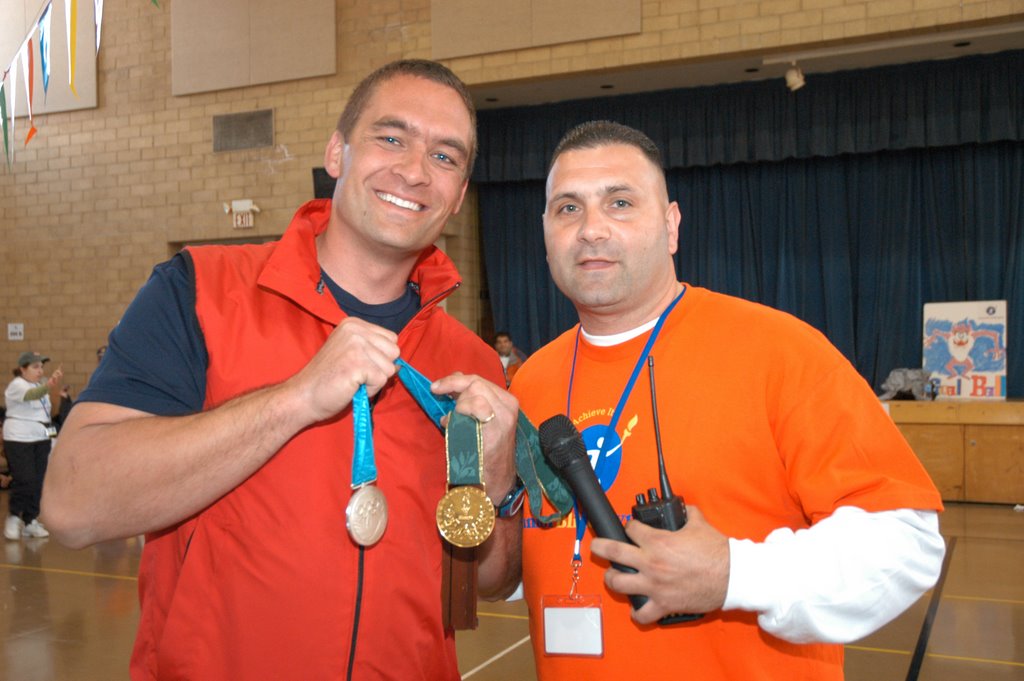
Here in the US, high school students can get rowing university scholarships SIMPLY by pulling hard on a Concept2 Rowing Machine.

SPORTS DESK

COLLEGES; Never Rowed? Take a Free Ride

By JULIET MACUR (NYT) 1763 words
Published: May 28, 2004

On the day Ohio State freshmen signed up for extracurricular activities like sororities, paintball and recreational badminton, Amanda Purcell heard a sales pitch. Two women on the university's varsity rowing team begged her to join.
Purcell, a 5-foot-9, 250-pound French horn player and music major who had never played a sport before, said no, but the women persisted. Finally, she decided to give it a try.


Suddenly, she had a new hobby -- and a new way to pay her college education.

A junior now, 60 pounds lighter and physically fit, Purcell has been on scholarship for more than a year and is competing in Ohio State's top varsity boat at this weekend's N.C.A.A. women's rowing championships in Sacramento. She is even thinking of the Olympics.

''I'm still shocked,'' Jim Purcell, Amanda's father, said. ''She was always afraid to touch any sport, but look at her now.''

Purcell and her family quickly learned a fact of life in the 21st century Title IX world: women are getting scholarships in sports they have never tried, perhaps never even heard of.

As an effort to satisfy Title IX legal requirements for gender equity in federally funded institutions, many colleges have added nontraditional sports for women, like rowing. It is a phenomenon particularly true of universities like Ohio State, an institution with a major football program that skews the balance of sports participation and scholarships in the men's favor.

Ohio State elevated its women's rowing program to varsity status nine years ago. Now, as the men's club team runs programs such as Rent-a-Rower ($50 for four hours of chores like raking leaves, cleaning garages or moving furniture to raise money for equipment and travel), the women are fully funded.

The team has an N.C.A.A. maximum 20 scholarships, and 16 women receive full rides. The remaining money is divvied up among other rowers. The team's annual budget is nearly $900,000.

''In the fall, rowing is a sport that you carry 70 to 80 people, then in the spring at least 46 kids get out and race,'' Ohio State's athletic director, Andy Geiger, said. ''It's an expensive sport, but it's worth it. It really does help offset football.''

Rowing has become a popular way to equalize any imbalance between men's and women's sports because it requires high numbers of athletes. A single varsity eight boat requires nine people: eight rowers and a coxswain, a small but vocal person who steers the boat and shouts commands.

Most teams have at least two eight-person boats on varsity and two more on the novice team. Many crews also have four-person boats, which carry four rowers and a coxswain.

It isn't easy, however, to keep rowers on the team. Rowing is a year-round activity, with fall and spring seasons, and weekly races from March through May. Many women who try the sport don't make it through the winter.

Though the National Collegiate Athletic Association puts limits on the number of practice hours, the time commitment is still daunting. Many teams practice twice a day, with a predawn workout on the water that could last several hours. In the afternoon, rowers head to the gym to lift weights or train on the rowing machine.

Blisters form on hands because of friction against oar handles. Pain and soreness develop in nearly every muscle because rowing uses the upper and lower body.

''Sure, you might get a scholarship,'' Geiger said. ''But it's not going to be easy.''

Eighty-five Division I colleges this year had women's rowing teams, a 55 percent jump from 1997, the year women's crew became an N.C.A.A. sport. And now the top teams aren't only the traditional rowing powers like the Ivy League universities and, say, the University of Washington.

Michigan, Virginia and Tennessee are all in the top 10. Ohio State is ranked third going into the championships. Cal is ranked No. 1.

''When we beat Princeton and Brown this year at Princeton, the silence was deafening,'' Ohio State Coach Andy Teitelbaum said. ''But these changes haven't happened overnight. It's taken awhile for us to build our programs.''

With so many programs offering rowing scholarships, recruiting has become instrumental in keeping new programs on top. The problem is that there aren't enough high school rowers to go around.

''We'd be recruiting a kid who'd already have three scholarship offers from Louisville, Texas and Michigan, and we'd be like, 'O.K., this isn't how it used to be,''' said Mike Zimmer, coach of the women's crew at Columbia, which, as an Ivy League university, does not give athletic scholarships but can offer grants and need-based financial aid.

''Now even the women who are on the middle of our list are being chased by a lot of different schools.''

And recruits aren't coming strictly from New England prep schools anymore. They are coming from high schools across the nation, even parts of the country with no history of rowing.

They are also coming from overseas. Ohio State's top varsity boat has rowers from schools called College of Olympic Reserve, Gymnasium Grosse Stadtschule and Red October. Seven of the nine people in the boat are international rowers: five from Germany, one from Russia, one from the Netherlands.

''Rowing has grown so unbelievably fast -- it is where soccer was 10 or 15 years ago -- so the supply and demand is unbelievably off,'' Mark Rothstein, coach of Michigan's women's crew, said. ''But the idea that there aren't enough rowers to go around is changing pretty quickly.''

Still, Rothstein sends a letter to all of Michigan's incoming female freshmen, trying to lure them to the first rowing practice. (He purposely fails to mention that varsity practice begins at 5:45 a.m.)

And at Cal, as at most universities, coaches scour high school rosters for athletes of all kinds who may not want to continue their sport in college. If a woman is tall, aerobically strong and willing to work hard, says Cal Coach Dave O'Neill, chances are she can be a good rower.

''It's not necessarily an easy sport to learn because you have to have certain genetic variables, but it does reward people with a strong work ethic,'' O'Neill said. ''Someone who is a 6-1 swimmer who blew out her shoulder or is sick of being in the pool, now that's the perfect scenario. It's more of a gamble, but it's something that we just have to do.''

Heather Mandoli, a 5-foot-10 athlete who played basketball, soccer and rugby in high school, fits into that category. She scarcely had one month's rowing experience when she was flooded with scholarship offers and wound up at Michigan.

''I thought, a scholarship?'' she said. ''O.K., for basketball, maybe.''

As a high school senior in a small town in British Columbia three hours inland from Vancouver, she won a week's worth of rowing lessons at a start-up rowing club. She didn't actually get on the water in a boat, but she learned her technique on a rowing machine. The machine -- called an ergometer, or erg -- generates a computerized score when set for a specific time or distance.

A few weeks later, Mandoli sent her ergometer score to Canada's national team, and soon she was fielding calls from colleges throughout Canada and the United States, including Michigan, Princeton and Washington.

''After Michigan offered me a scholarship, the first thing I said was, 'You know I can't row, right?''' said Mandoli, who this month was chosen the Big Ten Conference women's rowing athlete of the year. ''They just said, 'We're recruiting you on potential.' That was enough for me.''

Such stories have been enough to promote the growth of high school and recreational rowing programs. In Oakland, Calif., for example, a local water-sports facility started a rowing program this year strictly for public school girls. None of the 21 who signed up could pass the swimming test, and 16 didn't even have bathing suits. Still, DeDe Birch, executive director of the Jack London Aquatic Center, pushed forward.

''Whatever we can do to get these girls a scholarship, we'll do,'' she said. ''Hey, if colleges gave kayaking scholarships, we'd start that team, too.''

None of the talk about scholarship opportunities in rowing had reached Purcell before she signed up for crew that day at Ohio State. She knew nothing about the sport until she showed up for the first practice. But she quickly learned one thing: she was good, particularly on the erg, where her scores were among the best on the team.

But she could not juggle the time commitment with her music studies and her job as a waitress. So she quit the varsity program and joined the club team.

A year later, seeing her potential, her club coach took her to an international rowing machine competition in Boston. Purcell pulled the second-best score of 293 women in the competition and the top collegiate score -- 6 minutes 48.9 seconds for 2,000 meters.

Later that day, she had voicemails and e-mail messages offering scholarships to Fordham, Michigan and San Diego State. She chose to stay at Ohio State, and now the university not only pays her tuition, but it also sends her a monthly check for about $900 for room, board and books.

Purcell's erg scores were so good that she was invited to a national team training camp last summer. There, she realized how far she could go in rowing. Now she wants to make the 2008 Olympic team.

''In the second grade, I tried the viola, but the teachers said I had no musical talent,'' Purcell said. ''Now look at me. I'm a music major. Rowing has kind of been the same thing. Nobody ever knew I'd be good at it. I guess I can thank Title IX for that.''

The testing is done on a CONCEPT2 rowing machine
Xeno Muller, Olympic gold and silver medalist, indoor rowing, rowing technique.

Mar 9, 2006

Indoor Rowing Gloves for Rowperfect and Concept2 rowing machines


If you want soft hands and still want row many kilometers check out the address below.

http://www.newgrip.com/rowing.html
Xeno Muller, Olympic gold and silver medalist, indoor rowing, rowing technique.

Concept2 Rowing machines are in use in the U.K.


North Wales

School rowers claim indoor record Mar 8 2006
By Antony Stone, Daily Post

A JUBILANT secondary school rowing team claimed an indoor world rowing record yesterday after a gruelling 24-hour charity drive.

A team of 10 pupils at Monmouth Comprehensive School Junior Rowing Club clocked up a staggering 215 miles without ever laying eyes on water.

The team, whose members are all under 17, worked in six hour shifts with five minute intensive rowing bouts followed by a 20 minute rest.

Now their 24 hour charitable exploits on a school rowing machine are being checked by the Guinness Book of Records.

The marathon event at the weekend raised cash for the boat club, and more than £6,000 for the trust set up by five times Olympic gold medalist Steve Redgrave.
Xeno Muller, Olympic gold and silver medalist, indoor rowing, rowing technique.