Mar 31, 2006

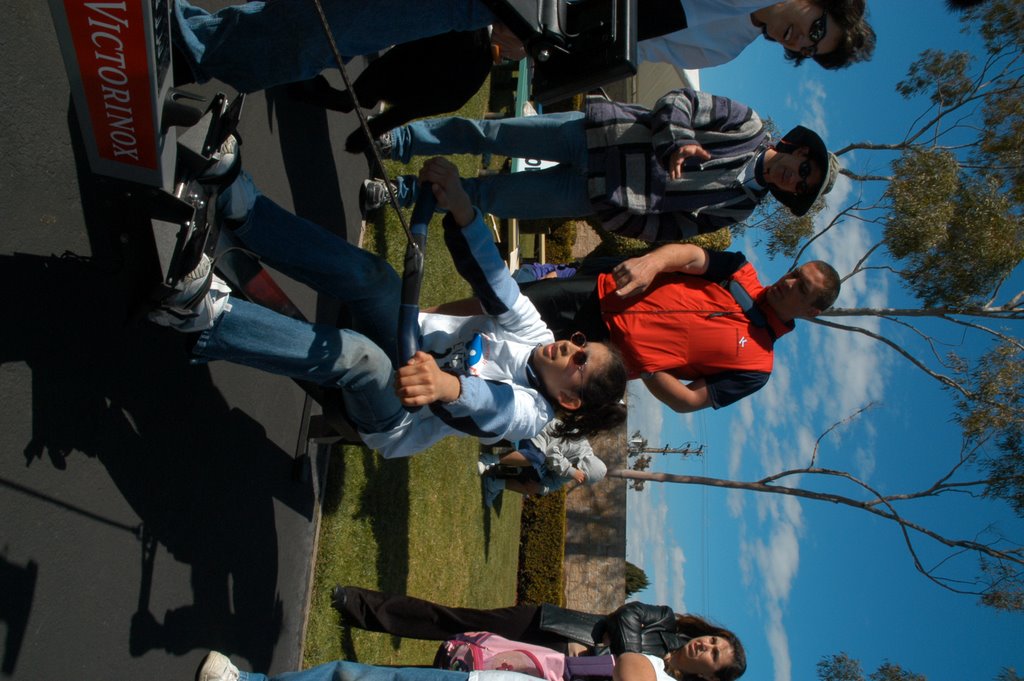
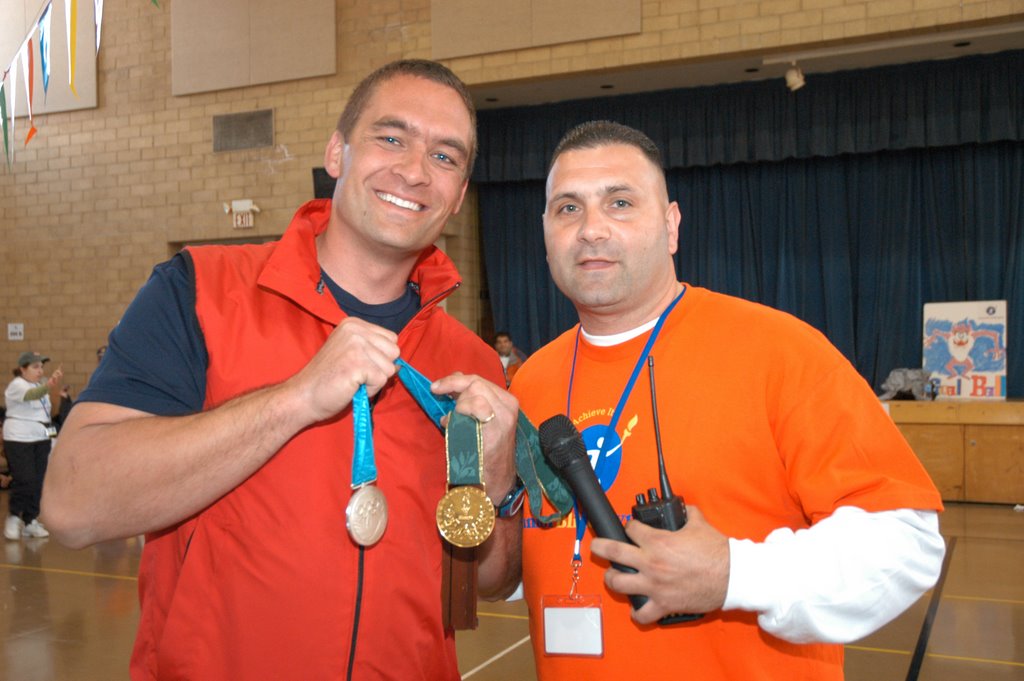
Fotos from the Junior Blind Olympics in Los Angeles

Hello,
I enjoyed every second at the Blind Olympics. I hope to raise funds to start an indoor rowing program.
Sincerely, XENO


Xeno Muller, Olympic gold and silver medalist, indoor rowing, rowing technique.

Aerobic conditioning and anaerobic conditioning.

Here is what we know today.

The main source of power for a 2K sprint comes from the anaerobic capacity. By pushing hard we accumulate lactic acid which makes us weaker farther into our atheltic performance to a point to have to ease up or stop completely.

The aerobic capacity is NOT the main source of power for a 2k sprint race. B U T in order to complete the aerobic cycle, lactic acid is required. It is therefore crucial that training should be geared toward developing the aerobic capacity to FILTER the blood from lactic acid. The larger the aerobic capacity the slower the rise of lactic acid in the body, the longer an athlete can push hard.

This should be a law that US ROWING should propagate througout the USA.

"Anaerobic capacity requires less time to develop. Aerobic capcity requires years. Aerobic capacity is developed below 2 mmols. The aerobic capacity relieves the cardio vascular system from lactic acid, thus enabling the rower to go farther and faster."
Xeno Muller, Olympic gold and silver medalist, indoor rowing, rowing technique.

Mar 26, 2006

This summer we have 2 6-day indoor rowing camps at the IRON OARSMAN

Hello All,

I am planning two six-day training camps this summer. It will be open to all ages, who look to be HIGHLY competitive on the Concept2 rowing machines. The training requirement will be four hours per day and bring a heart rate monitor.

The dates are: July 3-8, and August 1-6, 2006

Indoor rowing technique will be drilled, filmed and analyzed.

The rowers will learn how to administer lactate tests and use the results to tailor their own future training program. Microsoft Excel program will be used to graph the results.

We will train in the weight room and carefully coach lifting technique which is necessary for better rowing performance and injury prevention. This too, will be filmed and analyzed.

We will work on stretching which enhances better rowing technique and injury prevention.

We will use cross training workouts to spice up and complete the conditioning week.

In order to keep the coaching top notch, each week will have a limit of ten participants.

I have not advertised these camps on row2k.com yet. I am presenting this to you first.

If you want to be part of the camp, email me your intention and send me a check to Iron Oarsman, Summer Camp, 440 East 17th Street #5, Costa Mesa, CA 92627. Lodging is not included, if you would like I can provide accomodation information.

The cost is $995.

All the very best and sincerely,
XENO
_________________
Olympic Gold and Silver medalist, 1996 & 2000 men's single scull.
www.cafepress.com/gorow
www.indoor-rowing.blogspot.com
and our official website is www.GOROW.com.
You can call me at 949-400-7630.
5:53 for 2k.
Xeno Muller, Olympic gold and silver medalist, indoor rowing, rowing technique.

What resistance to pick on the Concept2 Rowing machine

Using the Concept2 Indoor Rowing Machine

>Dear Xeno,
> I saw your advice on a rowing forum (and you
> recommended looking at your
> gorow.com site) and wondered if, with your
> experience, you might give me
> some tips. I am 17 yrs old, female and 5' tall with
> kind of short legs for
> my height, so I don't have a natural body type for
> rowing. I am strong and
> aerobically fit, but can't seem to improve my ERG
> times much. The tips I
> get from coaches seem to work much better for the
> taller rowers than they do
> for me. As a matter of fact, when I do what they
> tell me, my times just go
> way up. My best time is only 8:40. I can only even
> get that by rowing with
> a vent setting of between 8 and 10 with a stroke
> rate of around 32 or 33.
> If I drop the vent setting even to 7, I have to keep
> a stroke rate of 36 or
> 38 to even keep a time of 8:40. You mentioned in
> your post to increase the
> torque. I'm not sure what that is, or how one does
> that.
>
> Thanks for any advice that you can give me.
>
> K.

Hello K.
I don't race a 2k at lower than six or seven.
Anything less I do not get enough "torque". The
computer of the rowing machine calculates the change
in speed of the flywheel.
Your strength will always be torque. However, whether
you are five feet or seven feet tall, the technique
does not change.
With speed work you will be able to rate higher. Your
base cadence of 33 is good.
Your choice of resistance is therefore good.
XENO
Xeno Muller, Olympic gold and silver medalist, indoor rowing, rowing technique.

Mar 22, 2006

Visit with rowing machine at the JUNIOR BLIND OLYMPICS in Los Angeles


This is Aerial with Hedda her guide dog.


Aerial Gilbert whom I met in November of 2004 is a blind rower. Two months ago she asked me if I were interested in joining the Junior Blind Olympics in L.A. I said "yes, of course." My family drove the rowing machine to the blind school's campus on Friday night so that the children were able to row until I could free myself from my duty at the Iron Oarsman on Saturday. Aerial was helping the children to row and once me and my family arrived she told me how much the kids LOVED rowing. The experience I got from joining the event was one of kind. I felt very humbeled by the childrens ability to cope and do a superb job running, jumping, rowing, AND having fun doing so. It was very rewarding to be there and give a hand showing an additional activity which blind people can enjoy to the fullest. I was asked to help out during a summer camp in Malibu for older visually impaired teenagers. I had no problem saying yes and I look forward to working with such an enthusiastic group. My family also enjoyed petting the lovely guide dogs who were so attentive to their masters. Count me in for next year!
Thank you Aerial from the Mullers.

Below is more about Aerial:

Director of Volunteers Aerial Gilbert

Aerial Gilbert is the director of volunteers for Guide Dogs for the Blind. She manages a vibrant staff of 500 dedicated volunteers who tackle a variety of jobs from giving campus tours to caring for the organization’s dogs and puppies.

Her own dog, a 3-year-old German Shepherd Guide Dog named “Hedda,” assists her in her daily travels. As a team, they demonstrate the enhanced mobility that is the essence of guide dog use.

Aerial is also an avid athlete. She rows regularly on San Francisco Bay and has competed successfully in the Sausalito Open Water Regatta, the Tahoe Regatta and the 33-mile Annual Catalina Crossing across open ocean. In September 2002, she competed in the first-ever Adaptive Division of the World Rowing Championships in Seville, Spain; her team took home the bronze medal. In August 2003, she competed in the adaptive division of the World Rowing Championships in Milan; her team came in fourth. In Summer 2004, Aerial will again compete with the United States Rowing Team in the World Championships in Banyoles, Spain. If enough teams participate, rowing will be sanctioned as an official Para Olympic sport in the 2008 Olympics in Beijing.

She is a member of the Board of Directors of Sonoma County’s Earle Baum Center of the Blind, a member the Volunteer Center of Marin, the Association for Volunteer Administration, and the American Council of the Blind and Guide Dog Users, Inc. She is a registered nurse with a Bachelor of Science degree in biology.

Through her work with Guide Dogs for the Blind, her personal courage and spirited enthusiasm for life, Aerial has helped many others understand blindness. She shares her personal experiences in public presentations to fraternal organizations, businesses, schools and other groups. She has been featured in numerous publications, including Sunset, Outside and Family Circle as well as on the website: www.incrediblepeople.com.
Xeno Muller, Olympic gold and silver medalist, indoor rowing, rowing technique.

Mar 31, 2006

Fotos from the Junior Blind Olympics in Los Angeles

Hello,
I enjoyed every second at the Blind Olympics. I hope to raise funds to start an indoor rowing program.
Sincerely, XENO


Xeno Muller, Olympic gold and silver medalist, indoor rowing, rowing technique.

Aerobic conditioning and anaerobic conditioning.

Here is what we know today.

The main source of power for a 2K sprint comes from the anaerobic capacity. By pushing hard we accumulate lactic acid which makes us weaker farther into our atheltic performance to a point to have to ease up or stop completely.

The aerobic capacity is NOT the main source of power for a 2k sprint race. B U T in order to complete the aerobic cycle, lactic acid is required. It is therefore crucial that training should be geared toward developing the aerobic capacity to FILTER the blood from lactic acid. The larger the aerobic capacity the slower the rise of lactic acid in the body, the longer an athlete can push hard.

This should be a law that US ROWING should propagate througout the USA.

"Anaerobic capacity requires less time to develop. Aerobic capcity requires years. Aerobic capacity is developed below 2 mmols. The aerobic capacity relieves the cardio vascular system from lactic acid, thus enabling the rower to go farther and faster."
Xeno Muller, Olympic gold and silver medalist, indoor rowing, rowing technique.

Mar 26, 2006

This summer we have 2 6-day indoor rowing camps at the IRON OARSMAN

Hello All,

I am planning two six-day training camps this summer. It will be open to all ages, who look to be HIGHLY competitive on the Concept2 rowing machines. The training requirement will be four hours per day and bring a heart rate monitor.

The dates are: July 3-8, and August 1-6, 2006

Indoor rowing technique will be drilled, filmed and analyzed.

The rowers will learn how to administer lactate tests and use the results to tailor their own future training program. Microsoft Excel program will be used to graph the results.

We will train in the weight room and carefully coach lifting technique which is necessary for better rowing performance and injury prevention. This too, will be filmed and analyzed.

We will work on stretching which enhances better rowing technique and injury prevention.

We will use cross training workouts to spice up and complete the conditioning week.

In order to keep the coaching top notch, each week will have a limit of ten participants.

I have not advertised these camps on row2k.com yet. I am presenting this to you first.

If you want to be part of the camp, email me your intention and send me a check to Iron Oarsman, Summer Camp, 440 East 17th Street #5, Costa Mesa, CA 92627. Lodging is not included, if you would like I can provide accomodation information.

The cost is $995.

All the very best and sincerely,
XENO
_________________
Olympic Gold and Silver medalist, 1996 & 2000 men's single scull.
www.cafepress.com/gorow
www.indoor-rowing.blogspot.com
and our official website is www.GOROW.com.
You can call me at 949-400-7630.
5:53 for 2k.
Xeno Muller, Olympic gold and silver medalist, indoor rowing, rowing technique.

What resistance to pick on the Concept2 Rowing machine

Using the Concept2 Indoor Rowing Machine

>Dear Xeno,
> I saw your advice on a rowing forum (and you
> recommended looking at your
> gorow.com site) and wondered if, with your
> experience, you might give me
> some tips. I am 17 yrs old, female and 5' tall with
> kind of short legs for
> my height, so I don't have a natural body type for
> rowing. I am strong and
> aerobically fit, but can't seem to improve my ERG
> times much. The tips I
> get from coaches seem to work much better for the
> taller rowers than they do
> for me. As a matter of fact, when I do what they
> tell me, my times just go
> way up. My best time is only 8:40. I can only even
> get that by rowing with
> a vent setting of between 8 and 10 with a stroke
> rate of around 32 or 33.
> If I drop the vent setting even to 7, I have to keep
> a stroke rate of 36 or
> 38 to even keep a time of 8:40. You mentioned in
> your post to increase the
> torque. I'm not sure what that is, or how one does
> that.
>
> Thanks for any advice that you can give me.
>
> K.

Hello K.
I don't race a 2k at lower than six or seven.
Anything less I do not get enough "torque". The
computer of the rowing machine calculates the change
in speed of the flywheel.
Your strength will always be torque. However, whether
you are five feet or seven feet tall, the technique
does not change.
With speed work you will be able to rate higher. Your
base cadence of 33 is good.
Your choice of resistance is therefore good.
XENO
Xeno Muller, Olympic gold and silver medalist, indoor rowing, rowing technique.

Mar 22, 2006

Visit with rowing machine at the JUNIOR BLIND OLYMPICS in Los Angeles


This is Aerial with Hedda her guide dog.


Aerial Gilbert whom I met in November of 2004 is a blind rower. Two months ago she asked me if I were interested in joining the Junior Blind Olympics in L.A. I said "yes, of course." My family drove the rowing machine to the blind school's campus on Friday night so that the children were able to row until I could free myself from my duty at the Iron Oarsman on Saturday. Aerial was helping the children to row and once me and my family arrived she told me how much the kids LOVED rowing. The experience I got from joining the event was one of kind. I felt very humbeled by the childrens ability to cope and do a superb job running, jumping, rowing, AND having fun doing so. It was very rewarding to be there and give a hand showing an additional activity which blind people can enjoy to the fullest. I was asked to help out during a summer camp in Malibu for older visually impaired teenagers. I had no problem saying yes and I look forward to working with such an enthusiastic group. My family also enjoyed petting the lovely guide dogs who were so attentive to their masters. Count me in for next year!
Thank you Aerial from the Mullers.

Below is more about Aerial:

Director of Volunteers Aerial Gilbert

Aerial Gilbert is the director of volunteers for Guide Dogs for the Blind. She manages a vibrant staff of 500 dedicated volunteers who tackle a variety of jobs from giving campus tours to caring for the organization’s dogs and puppies.

Her own dog, a 3-year-old German Shepherd Guide Dog named “Hedda,” assists her in her daily travels. As a team, they demonstrate the enhanced mobility that is the essence of guide dog use.

Aerial is also an avid athlete. She rows regularly on San Francisco Bay and has competed successfully in the Sausalito Open Water Regatta, the Tahoe Regatta and the 33-mile Annual Catalina Crossing across open ocean. In September 2002, she competed in the first-ever Adaptive Division of the World Rowing Championships in Seville, Spain; her team took home the bronze medal. In August 2003, she competed in the adaptive division of the World Rowing Championships in Milan; her team came in fourth. In Summer 2004, Aerial will again compete with the United States Rowing Team in the World Championships in Banyoles, Spain. If enough teams participate, rowing will be sanctioned as an official Para Olympic sport in the 2008 Olympics in Beijing.

She is a member of the Board of Directors of Sonoma County’s Earle Baum Center of the Blind, a member the Volunteer Center of Marin, the Association for Volunteer Administration, and the American Council of the Blind and Guide Dog Users, Inc. She is a registered nurse with a Bachelor of Science degree in biology.

Through her work with Guide Dogs for the Blind, her personal courage and spirited enthusiasm for life, Aerial has helped many others understand blindness. She shares her personal experiences in public presentations to fraternal organizations, businesses, schools and other groups. She has been featured in numerous publications, including Sunset, Outside and Family Circle as well as on the website: www.incrediblepeople.com.
Xeno Muller, Olympic gold and silver medalist, indoor rowing, rowing technique.