Mar 3, 2012

Are you a member of a losing rowing team? Do you want to beat the top 1%?

I am your undercover weapon to row faster, much faster.
Whether you are a coach or a rower of a losing team, why not change your odds and start winning. Let me illustrate this from personal experience. Prior to our freshmen class at Brown University, Harvard dominated the collegiate races. Just because I was not a member of the Crimson crew, I was not going to roll over and die. Luckily we had a great coach, Scott Roop, and rowers like Jamie Koven and few similar chaps from U.S. prep-schools. During our winter and spring preparation, my national team coach form Switzerland, Harry Mahon, came to visit us. He taught Scott Roop and my team members how to set the blade and connect to the leg drive. This became the beginning of 5 years of practically undefeated seasons. By the time we were done with our collegiate rowing careers, we had several bags full of shirts from rowers whom we beat. Your team can achieve the same. For this, your coach has to be open minded, and allow an outside adviser like me to view rowing footage of your team. When a coach does not get outside information, his or her coaching eye becomes stale and does not pick up on subtle and gross technical problems. I have NO DOUBT that underdog rowing teams have more heart at any given time than crews that think that they have it all wrapped up. Don't you hate seeing the same 1% winning the gold medals. You must change this. I can help underdog crews go faster, MUCH FASTER, without taking the limelight away from the coach. As a matter of fact, I don't even want to be mentioned at the medal ceremony or awards banquet. Leave me in the shadows of the unknown, I would love it that much more. Doing my undercover job, from home, and directing motivated coaches and rowers into the fast lane, is a dream come true :-).

 Join me at www.xenorowingcoach.com and let's beat the 1% into the ground, and finish them off.
Xeno Muller, Olympic gold and silver medalist, indoor rowing, rowing technique.

Mar 2, 2012

When you are an underdog and you start winning.

In 1989, I rowed the single scull for Switzerland at the junior world championship in Szeged Hungary. I knew very little about crew in the United States. I caught myself watching the US junior coxswain give orders to his crew when they got ready to go on the water, setting the boat down, and as they began the pick drill. I loved watching and listening to the commands the coxswain was giving. On the last day of competition I took the shuttle bus back and ended up sitting on row behind

Our rower Matthew won the CRASH-B junior lightweight division


Hello rowers,
Above is a cool clip of our rower Matthew winning CRASH-B.  I first met Matthew 2 years ago.  He was able to push 6:53 for 2k.  After working with him, (him doing all the work, me advising), he ended up winning the hammer last February, by out-sprinting his competition in the final meters, clocking 6:22.1
You can find more information on my coaching at www.xenorowingcoach.com.
Xeno Muller, Olympic gold and silver medalist, indoor rowing, rowing technique.

Feb 29, 2012

When rage drives you to Olympic Gold

En route to 6:44.85 current Olympic record and Atlanta Gold.
It is a few years back, the year after my father's untimely passing.  I did not win the national selection regatta in the single scull, I came in second behind Ueli Bodenman.  For the first time in my international rowing career, I had to compromise on how I was going to compete at the world championship

The year was 1993.  As a collegiate rower we had an amazing season racing our Brown varsity 8.  We completed a two year undefeated run, including winning the Ladies Plate at the Henley Royal Regatta.  But unlike the Olympic year before, I was not able to bring sculling and rowing the eight under one roof.

After 6 weeks of intensive training in the double scull, soul searching, and questioning my existence as a rower, we finished the world championships in 8th place.  I was not happy.  A few hours after our final, I stood at the base of the grandstand, approximately 150 meters from the finish line, and waiting for the final of the men's single scull to come through.  There I stood, with a storm of mixed emotions ripping through my chest.  My throat started knotting up.  I thought of my father.  I thought of my great Olympic run the year before.  I remember doing a 1000 knee bends in the forest as a junior.  I was meant to be racing my single scull, right there on the race course which I was observing as a SPECTATOR.  How could I have let this happen?  From a state of mixed emotions, one emotion started rising like a tidal wave... RAGE.

Suddenly, my rage changed into a weird sense of helpless observer, who had a hard time believing that his idol, the German Terminator, was being beaten.  Porter, Lange, and Chalupa entered their final 750 meters and were in a dogfight for gold.  Chalupa had the lead and lost it to Porter.  To my complete astonishment, my childhood hero, Thomas Lange, did not win.  Victory went to Derek Porter a tall lean Canadian.  He was the one capable of beating Thomas Lange.
Here is the link to the 1993 final.
Left to right, Vaclav Chalupa, Derek Porter, Thomas Lange, the next day I met Derek.

The next day, I watched the rest of the finals.  As I made my way to the shuttle, I felt a huge relief. Finally, I was taken away from a place that brought so much grief and anger to me.  Little did I know that a new personal chapter in Olympic determination was about to begin.

Steps before boarding the bus, I spotted Derek Porter, who still wore his gold medal around his neck.  I was excited to congratulate him, because he helped solve the problem of how to beat an idol, even if it was my idol.  I stretched out my hand and said: "Derek, congratulations for winning, and you beat Thomas Lange.  Finally, someone could beat him, and you are the one who did it, it was incredible."  When I said those words, I wore my heart on my sleeve.  "Yeah, thanks," was his response and kept on walking.   I felt rejected.  By instinct, I turned into a first impression character judge, which is truly unfair to Derek.  The vibe I picked up from how he responded, fueled my passion for competition and my view of Derek immediately became subjective and thus I felt that he had an air of superiority that to me spelled out: I am superior to you and anyone else for that matter.

My view of his passive response to my "groupie-ish" behavior hurt me deep down.  Without knowing it, Porter, arguably, committed the greatest mistake in his single sculling career.  As the saying goes, "don't look down to people who look up to you." That day, I was the one looking up to him.  It was that moment in my life, as a single sculler, that the final gold medal ingredient found its way into my racer-brain which galvanized my Olympic determination.  I took a deep breath, balled my fists as hard as I could.  I felt my entire body tightening up as if I was going to be shot at with a canon ball.  Aggressive energy started to flow through my veins and just like that the rage of the day before became RAGE of victory.

As soon as I returned to Brown, I started training on my own.  I did thousands of bench rows, squats, lat pull downs, horizontal rows, miles on the erg and water.  Not one day would go by without me thinking at least twice about that fateful encounter.  Not one day would go by without me thinking of my father who did not live to see the day I would win gold.  My Olympic goal was set straight in front of me, like a sight on a target.  I was on board of an unstoppable freight train, bound to smash a record on Lake Lanier.

At the world championship in 1994 and 1995, I denied Porter entry to the final. At the 1996 Olympics I overtook him in the last 250 meters to win gold and set the current Olympic record.  In 1998, I won silver and I don't remember where he ended up.  In 1999, I won another silver, he got bronze.  In 2000, I was dying in the last 500 meters, but it was over my dead body that  Porter was going to beat me.  I won silver and he came in fourth.

Since, I have mellowed out a lot, and for the sake of my wife and four children, I am very happy about it.

From left to right, Derek Porter, Xeno Müller, Thomas Lange 1996 Olympics
(Derek, if you read this, in no way do I want to portray you as someone you are not.  At the time, I had a lot of personal challenges I had to meet, and the circumstance of our encounter was so unplanned.  I am certain that you are a great person.)

 Join one of the fastest growing communities of indoor rowers at www.row2go.com and become the fastest rower at www.xenorowingcoach.com
Xeno Muller won an Olympic Gold in Atlanta and an Olympic Silver in Sydney, and is the current Olympic Record holder in the 2000m Single Scull. 


Link to the Olympic final of 1996 
Xeno Muller, Olympic gold and silver medalist, indoor rowing, rowing technique.

Feb 24, 2012

CRASH-B y Row2K muestran problemas técnicos “en masse “

Remera en primer plano tiene problemas técnicos, mientras la segunda remera muestra una mejor posición-
Problemas técnicos a considerar: Probablemente ha oído hablar de “la manera correcta de
remar”, sin embargo al ver alguien remar frente a uno, posiblemente se sienta algo intimidado
en tratar de corregirle la remada. Como se puede ver en esta foto, muchas veces se encuentra
gente que esta combinando el empuje con la jalada. Los brazos se quiebran durante el empuje de
las piernas mientras la espalda esta cerca de alcanzar el ángulo del final de la remada. Tampoco
es inusual detectar varios empujando con la punta de los pies o finalizando con la rótula del
pié. Este tipo de atletas acaban siendo víctimas de una falta de soporte de la espalda baja. Sus
codos apuntan hacia el piso, con las muñecas en un ángulo de 90° a sus antebrazos. La espalda
esta cerca del piso mientras el mango del ergo es jalado a la altura superior de los pectorales. En
estos casos es muy raro ver que las rodillas están completamente estrechadas, pero en cambio
se encuentran levemente flexionados con los cuádriceps no aplicados. Esta posición final lleva
al remero a regresar el mango…. la espalda, y las rodillas a la toma, todo al mismo tiempo. De
esta manera el musculo flexor de la cadera es mal utilizado para levantar las rodillas, lo cual deja
totalmente fuera de uso al tendón de la corva. La preparación de la parte superior del cuerpo
se retrasa en comparación al tiempo en el que las rodillas se levantan. Esto provoca una parada
de las rodillas en el momento de la compresión máxima y esto lleva a alargar el cuerpo superior
y la extensión de los codos para alcanzar con el mango la máxima cercanía a la rueda de viento.
Consecuencia de esto es que en la remada se contraigan los brazos con una apertura prematura
de la espalda, dejando el empuje de las piernas en un segundo plano.

Abajo tenemos más fotos con las cuales podemos ilustrar lo que describo arriba.

Si eres uno de los remeros en estas fotos, no te sientas avergonzado porque el 99% de los
remeros que han participado en el Crash-B comparten tu técnica. Estoy seguro de lo que afirmo
porque sé de la experiencia personal el desconecte mental que tienen los entrenadores entre lo
que es remo en agua y remo en máquina.
Esta foto ilustra muy bien la remada descripta arriba. Además no entiendo bien que es lo que está pasando con el pié
derecho.

Este es un clara quebrada anticipada de brazos, lo cual retrasa el empuje de piernas, el cuerpo se levanta
anticipadamente, mientras que el talón de los pies aún no ha conectado la pedalina.
En la derecha el remero se encuentra en la recuperación mientras el de la izquierda esta jalando. La simetría individual
es totalmente defectuosa. La forma de ver quien esta jalando y quien está en la recuperación está en las características
de la cadena. Tensa en la derecha y suelta en la izquierda
Esta foto no la elegí precisamente por los dos primeros remeros. La mayoría de las fotos tomadas por row2k son de
la fase de jaleo por lo cual es difícil encontrar fotos de la fase de recuperación. Echen un vistazo al remero de más a
la derecha. El se encuentra en la recuperación combinando todas las partes de su cuerpo para moverse a la toma. Este
tipo de remada va a crear un aventón en un bote de conjunto. El atleta en el medio tiene una apertura anticipada de
la espalda , está quebrando los brazos al mismo tiempo el ángulo de su cuerpo ya está en posición vertical con lo cual no
deja nada para conectar en el último cuarto del empuje de piernas. El joven del frente está rodeando el mango con sus
puños con lo cual reduce la habilidad de maximizar el largo efectivo de los brazos en la toma y la sacada.

Xeno Muller, Olympic gold and silver medalist, indoor rowing, rowing technique.

Feb 21, 2012

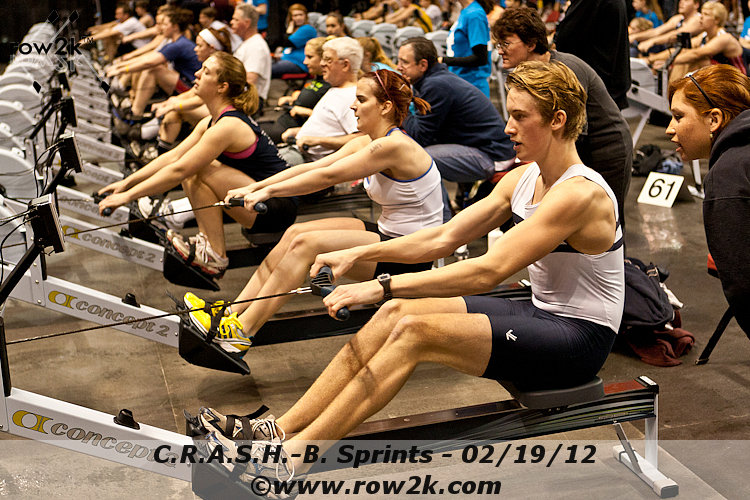
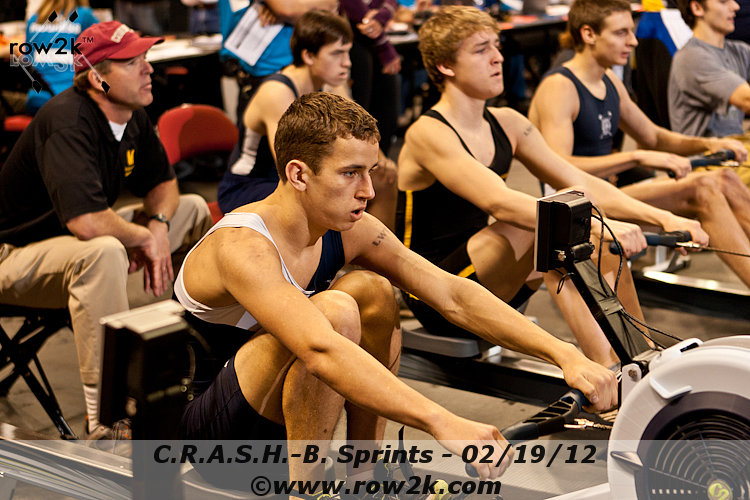
CRASH-B and Row2K showcase technical problems "en masse."

Rower in the foreground has technical problems, whereas second rower shows a better hang.
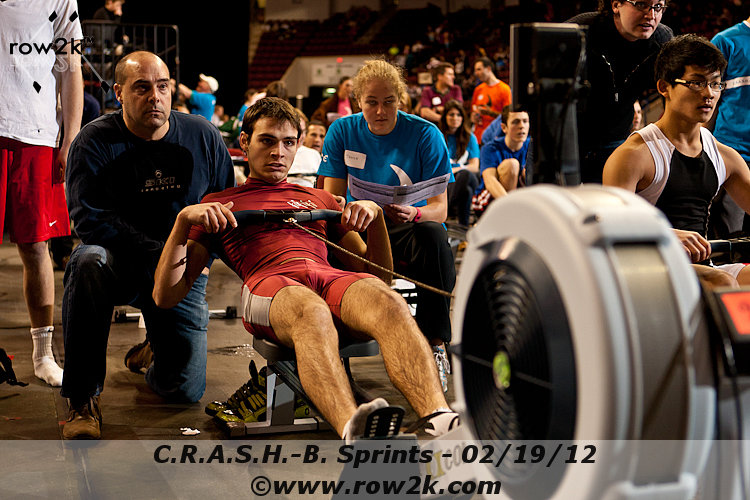
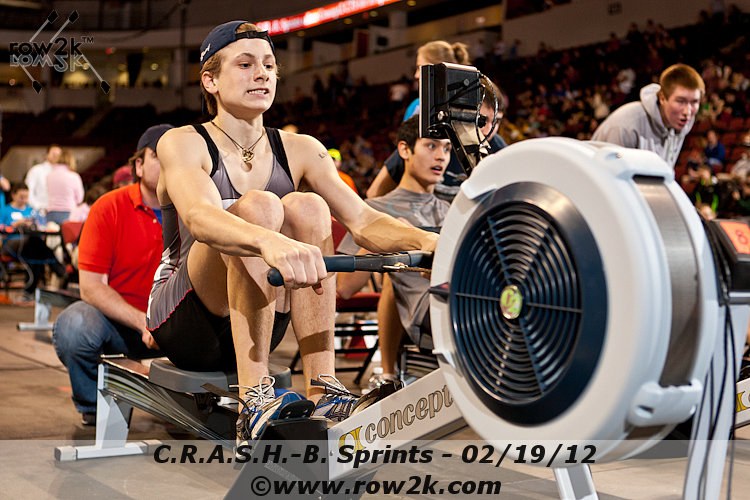
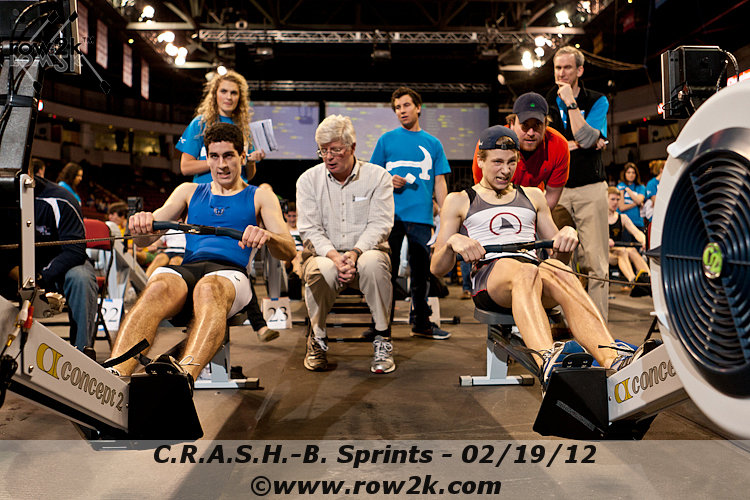
Technical issues to consider: You may have heard about "the proper way of rowing" however when you see somebody row in front of you, you may find the task of correcting a rowing stroke a bit daunting. As seen on this picture, very often you find people combining pulling with pushing. The arms bend during the leg drive while the back is close to being in its final finish angle. It is also not unusual to spot many toe pushers, or "ball of the foot finishers." These types of athletes are victim to a lack of support in their lower back. Their elbows point straight down to the floor, with wrists at a 90 degree angle to their forearms. The lay back is almost level to the ground with the handle pulled to the upper half of the pectoral muscle. In such instances it is rarely the case that the knees are fully straight, instead they show a slight angle with a quadriceps that is not engaged. Such a finish position leads the rower to return the handle... the lay back, and the knees back to the catch, all at the same time. In this manner, the hip flexor is wrongly used to lift the knees, which completely leaves out the use of the hamstrings. The preparation of the upper body lags behind in comparison to the timing with the rise of the knees, this creates a stop of the knees at the full catch compression and results in a reach of the upper body and elbow extension to get the handle as close to the flywheel as possible. This leads to an early contraction of the arms with a premature opening of the back, putting the leg drive in a secondary position. Here are more pictures I found to illustrate what I am describing above.

If you are one of the rowers in these pictures, feel no shame, because 99% of the rowers who took part at CRASH-B share your technique.  I am confident of my statement, because I know from personal experience the disconnect that exists in coaches' minds between water rowing and erging. 
This picture illustrates well the above described rowing stroke.  Also I am not quite sure what is going on with the right foot.
This is a clear early arm draw, which puts the leg drive on the back burner, the upper body is opening early, while the heel has not yet connected to the foot board.
On the right, the rower is on the recovery, while the left rower is in the drive phase.  The individual symmetry is totally lacking.  Key to noticing who is driving and who is on the recovery is the characteristic of the chain.  Tight on the left, floppy on the right.
This picture I chose not necessarily for the first two rowers.  Most of the pictures taken by row2k are in the drive phase so it is hard to find shots on the recovery.  Have a look at the rower all the way to the right.  He is on the recovery, combining every part of his body to move to the catch.  Such a rower creates a rush in a team boat.  The fellow in the middle has an early opening of back, is breaking the arms at the same time, and the angle of the upper body is already at vertical which leaves nothing to connect in the last quarter of the leg drive.  The young rower at the forefront is gripping the handle in his fist reducing his ability to maximize his effective length at the catch and at the finish.

Join one of the fastest growing communities of indoor rowers at www.row2go.com and become the fastest rower at www.xenorowingcoach.com
Xeno Muller won an Olympic Gold in Atlanta and an Olympic Silver in Sydney, and is the current Olympic Record holder in the 2000m Single Scull. He is also the President of XenoRowingCoach and Row2Go which is quickly becoming THE online community for both indoor and on-the-water rowers providing its members with weekly online workout routines and individualized coaching programs.


Xeno Muller, Olympic gold and silver medalist, indoor rowing, rowing technique.

Feb 20, 2012

Our rower Matthew won the Hammer at Crash-B!

Congratulations Matthew for winning the CRASH-B Sprint, Indoor Rowing World Championship, in the junior lightweight division in 6:22/2K

2 years ago Matthew tested 6:53/2K, with hard work and smart training he achieved a very tough result.

Xeno Muller, Olympic gold and silver medalist, indoor rowing, rowing technique.

Feb 17, 2012

If rowing is your sport, this book is a must read, Olympic Obsession :-)

 I am currently reading this book. It is fantastic and TIMELESS. The second chapter is about my own Olympic coach, Harry Mahon. With the KINDLE app anyone with a smart phone can read this book anywhere, it is so cool. Perfect to read as we get ready for the 2012 Olympics.
Xeno Muller, Olympic gold and silver medalist, indoor rowing, rowing technique.

Feb 15, 2012

How I met the bench row, a key component to Olympic gold


First day of rowing January 198
I was 13 and a half when I started rowing in Fontainebleau, France.  As a "cadet" rower, we were asked to join the Friday evening strength training session.  The weight room was part of an athletic complex across the street of a famous business school called, Insead.  This school attracted well accomplished US rowers such as, Alyson Townley, Chris Carlson, C.B. Sands-Bohrer, Anne Marden, and John Marden.  This early US rowing interaction presented me with the opportunity to hold Anne Marden's freshly won Olympic silver medal from the Seoul Olympics in my young hand.  It was amazing how big and heavy the medal was.  As I held it,  I remember looking at it long and hard which gave me the impression that the medal grew larger in my hand.  Then a voice inside of me said: "Xeno, you can achieve this, but it is going to cost you, you will suffer."  I tightened my jaw and knew that I was in it for the long haul.

My dad and I the year before Brown
As a young teenager I was a fan of movies such as Rambo, Rocky, Commando, the Running Man and a few others staring these actors...  I wanted to be as buff as Stallone and Schwarzenegger.  Even my father and grandfather enjoyed telling me that a strong body is important in a young man's life and beyond.  So it was no wonder that I was given a piston rowing machine and a punching bag for Christmas the year before I started rowing on the water at the Club D'Aviron Fontainebleau Avon.  When I first set foot in the gym that Friday evening, all I saw were free weights, a couple Smith cages, and monkey bars...  The elder rowers told us to grab four benches that were stacked along the concrete wall.  I had no clue what we were going to do with them.  Maybe we were going to sit down and talk about what we were going to do.  We were told to place three benches parallel to each other and the fourth bench was set on top.  Then an Olympic bar was placed underneath the top bench and I was told to lay belly down and grab the bar and start pulling.  The date was February 15th, 1985.

Shortly before driving to Sydney from Murwillumbah
The company of the bench row lasted 19 years from that evening on.  I did bench rows in Fontainebleau, Zurich, Sarnen, Providence, Boston, and Newport Beach.  There is no doubt in my mind that this specific exercise brought a huge amount of torque to my sculling and sweep rowing stroke.  I excelled at the French national bench row test, which consisted on how many bench pulls with 40kgs one could do in 6 minutes.  Years later, I laid there in the gym of the Newport Aquatic Center, my stopwatch already running and placed on the ground right below me, my finger tips hooked around the bar. As the stop watch reached one minute, I began pulling at a deafening pace, literally, because at the end of every pull the Olympic bar hit the metal frame creating a loud bang.  I thrived on that ear piercing sound.  I felt rage, I was in my element, my mind was screaming to go faster, harder, I wanted to tear everything apart so that my my opponents would get destroyed, they shall regret having chosen to race the single scull.  The metallic banging reminded me of a sledgehammer.  As I progressed through the six minutes, I increasingly felt my lat muscles pulsate with every draw.  My arms became twice as big.  Sweat dripped off my forehead onto the floor.  I kept counting, I wanted to go farther than 240, which meant an above 40 strokes a minute pace. I kept ramming the bar against the bench.  At one minute to go, I demanded that my body released every ounce of energy for the final sprint to complete the six minutes of hell, or was it heaven...  That day I pulled my absolute best, 248 draws at age 28, a month and a half before the Sydney Olympics.

Join one of the fastest growing communities of indoor rowers at www.row2go.com and become the fastest rower at www.xenorowingcoach.com
Xeno Muller won an Olympic Gold in Atlanta and an Olympic Silver in Sydney, and is the current Olympic Record holder in the 2000m Single Scull. 


Xeno Muller, Olympic gold and silver medalist, indoor rowing, rowing technique.

How to enjoy rowing more, row faster, row safely, join us.

Join one of the fastest growing communities of indoor rowers at www.row2go.com and become the fastest rower at www.xenorowingcoach.com
Xeno Muller won an Olympic Gold in Atlanta and an Olympic Silver in Sydney, and is the current Olympic Record holder in the 2000m Single Scull. He is also the President of XenoRowingCoach and Row2Go which is quickly becoming THE online community for both indoor and on-the-water rowers providing its members with weekly online workout routines and individualized coaching programs.
Xeno Muller, Olympic gold and silver medalist, indoor rowing, rowing technique.

Feb 10, 2012

Chronic issues on the water with boats and technique.

Hi Rowers and Coaches,

Yesterday as I was communicating with a couple rowers over the internet it occurred to me that I ought to write about chronic problems that I encounter and hear about of technique and rigging issues, here goes:


This is not good enough of a hang either :-)
Scullers and sweep rowers seem to be chronically rigged too far into the stern, which forces an insanely uncomfortable lay back.  This leads to washing out of the blades at the finish and contributes to a sore lower back.  The biceps are overdeveloped and the latesimus dorsalis underdeveloped. The finish posture leads to a bunched up recovery where arms away is combined with a forward body angle similar to the hunchback of Notre Dame, and a skyward tug of the knees which is solely the result of contracting the hip flexor, totally leaving out the far more important hamstrings.  The movement of the seat arrives too early to the end of the track which stops the knees and allows a lurch of the upper body which leads to a drop of the handle height, a late squaring and skying of the blade.  In a women's  eight, the shoes are usually set too low making over-compressing of the knees likely and perpetuating the lurch at the catch.  The leg drive tends to be shortened through the steeper angle at which the legs are at extension because of the low foot board position and over-sized shoes.  Men in sweep and in sculling are rigged too low, while women are rigged too high.  In sweep rowing, the inboard handle is either too short, or the span too wide.  The sculls and sweep oars are held in fists instead of fingers creating blisters in the palm of the hand.  Shoulders during the drive look like they are attached to the rower's earlobes.  That catch occurs when the boat sits deep in the stern instead of when the hull comes out on its own buoyancy. During the drive the notion of hanging of the leg drive is fuzzy.  Hanging does not mean contracting muscles above the hip joint while pushing with the legs.  Heels come off the foot board at the finish creating and perpetuating the lack of support in the lower back and the lack of use of the hamstrings to lever the swing of the upper body against the last quarter of the leg drive, which is the most powerful angle, but also the shortest distance the seat travels, creating a drop of the knees indicates the loss of connection between leg drive and upper body swing.  Catches are performed with an early opening of the back, clearly showing that the knees/legs are not the primary driving force of the rowing stroke.  Arms are used in similar manner as a squirrel holds an acorn, which slows down the extension of the legs and uses up the draw too early in the stroke which then prevents a supported finish position.  Foot boards are usually too flat instead of too steep.  Larger junior teams spend more time lining the boats up than worrying about training at target heart rate and building torque.  Junior teams tend to train too little at the aerobic zone, and too often at and above the anaerobic threshold.  Such training leads to injury, mental and physical plateau, an angry coach, because the team is not improving, a dislike of returning to the boathouse, low self esteem.  Coxswain are the most underrated assets in a boathouse.  If the coach new how to coach, the coxswain would make the coach's life a living dream.  Coxswains feel boat and hear what the team is saying without the coach hearing it.  The coach is to a crew what a five star general is to an army, therefore the coxswain is a four star general. 
Ok, got to quit I have a couple stroke analysis to do.
You can find me on www.xenorowingcoach.com and @rowingadviser on twitter.  You can row with me at www.row2go.com.
Happy February and know that I am certain that you can go 20 seconds faster on a 2K if you have never been coached by me or have made it to the national team.

Xeno Muller, Olympic gold and silver medalist, indoor rowing, rowing technique.

Feb 9, 2012

A better erg score can save parents thousands of dollars in tuition cost..

Are a parent of a high school student who loves to row?  You may be in luck or not...

You are in luck, if your child has a good erg score.  A good erg score, a.k.a. fast 2K on a Concept2 rowing machine, makes rowing coaches foam at the mouth.  If your child is a girl with a good score, you could get thousands of $ off tuition through a rowing scholarship.  For the boys it is a little different.  Men's crew at the University level does not receive funding from the athletic department because of title IX.  However,  a good erg score for a male rower can get him into a great rowing university.  The better the 2K the more likely a H.S. student is to be recruited for a university crew program.

If your child's erg score is not good enough yet... you are in luck, because I can help you.  If your son or daughter is determined to put in the rowing meters, I can help lower the erg score by twenty seconds depending on how much time is left before applying to a university.

Through superior internet speed, helping rowers worldwide, has become the main part of my coaching business.  I receive rowing clips on a daily basis.  These excerpts are between 45 and 60 seconds long, taken at 90 degrees, full side view.  I complete a slow motion stroke analysis by carefully explaining and graphically illustrate the strong and weak points of a rowers technique.  I then explain which technical drills need to be done to improve power application.  Each analysis comes complete with a one month training program. 

Your child's rowing stroke improves dramatically without pain. 

With today's tuition cost averaging $28,000 per year it is an absolute must to utilize a professional stroke analysis, by one of the most successful rower and coach in history.

Learn more at www.xenorowingcoach.com

Sincerely,
Xeno Müller
Olympic gold and silver medalist, Olympic record holder.
Xeno Muller, Olympic gold and silver medalist, indoor rowing, rowing technique.

Feb 6, 2012

What, my rest is already over?

I coached a junior today.  We did rowing specific resistance work. Without getting into the detail of the workload, a new blog topic came to me:  Why stress over rest when the pieces are hard enough.

Five days before the Olympics
Once I quit my competitive career and began to coach privately, I started hearing from rowers' hellish stories of interval training with little to no time to rest between pieces.  The first few times I heard of these brutal beatings I exclaimed by saying how sorry I was about being subject to such senseless abuse and that it must be hard.  Then after hearing such tales over and over, I started growing a thicker skin and simply responded, by saying: "This type of training leads to nothing else but physiological plateau, mental burnout, technical stagnation, and injury; your coach should be beaten (figuratively speaking) and drug behind the coaching launch (also figuratively speaking) for the amount of pain he or she puts you through."

Hard pieces are meant to teach the athlete to move the boat as efficiently as possible through the water no matter what level of pain is felt.  Therefore giving a break between pieces that is "too" short sabotages the ability to find maximum efficient speed.  Some coaches will argue that the shorter break brings more stress to the rower or crew and makes finding maximum speed in the boat even harder.  Yes.., but what does the rower or crew get out of it when they are barely conscience of their movements... the experience of living with pain and keeping the body moving.  Well that does not make you win races...

I follow the 100%+ method.  No matter how hard or long the pieces are, the rest time is of same length if not more depending on physical distress.  My goal as athlete was always to execute my pieces with the best possible technique and greatest aggression.  I made sure that I kept full control over the boat and that the blades were set in the water as the hands moved to the stern.  It was crucial for me to feel the draw of my hamstrings as I moved the foot board back to my seat.  Thanks to the appropriate rest between pieces, I was able to deliver a sound accelerating stroke, a single scull gliding on the water like a skate on ice with puddles quickly passing the stern.

Xeno
I coach rowers worldwide on www.xenorowingcoach.com and make it easy for others to use their rowing machine at www.row2go.com.

Xeno Muller, Olympic gold and silver medalist, indoor rowing, rowing technique.

Jan 30, 2012

Mens eights final Sydney 2000 olympic regatta.mpeg


Harry Mahon, one of two coaches of the GBR 8+, was my coach. This eight is a beautiful demonstration of how much technique matters. No eight has yet achieved such perfection. Harry Mahon is awesome, rest in peace Harry.
Xeno Muller
Xeno Muller, Olympic gold and silver medalist, indoor rowing, rowing technique.

Jan 29, 2012

Lange Training Film 2 XOlympic gold medalist and bronze medalist


I found a gem of technical analysis. Thomas Lange was my idol, although the goal was not to row like him, his toughness is what I wanted to emulate. Great athlete he is.
Xeno Muller
Xeno Muller, Olympic gold and silver medalist, indoor rowing, rowing technique.

Jan 28, 2012

Some common mistakes when training for endurance competitions.

Hello rowers and endurance athletes.

Congratulations and thank you for illustrating my first point I am about to make on personality of an athlete or coach.  Through your active search, you found me and this article, because you are in search of greater aerobic capacity for either yourself or people you train, which in turn describes you as a motivated individual.

1996 Olympics, Derek Porter, Xeno Muller, Thomas Lange, Olympic record 6:44.85
Do rowers and coaches know when to slow down?

In order to achieve maximum results from training, the mind and body need to be in harmony.  From personal experience as an Olympic gold/silver medalist and coach I have noticed that athletes too often forget to look for the connection between the two.  Such disconnect can be caused from guilt and competitive paranoya of the "what if I don't train..."  Athletes are guilty of this as much as coaches.  Coaches who don't understand the importance of limiting hard workouts and neglecting to observe the rowers demeanor during and outside of the workouts, fall into a situation in which more injuries appear and morale of the crew becomes gloomy.  Slowing down is not in the nature of motivated people it must therefore learned and accepted in order to improve fitness.

Believing that achieving new personal bests is mainly caused when the mind gets stronger... another problem.

I have heard it many times from club and university rowers.  As training "progresses" coaches chose to test their crew members to confirm that their training plan delivers better 2K, 6K, and more boat speed.  Some of these coaches also tend to favor harder workouts instead of aerobic training sessions.  When too few personal bests are recorded the coaches' answer are more high intensity training with team meetings denouncing that the crews are not pushing hard enough and that it is a matter of getting mentally tougher to sustain more pain.  For rowers with less coaching interference a similar situation exists.  All-out-effort-self-testing becomes a form of security blanket.  Unfortunately the blanket is sometimes used in moments of doubt, for example when coming out of sickness such as the flu.  In such cases the test which ought to show improvement ends up informing the rower of how much the illness impacted their fitness.  More often than not, the result of the test is less than satisfactory and leads the rower down a path of self-doubt mixed with impatience that lead to harder workouts, because of the idea lost time from being ill needs to be made up.

 "No pain, no gain, no Spain."  Learn from other endurance disciplines, look outside the box.

This was a headline in Sport Illustrated back in 1992 as the world was preparing for the Olympics in Barcelona, Spain.  Rowing is known to be one of the toughest sports and therefore it is easy to imagine that training has to be filled with intensity and pain.  Many rowers and coaches believe that rowing success comes from going through hell on water and land.  This concept of training is so wrong, it makes me cringe.  My coaches' adopted training methods from different disciplines such as cross country skiing, flat water kayak, cycling, and Olympic weight lifting.  Learning from mistakes and successes of other successful.

Training on Lake Sarnen, Switzerland
Improvement in rowing comes through a carefully mixed training program that gives the athlete enough time to recover from hard workouts and plenty of aerobic mileage to increase the mitochondria count in muscle cells throughout the body and not just the core rowing muscles. Cross training is crucial to avoid chronic injuries, mental burnout, yet extremely beneficial for total body fitness at the molecular level.  As rower, listening to ones body, accepting gut feeling, erring on the side of caution is a better way to becoming a champion.  Coaches need to accept that athletes achieve greater performance through mileage and fine tuning, rather then creating a living hell, where mental toughness is the means to an end.

Now go and puke your gut out at CRASH-B and its satellite regattas.
Xeno, Olympic gold and silver medalist, Olympic record holder.  Row2go, XenoRowingCoach, Digital Workouts.
Xeno Muller, Olympic gold and silver medalist, indoor rowing, rowing technique.

Jan 26, 2012

Can you afford not to? $175 Slow motion stroke analysis, greater success with less work.

When I receive rowing footage via Youtube or email (up to 50 seconds with iPhone), I complete a slow motion stroke analysis with commentary. I help rowers pick the right technical drill to improve deficiencies in their rowing stroke. 
The result is improved power application, greater speed, better boat control, and better erg score, without training harder.
How effective can training be, when you don't know what your weaknesses are and how to strengthen them?

Xeno Muller, Olympic gold and silver medalist, indoor rowing, rowing technique.

Jan 23, 2012

En Español! Remándole... Normal para remeros, nuevos jugadores de tenis.

Veo partidos muy reñidos en la tele y se me ocurrió que muchos de estos atletas tienen poco tiempo para recuperarse para la siguiente ronda; especialmente los jugadores que se enfrentan en dobles y singles durante el mismo torneo. Conozco una manera suave para apresurar la recuperación. Pero primero echemos un vistazo rápido a lo que se hace comúnmente.


Xeno Müller, Olympic Gold and Silver Medalist, Olympic record holder

Dependiendo de la edad y el nivel físico, el tiempo necesario para regenerarse después de un partido duro puede variar mucho entre individuos. Con el fin de "ayudar en la recuperación", la mayoría de los jugadores pasa algo de tiempo bajo la regadera caliente, lo cual en términos fisiológicos se describe como recuperación pasiva. Muy pocos se tomarán un baño con hielo, el cual atrae la sangre a la piel del cuerpo de ese modo sacando el ácido láctico del tejido muscular. Algunos harán tiempo para una sesión de masaje valiosa, lo cual se describe como un método de recuperación semipasiva. Tal vez unos cuantos usarán una bicicleta estacionaria para producir el lactato en las piernas bien torneadas. No tengo duda que un porcentaje de los mejores jugadores usa alguno de estos métodos para sacar ventaja en la recuperación. Aún así uno de los métodos de recuperación activa más eficientes en cuanto al tiempo ha permanecido sin descubrirse en el mundo del tenis, hasta ahora.
Tiempo para presentar el "remo regenerador" de 20 minutos". ¿Por qué un jugador de tenis querría usar el remo para una recuperación más rápida? Para los novatos, el remo es un movimiento soportado por el peso de cero impacto de cuerpo completo que es extremadamente suave en las articulaciones y así facilita lograr una gama completa de movimiento con las rodillas, caderas y tobillos. La parte superior del cuerpo se asegura en la articulación coxofemoral con los hombros flojos mientras que la parte inferior de la espalda se apoya permitiendo que se estiren y contraigan suavemente los tendones, al mismo tiempo la espalda se involucra de manera uniforme durante todo el ciclo de remada. La resistencia suave y gradual de remar es una excelente terapia para el dolor muscular. Remar es un proceso ACTIVO para regenerar el cuerpo.

Existen otros beneficios regeneradores importantes que el remo proporciona, tales como el ritmo de respiración profunda usado para relajar el cuerpo en la recuperación y cómo la aceleración que comienza desde el impulso de las piernas suspendiendo la parte superior del cuerpo desde la fuerza de su esqueleto. El remo fácil también es suave con el corazón debido a la posición paralela del riel al piso y, así, reduce a la mitad el poder necesario para que el sistema cardiaco bombee la sangre a través del cuerpo.
El remo también es un excelente ejercicio de entrenamiento en múltiples áreas. Los ejercicios físicos varían en intensidad y duración. Se sabe que el deporte produce algunos de los atletas más aeróbicamente sanos y mentalmente duros. La adición del remo a la rutina de ejercicio semanal brinda variedad al entrenamiento que, de lo contrario, se enfoca enormemente en estar erguido y poner mayor presión en las articulaciones que ya están puestas a prueba de manera importante a través de los entrenamientos y partidos de tenis.
¡Sería sorprendente para mí ayudar a los jugadores de tenis a usar el remo para mejorar su recuperación y récord de triunfos! Considere nuestro paquete de iniciación de 10 semanas, el cual es excelente para aprender de forma pausada a remar y es perfecto para enfriamientos del tenis y entrenamiento en múltiples áreas.
Xeno www.row2go.com para entrenamientos de remo en línea. www.xenorowingcoach.com para DVDs y coaching privado.
Xeno Muller, Olympic gold and silver medalist, indoor rowing, rowing technique.

Jan 20, 2012

Learning from Olympic gold and silver medalists, directly to your computer.

This is a digital compilation of my Olympic training and technical understanding of how to make the boat move as fast as possible with the smallest amount of wasted energy. Rowers who seek more speed on and off the water will benefit from this information. No matter whether it is sweep rowing or just sculling. The technical method has been proven successful at the Olympics in eights and in the single scull. My technical form keeps the Olympic record in the single scull alive to this day. So enjoy following the training program in the digital download as well as my life commentary as I scull my single in the Newport Harbor, my Olympic training site, under the sunny sky of Southern California.
Olympic high performance sculling package, with Xeno Muller, Olympic gold and silver medalist
Xeno Muller
Xeno Muller, Olympic gold and silver medalist, indoor rowing, rowing technique.

Jan 19, 2012

Rowing it off... Normal for rowers new for tennis players.

I am watching hard fought matches on TV and it occurred to me that a bunch of these athletes have little time to recover for their next round; especially the players who play doubles and singles during the same tournament. I know of a gentle way to quicken recovery. But first let's take a quick look at what is commonly done.

Depending on age and fitness level the time needed to regenerate after a hard match can vary quite a bit between individuals.  In order to "help recovery" most players will spend some time standing under a hot shower, which in physiological terms is described as passive recovery.  Very few will take an ice bath which draws the blood to the body's skin thus removing lactic acid out of the muscle tissue. Some will make time for a valuable massage session, which is described as a semi-passive recovery method.  Maybe a few will use a stationary bike to spin off the lactate in their hard worked legs. I have no doubt that a percentage of top players use some of these methods to get a leg up on recovery.  Yet one of the most time efficient, active recovery method, has stayed undiscovered in the tennis world, until now. 

Time to introduce the 20 minute "regenerating-row-off." Why would a tennis player want to use rowing for faster recovery.  For starters, rowing is a full-body-zero-impact-weight-supported motion which is extremely gentle on the joints and thus makes it easy to attain full range of motion with knees, hips, and ankles.  The upper body hinges at the hip joint with loose shoulders while the lower back is supported allowing the hamstrings to gently stretch and contract, while the back is evenly engaged during the entire stroke cycle.  Rowing's gentle and gradual resistance is excellent therapy for sore muscles.  Rowing is an ACTIVE process for regenerating the body.
 
There are other important regenerating benefits that rowing provides such as the deep breathing rhythm used to relax the body on the recovery and how the acceleration starting from the leg drive is applied by suspending the upper body from its the skeleton strength.  Easy rowing is also gentle on the heart due to the parallel position of the track to the ground and thus reducing by half the power needed for the cardiac system to pump the blood through the body.

Rowing is also an excellent cross training exercise.  Workouts vary in intensity and duration.  The sport is known to produce some of the most aerobically fit and mentally tough athletes.  Adding rowing to the weekly workout routine brings variety to training that otherwise is heavily focused on being upright and putting further pressure on joints that are already heavily taxed through tennis workouts and matches.

It would be awesome for me to help tennis players use rowing to improve their recovery and winning record! Consider our 10 Week Beginner package, which is excellent to gently learn to row, perfect for tennis cool downs and cross training.

Xeno
www.row2go.com for online rowing workouts.
www.xenorowingcoach.com for DVDs and private coaching.
Xeno Muller, Olympic gold and silver medalist, indoor rowing, rowing technique.

Jan 16, 2012

Rowing on Lake Union a beautiful 7 minute piece of history


I am so happy that I came across this beautiful piece about rowing. The filming is great and the voice of the coach extremely nice to listen too. Great job and I am excited about sharing it!
Xeno Muller
Xeno Muller, Olympic gold and silver medalist, indoor rowing, rowing technique.

Jan 15, 2012

Rowing the Xeno Signature Waterrower | Xeno Rowing Coach

Xeno,
Love my Waterrower because I can get an erg in anytime at home, it feels like rowing (no

Signature Waterrower


flywheel chain pulling me to the catch and it feels like water against the blades on the drive) and it is quiet and peaceful and not consigned to the garage or basement. The signature series changes are great additions as well especially the wide handle.

Rowin happy,

Rich

Hello Rich, 

I am so happy that you love your Signature Waterrower.  

I fell in love with the "machine" when I lead classes at my indoor rowing studio.  The quiet swishing of the water in the paddle drum created a stress free sound.

The seat and the handle were also extremely comfortable to use.  I put in a special request to Waterrower to lengthen the handle for added mobility for larger people.  I also made a change to the foot board height which is lower than on standard Waterrowers.  By having the feet lower, people with slightly less flexibility were able to find more leg compression and therefore develop more power during the push.

The first time I rowed a Waterrower I had an epiphany so to speak.  I noticed that the water drum was heavy enough to use the Waterrower for different STANDING exercises.  This was a total out of the box thought.  We started doing standing "reverse" pullovers and one arm triceps exercises to name a couple.

It become obvious that with the changes the owner of Waterrower thought we should create the Xeno Müller Signature Waterrower.  So everyone who gets a Xeno Rower is rewarded with my digitized rowing workouts, a total of over 80.  The workouts are a complimentary gift in form of a 6 months membership to www.row2go.com.

Enjoy rowing and you and I will live to be 300 years old!  All the best from Southern California!

Xeno!

Find the Signature Waterrower here.


Xeno Muller, Olympic gold and silver medalist, indoor rowing, rowing technique.

Costa Mesa, CA 92627 © October 2012

Jan 2, 2012

Mental preparation for rowing, and where to find great examples for pushing through pain.

Alas, our rowing stories are not as well publicized as other athletes' stories of other sports.  We could claim that our rowing market is smaller and there is not as big of a financial gain to be made or public interest in publishing autobiographies of rowers.  Maybe it is partly because the rowing archetype tends to not brag publicly about personal rowing achievements.  Whatever the reason, we as coaches need to come up with stories that illustrate what it takes to win no matter what.  In my case I can whip out personal stories to tell to the rowers I coach; I have a few, but telling the same story over and over would get old for me as well as to my audience, that is why I enjoy reading about other athletes' feats.

Here are three autobiographies that I highly recommend.  The beauty about the three books is that every epic battle can be found on Youtube by typing in the names of the athletes and the name of the event.  I enjoyed devouring, Andre Agassi's, Pete Sampras', and Rafael Nadal's, autobiographies.  Holy cow, it is amazing, what epic battles these guys endured in order to be victors in their own sports.

Pete Sampra's account of his 5 set match where he vomits and still wins here is the link: http://youtu.be/gIvxjjfCGvA  EPIC to read and EPIC to watch.

Andre Agassi finally winning the French open, an elusive feat for hard court players.  http://youtu.be/gIvxjjfCGvA
Hilarious is also how Andre found Brad Gilbert when he was looking for a new coach.

Rafael Nadal losing Wimbeldon http://youtu.be/4JwT5I2yt5A and then winning the next year.

These three books are entertaining to read and arm coaches with a delightful amount of anecdotes that can be used when rowers come to their weekly realization that the sport they chose is one of the toughest known to man :-).

Xeno Muller, Olympic gold and silver medalist, indoor rowing, rowing technique.

Jan 1, 2012

Being coached by Harry Mahon leading to Olympic Gold and Olympic record

I met Harry in April 1988 on a lake in Switzerland. I was 16 participating at a 3 day rowing camp. Harry at the time was the Swiss national team coach. That morning I had heard that “He” was coming to watch some of our club row. I had no idea what he looked like, sounded like, all I knew is that he had a beard and was from New Zealand.

As I sculled my single on a amazingly glassy lake, a morning so crisp that sound traveled for miles, and clock towers from different villages along the lake created a symphony celebrating the holy weekend. I spotted at one kilometer across the lake Harry and a couple other club coaches following a men’s straight four. Then the launch veered of and started approaching. I later heard from one of my future junior coaches that Harry suddenly spotted me at a distance and asked who that was and the answer given: “A new kid, he comes from France, has a Swiss passport, speaks English, a big kid, needs some work.” At that moment my quest for Olympic gold in the single scull took a serious turn to reality.

My work with Harry spanned from 1988 to 1992. I had the pleasure to work with Harry in Sarnen, Switzerlandduring summer vacations in preparation of the junior and senior world championships and my first Olympic participation in 1992. He came to coach me a couple of times in Fontaine bleau,Francewhere I lived as a kid. Scott Roop and Steve Gladstone our Brown University coaches inProvidenceRhode Islandhad the pleasure to have him visit me and get his opinion on our Freshmen eight, as I was also training the single scull to prepare for the Olympic qualification.

I have several memorable experiences with Harry regarding sculling technique. He reminded me constantly that him pulling 1:47 at stroke rate 20, with his body size is only the result of hanging from the leg drive and connecting with the upper body without pulling. He would watch like a hawk for any contraction in the upper body that came prematurely during the leg drive. While he coached us on the rowing machine, he would stand next to me and mimic relaxed shoulders with hands drawn to the side of the ribcage, with a totally relaxed face, and say, that the stroke is executed in a powerful relaxed way. Harry loved the Rowperfect and knew how difficult it was to teach pushing and hanging on a static rowing machine. Harry’s ability to understand, push and hang, without ever having been a record smashing rower himself is really remarkable. He simply had a great understanding of body mechanics and the Eye.

He made me row circles on different lakes, explaining me how the blade needed to be extracted at the finish and how I had to catch on the way up so that I would not miss water and cancel out any chance of rowing it in. I would scull along his coaching launch and he would mention squaring the blade earlier and quietly tell me that I started to move away from the constant speed the launch was traveling at. One of Harry’s trademark coaching technique was to observe the stern of my sculling boat and help me understand what an efficient pick up was. He would pull the launch right behind my stern so that I had the ability to gage my boat movement with the constant speed of the coaching launch. On good catches my single scull would stay at a constant speed away from the bow of Harry’s launch, when I missed, his launch would surge towards me, scarring me at the beginning, when in reality it was me checking the boat, because of a poor catch… rowing it in. At times he would comment every single catch for minutes at a time to let me know whether the way I was doing it was correct or not here is a sample: “No, no, no, no, no, yes, no, no, no, no, no, no, NOOO! Zeino, you have to hang from the shoulders, you go like this, I would look at him and he would shrug his shoulders, blow air in his cheeks, and bend the arms and I would curse inside of myself and want to break boat and oars once I came on the shore with my fits, I never did. Then one day in Providence, suddenly started hearing: “Yes, yes, yes, yes, yes, yes…” tears started flowing over my cheeks and I stopped the boat, and began cry. I finally felt it, at the time I could not describe in words, how I did it, but I felt it and I could recreate it. Today, I can describe everything that Harry taught me and convey it to scullers and rowers whom I have the pleasure to coach. Harry pulled his launch up to me and asked what was wrong. I gathered my strength and controlled my mixture of emotional happiness and urge to go to rowing war. I said: “Harry, I get it, I GET IT, holy s..t, I G-E-T it!!!” I then saw his smiling face, his blue eyes, his friendly smile come through his beard. He was happy, he LOVED giving this type of “AHA” moments to rowers of all ages, nationalities, and caliber.

Thank you Harry, you enabled me to become an Olympic gold and silver medalist, and Olympic record holder. You gave me athletic freedom that lead me to California where I met my wife and now have four wonderful children. Thanks to you and the people who supported me over the years I can say that I have no regrets and that you were a huge part of it by sharing your passion on the water and believing in your talent as a coach and the ability of the people you worked with.
Xeno
Xeno Muller, Olympic gold and silver medalist, indoor rowing, rowing technique.

The weather is the primary reason I moved to SoCal.

In January of 1995, Joerg Weitnauer, owner of WM rowing boats, advised me to move and train in Newport Beach. 16 years later I am still here.
Xeno Muller, Olympic gold and silver medalist, indoor rowing, rowing technique.

A tip from personal experience about getting back your fitness and hurting yourself...

I am 39.  I am the proud father of four kids and life goes at one hundred miles per second.  There is little time for personal fitness, partly because my kids are not quite of age yet where I can share the same exercise type and duration that I would need to maintain an acceptable fitness level and body weight.  I am not the type of person who easily chooses to spend time alone to exercise.  I enjoy sharing such quality time with my family and very quickly adjust such time to what works best for the group and this ranges from walking, playground, some tennis. When the kids are in the backyard playing I grab the kettlebell and go at it and this is why I am writing this blog entry, how to overdo it :-)

One attribute I don't lack is personal motivation to exercise.  When time is of essence and I feel horribly guilty for not having done any cardio exercise, I have made a couple painful mistakes by choosing shorter and harder workouts.  From rowing I have a strong back with solid lats which make horizontal kettlebell rows no problem and I don't feel winded quickly when I attack them.  So what do I have to worry about...  my elbows, it must be the lack of use but did I mess them up by pulling back the 60 pound bell like a mad former Olympian.  Now I am seeking some sort of muscle cream to help whatever I messed up.  My lesson learned from this pain, and I hope I won't forget it ever in my lifetime, is that any type of physical exercise that you start up doing after a longer break needs to be brought back to life slowly.  The little joints and muscles will give you major flak if you don't.

So why don't I row more consistently... good point, it is because our house is too small to handle a permanent spot for the rower, and there are other logistical issues that are inexcusable reasons for not putting in the miles.  Writing this makes me wonder about my ability to self-inflict "AHA" moments.  I NEED TO ROW MORE.  Rowing is gentle on the joints, I yell it at the top of my lungs on rooftops all the time.  Rowing gives you range of motion without being hard on your joints.  Rowing allows your entire body to find a rhythm that is dictated by your breathing pattern (and not the other way around!)  Stay low with your stroke rate and increase the resistance by raising the drag factor on the concept2 rower, or add more water to your waterrower.  One of the "special" ways to increase drag on the C2 is dangerous when you have little kids: removing the silver mesh.  You will find double the drag :-) however you will also hear TRIPLE the noise!

Ok now for the business part of it all.   I have a workout library that is available online at www.row2go.com.  You can access over 70 workouts and use my instruction and rowing rhythm to get a great row out of your machine.  In case you are a possessed on the water rower or a psychotic 2K chaser on the Concept2 machine you will enjoy www.xenorowingcoach.com.  In case you want direct downloads have a look at www.facebook.com/row2go :-)
That is it for now!!!


Xeno Muller
Xeno Muller, Olympic gold and silver medalist, indoor rowing, rowing technique.

Mar 3, 2012

Are you a member of a losing rowing team? Do you want to beat the top 1%?

I am your undercover weapon to row faster, much faster.
Whether you are a coach or a rower of a losing team, why not change your odds and start winning. Let me illustrate this from personal experience. Prior to our freshmen class at Brown University, Harvard dominated the collegiate races. Just because I was not a member of the Crimson crew, I was not going to roll over and die. Luckily we had a great coach, Scott Roop, and rowers like Jamie Koven and few similar chaps from U.S. prep-schools. During our winter and spring preparation, my national team coach form Switzerland, Harry Mahon, came to visit us. He taught Scott Roop and my team members how to set the blade and connect to the leg drive. This became the beginning of 5 years of practically undefeated seasons. By the time we were done with our collegiate rowing careers, we had several bags full of shirts from rowers whom we beat. Your team can achieve the same. For this, your coach has to be open minded, and allow an outside adviser like me to view rowing footage of your team. When a coach does not get outside information, his or her coaching eye becomes stale and does not pick up on subtle and gross technical problems. I have NO DOUBT that underdog rowing teams have more heart at any given time than crews that think that they have it all wrapped up. Don't you hate seeing the same 1% winning the gold medals. You must change this. I can help underdog crews go faster, MUCH FASTER, without taking the limelight away from the coach. As a matter of fact, I don't even want to be mentioned at the medal ceremony or awards banquet. Leave me in the shadows of the unknown, I would love it that much more. Doing my undercover job, from home, and directing motivated coaches and rowers into the fast lane, is a dream come true :-).

 Join me at www.xenorowingcoach.com and let's beat the 1% into the ground, and finish them off.
Xeno Muller, Olympic gold and silver medalist, indoor rowing, rowing technique.

Mar 2, 2012

When you are an underdog and you start winning.

In 1989, I rowed the single scull for Switzerland at the junior world championship in Szeged Hungary. I knew very little about crew in the United States. I caught myself watching the US junior coxswain give orders to his crew when they got ready to go on the water, setting the boat down, and as they began the pick drill. I loved watching and listening to the commands the coxswain was giving. On the last day of competition I took the shuttle bus back and ended up sitting on row behind

Our rower Matthew won the CRASH-B junior lightweight division


Hello rowers,
Above is a cool clip of our rower Matthew winning CRASH-B.  I first met Matthew 2 years ago.  He was able to push 6:53 for 2k.  After working with him, (him doing all the work, me advising), he ended up winning the hammer last February, by out-sprinting his competition in the final meters, clocking 6:22.1
You can find more information on my coaching at www.xenorowingcoach.com.
Xeno Muller, Olympic gold and silver medalist, indoor rowing, rowing technique.

Feb 29, 2012

When rage drives you to Olympic Gold

En route to 6:44.85 current Olympic record and Atlanta Gold.
It is a few years back, the year after my father's untimely passing.  I did not win the national selection regatta in the single scull, I came in second behind Ueli Bodenman.  For the first time in my international rowing career, I had to compromise on how I was going to compete at the world championship

The year was 1993.  As a collegiate rower we had an amazing season racing our Brown varsity 8.  We completed a two year undefeated run, including winning the Ladies Plate at the Henley Royal Regatta.  But unlike the Olympic year before, I was not able to bring sculling and rowing the eight under one roof.

After 6 weeks of intensive training in the double scull, soul searching, and questioning my existence as a rower, we finished the world championships in 8th place.  I was not happy.  A few hours after our final, I stood at the base of the grandstand, approximately 150 meters from the finish line, and waiting for the final of the men's single scull to come through.  There I stood, with a storm of mixed emotions ripping through my chest.  My throat started knotting up.  I thought of my father.  I thought of my great Olympic run the year before.  I remember doing a 1000 knee bends in the forest as a junior.  I was meant to be racing my single scull, right there on the race course which I was observing as a SPECTATOR.  How could I have let this happen?  From a state of mixed emotions, one emotion started rising like a tidal wave... RAGE.

Suddenly, my rage changed into a weird sense of helpless observer, who had a hard time believing that his idol, the German Terminator, was being beaten.  Porter, Lange, and Chalupa entered their final 750 meters and were in a dogfight for gold.  Chalupa had the lead and lost it to Porter.  To my complete astonishment, my childhood hero, Thomas Lange, did not win.  Victory went to Derek Porter a tall lean Canadian.  He was the one capable of beating Thomas Lange.
Here is the link to the 1993 final.
Left to right, Vaclav Chalupa, Derek Porter, Thomas Lange, the next day I met Derek.

The next day, I watched the rest of the finals.  As I made my way to the shuttle, I felt a huge relief. Finally, I was taken away from a place that brought so much grief and anger to me.  Little did I know that a new personal chapter in Olympic determination was about to begin.

Steps before boarding the bus, I spotted Derek Porter, who still wore his gold medal around his neck.  I was excited to congratulate him, because he helped solve the problem of how to beat an idol, even if it was my idol.  I stretched out my hand and said: "Derek, congratulations for winning, and you beat Thomas Lange.  Finally, someone could beat him, and you are the one who did it, it was incredible."  When I said those words, I wore my heart on my sleeve.  "Yeah, thanks," was his response and kept on walking.   I felt rejected.  By instinct, I turned into a first impression character judge, which is truly unfair to Derek.  The vibe I picked up from how he responded, fueled my passion for competition and my view of Derek immediately became subjective and thus I felt that he had an air of superiority that to me spelled out: I am superior to you and anyone else for that matter.

My view of his passive response to my "groupie-ish" behavior hurt me deep down.  Without knowing it, Porter, arguably, committed the greatest mistake in his single sculling career.  As the saying goes, "don't look down to people who look up to you." That day, I was the one looking up to him.  It was that moment in my life, as a single sculler, that the final gold medal ingredient found its way into my racer-brain which galvanized my Olympic determination.  I took a deep breath, balled my fists as hard as I could.  I felt my entire body tightening up as if I was going to be shot at with a canon ball.  Aggressive energy started to flow through my veins and just like that the rage of the day before became RAGE of victory.

As soon as I returned to Brown, I started training on my own.  I did thousands of bench rows, squats, lat pull downs, horizontal rows, miles on the erg and water.  Not one day would go by without me thinking at least twice about that fateful encounter.  Not one day would go by without me thinking of my father who did not live to see the day I would win gold.  My Olympic goal was set straight in front of me, like a sight on a target.  I was on board of an unstoppable freight train, bound to smash a record on Lake Lanier.

At the world championship in 1994 and 1995, I denied Porter entry to the final. At the 1996 Olympics I overtook him in the last 250 meters to win gold and set the current Olympic record.  In 1998, I won silver and I don't remember where he ended up.  In 1999, I won another silver, he got bronze.  In 2000, I was dying in the last 500 meters, but it was over my dead body that  Porter was going to beat me.  I won silver and he came in fourth.

Since, I have mellowed out a lot, and for the sake of my wife and four children, I am very happy about it.

From left to right, Derek Porter, Xeno Müller, Thomas Lange 1996 Olympics
(Derek, if you read this, in no way do I want to portray you as someone you are not.  At the time, I had a lot of personal challenges I had to meet, and the circumstance of our encounter was so unplanned.  I am certain that you are a great person.)

 Join one of the fastest growing communities of indoor rowers at www.row2go.com and become the fastest rower at www.xenorowingcoach.com
Xeno Muller won an Olympic Gold in Atlanta and an Olympic Silver in Sydney, and is the current Olympic Record holder in the 2000m Single Scull. 


Link to the Olympic final of 1996 
Xeno Muller, Olympic gold and silver medalist, indoor rowing, rowing technique.

Feb 24, 2012

CRASH-B y Row2K muestran problemas técnicos “en masse “

Remera en primer plano tiene problemas técnicos, mientras la segunda remera muestra una mejor posición-
Problemas técnicos a considerar: Probablemente ha oído hablar de “la manera correcta de
remar”, sin embargo al ver alguien remar frente a uno, posiblemente se sienta algo intimidado
en tratar de corregirle la remada. Como se puede ver en esta foto, muchas veces se encuentra
gente que esta combinando el empuje con la jalada. Los brazos se quiebran durante el empuje de
las piernas mientras la espalda esta cerca de alcanzar el ángulo del final de la remada. Tampoco
es inusual detectar varios empujando con la punta de los pies o finalizando con la rótula del
pié. Este tipo de atletas acaban siendo víctimas de una falta de soporte de la espalda baja. Sus
codos apuntan hacia el piso, con las muñecas en un ángulo de 90° a sus antebrazos. La espalda
esta cerca del piso mientras el mango del ergo es jalado a la altura superior de los pectorales. En
estos casos es muy raro ver que las rodillas están completamente estrechadas, pero en cambio
se encuentran levemente flexionados con los cuádriceps no aplicados. Esta posición final lleva
al remero a regresar el mango…. la espalda, y las rodillas a la toma, todo al mismo tiempo. De
esta manera el musculo flexor de la cadera es mal utilizado para levantar las rodillas, lo cual deja
totalmente fuera de uso al tendón de la corva. La preparación de la parte superior del cuerpo
se retrasa en comparación al tiempo en el que las rodillas se levantan. Esto provoca una parada
de las rodillas en el momento de la compresión máxima y esto lleva a alargar el cuerpo superior
y la extensión de los codos para alcanzar con el mango la máxima cercanía a la rueda de viento.
Consecuencia de esto es que en la remada se contraigan los brazos con una apertura prematura
de la espalda, dejando el empuje de las piernas en un segundo plano.

Abajo tenemos más fotos con las cuales podemos ilustrar lo que describo arriba.

Si eres uno de los remeros en estas fotos, no te sientas avergonzado porque el 99% de los
remeros que han participado en el Crash-B comparten tu técnica. Estoy seguro de lo que afirmo
porque sé de la experiencia personal el desconecte mental que tienen los entrenadores entre lo
que es remo en agua y remo en máquina.
Esta foto ilustra muy bien la remada descripta arriba. Además no entiendo bien que es lo que está pasando con el pié
derecho.

Este es un clara quebrada anticipada de brazos, lo cual retrasa el empuje de piernas, el cuerpo se levanta
anticipadamente, mientras que el talón de los pies aún no ha conectado la pedalina.
En la derecha el remero se encuentra en la recuperación mientras el de la izquierda esta jalando. La simetría individual
es totalmente defectuosa. La forma de ver quien esta jalando y quien está en la recuperación está en las características
de la cadena. Tensa en la derecha y suelta en la izquierda
Esta foto no la elegí precisamente por los dos primeros remeros. La mayoría de las fotos tomadas por row2k son de
la fase de jaleo por lo cual es difícil encontrar fotos de la fase de recuperación. Echen un vistazo al remero de más a
la derecha. El se encuentra en la recuperación combinando todas las partes de su cuerpo para moverse a la toma. Este
tipo de remada va a crear un aventón en un bote de conjunto. El atleta en el medio tiene una apertura anticipada de
la espalda , está quebrando los brazos al mismo tiempo el ángulo de su cuerpo ya está en posición vertical con lo cual no
deja nada para conectar en el último cuarto del empuje de piernas. El joven del frente está rodeando el mango con sus
puños con lo cual reduce la habilidad de maximizar el largo efectivo de los brazos en la toma y la sacada.

Xeno Muller, Olympic gold and silver medalist, indoor rowing, rowing technique.

Feb 21, 2012

CRASH-B and Row2K showcase technical problems "en masse."

Rower in the foreground has technical problems, whereas second rower shows a better hang.
Technical issues to consider: You may have heard about "the proper way of rowing" however when you see somebody row in front of you, you may find the task of correcting a rowing stroke a bit daunting. As seen on this picture, very often you find people combining pulling with pushing. The arms bend during the leg drive while the back is close to being in its final finish angle. It is also not unusual to spot many toe pushers, or "ball of the foot finishers." These types of athletes are victim to a lack of support in their lower back. Their elbows point straight down to the floor, with wrists at a 90 degree angle to their forearms. The lay back is almost level to the ground with the handle pulled to the upper half of the pectoral muscle. In such instances it is rarely the case that the knees are fully straight, instead they show a slight angle with a quadriceps that is not engaged. Such a finish position leads the rower to return the handle... the lay back, and the knees back to the catch, all at the same time. In this manner, the hip flexor is wrongly used to lift the knees, which completely leaves out the use of the hamstrings. The preparation of the upper body lags behind in comparison to the timing with the rise of the knees, this creates a stop of the knees at the full catch compression and results in a reach of the upper body and elbow extension to get the handle as close to the flywheel as possible. This leads to an early contraction of the arms with a premature opening of the back, putting the leg drive in a secondary position. Here are more pictures I found to illustrate what I am describing above.

If you are one of the rowers in these pictures, feel no shame, because 99% of the rowers who took part at CRASH-B share your technique.  I am confident of my statement, because I know from personal experience the disconnect that exists in coaches' minds between water rowing and erging. 
This picture illustrates well the above described rowing stroke.  Also I am not quite sure what is going on with the right foot.
This is a clear early arm draw, which puts the leg drive on the back burner, the upper body is opening early, while the heel has not yet connected to the foot board.
On the right, the rower is on the recovery, while the left rower is in the drive phase.  The individual symmetry is totally lacking.  Key to noticing who is driving and who is on the recovery is the characteristic of the chain.  Tight on the left, floppy on the right.
This picture I chose not necessarily for the first two rowers.  Most of the pictures taken by row2k are in the drive phase so it is hard to find shots on the recovery.  Have a look at the rower all the way to the right.  He is on the recovery, combining every part of his body to move to the catch.  Such a rower creates a rush in a team boat.  The fellow in the middle has an early opening of back, is breaking the arms at the same time, and the angle of the upper body is already at vertical which leaves nothing to connect in the last quarter of the leg drive.  The young rower at the forefront is gripping the handle in his fist reducing his ability to maximize his effective length at the catch and at the finish.

Join one of the fastest growing communities of indoor rowers at www.row2go.com and become the fastest rower at www.xenorowingcoach.com
Xeno Muller won an Olympic Gold in Atlanta and an Olympic Silver in Sydney, and is the current Olympic Record holder in the 2000m Single Scull. He is also the President of XenoRowingCoach and Row2Go which is quickly becoming THE online community for both indoor and on-the-water rowers providing its members with weekly online workout routines and individualized coaching programs.


Xeno Muller, Olympic gold and silver medalist, indoor rowing, rowing technique.

Feb 20, 2012

Our rower Matthew won the Hammer at Crash-B!

Congratulations Matthew for winning the CRASH-B Sprint, Indoor Rowing World Championship, in the junior lightweight division in 6:22/2K

2 years ago Matthew tested 6:53/2K, with hard work and smart training he achieved a very tough result.

Xeno Muller, Olympic gold and silver medalist, indoor rowing, rowing technique.

Feb 17, 2012

If rowing is your sport, this book is a must read, Olympic Obsession :-)

 I am currently reading this book. It is fantastic and TIMELESS. The second chapter is about my own Olympic coach, Harry Mahon. With the KINDLE app anyone with a smart phone can read this book anywhere, it is so cool. Perfect to read as we get ready for the 2012 Olympics.
Xeno Muller, Olympic gold and silver medalist, indoor rowing, rowing technique.

Feb 15, 2012

How I met the bench row, a key component to Olympic gold


First day of rowing January 198
I was 13 and a half when I started rowing in Fontainebleau, France.  As a "cadet" rower, we were asked to join the Friday evening strength training session.  The weight room was part of an athletic complex across the street of a famous business school called, Insead.  This school attracted well accomplished US rowers such as, Alyson Townley, Chris Carlson, C.B. Sands-Bohrer, Anne Marden, and John Marden.  This early US rowing interaction presented me with the opportunity to hold Anne Marden's freshly won Olympic silver medal from the Seoul Olympics in my young hand.  It was amazing how big and heavy the medal was.  As I held it,  I remember looking at it long and hard which gave me the impression that the medal grew larger in my hand.  Then a voice inside of me said: "Xeno, you can achieve this, but it is going to cost you, you will suffer."  I tightened my jaw and knew that I was in it for the long haul.

My dad and I the year before Brown
As a young teenager I was a fan of movies such as Rambo, Rocky, Commando, the Running Man and a few others staring these actors...  I wanted to be as buff as Stallone and Schwarzenegger.  Even my father and grandfather enjoyed telling me that a strong body is important in a young man's life and beyond.  So it was no wonder that I was given a piston rowing machine and a punching bag for Christmas the year before I started rowing on the water at the Club D'Aviron Fontainebleau Avon.  When I first set foot in the gym that Friday evening, all I saw were free weights, a couple Smith cages, and monkey bars...  The elder rowers told us to grab four benches that were stacked along the concrete wall.  I had no clue what we were going to do with them.  Maybe we were going to sit down and talk about what we were going to do.  We were told to place three benches parallel to each other and the fourth bench was set on top.  Then an Olympic bar was placed underneath the top bench and I was told to lay belly down and grab the bar and start pulling.  The date was February 15th, 1985.

Shortly before driving to Sydney from Murwillumbah
The company of the bench row lasted 19 years from that evening on.  I did bench rows in Fontainebleau, Zurich, Sarnen, Providence, Boston, and Newport Beach.  There is no doubt in my mind that this specific exercise brought a huge amount of torque to my sculling and sweep rowing stroke.  I excelled at the French national bench row test, which consisted on how many bench pulls with 40kgs one could do in 6 minutes.  Years later, I laid there in the gym of the Newport Aquatic Center, my stopwatch already running and placed on the ground right below me, my finger tips hooked around the bar. As the stop watch reached one minute, I began pulling at a deafening pace, literally, because at the end of every pull the Olympic bar hit the metal frame creating a loud bang.  I thrived on that ear piercing sound.  I felt rage, I was in my element, my mind was screaming to go faster, harder, I wanted to tear everything apart so that my my opponents would get destroyed, they shall regret having chosen to race the single scull.  The metallic banging reminded me of a sledgehammer.  As I progressed through the six minutes, I increasingly felt my lat muscles pulsate with every draw.  My arms became twice as big.  Sweat dripped off my forehead onto the floor.  I kept counting, I wanted to go farther than 240, which meant an above 40 strokes a minute pace. I kept ramming the bar against the bench.  At one minute to go, I demanded that my body released every ounce of energy for the final sprint to complete the six minutes of hell, or was it heaven...  That day I pulled my absolute best, 248 draws at age 28, a month and a half before the Sydney Olympics.

Join one of the fastest growing communities of indoor rowers at www.row2go.com and become the fastest rower at www.xenorowingcoach.com
Xeno Muller won an Olympic Gold in Atlanta and an Olympic Silver in Sydney, and is the current Olympic Record holder in the 2000m Single Scull. 


Xeno Muller, Olympic gold and silver medalist, indoor rowing, rowing technique.

How to enjoy rowing more, row faster, row safely, join us.

Join one of the fastest growing communities of indoor rowers at www.row2go.com and become the fastest rower at www.xenorowingcoach.com
Xeno Muller won an Olympic Gold in Atlanta and an Olympic Silver in Sydney, and is the current Olympic Record holder in the 2000m Single Scull. He is also the President of XenoRowingCoach and Row2Go which is quickly becoming THE online community for both indoor and on-the-water rowers providing its members with weekly online workout routines and individualized coaching programs.
Xeno Muller, Olympic gold and silver medalist, indoor rowing, rowing technique.

Feb 10, 2012

Chronic issues on the water with boats and technique.

Hi Rowers and Coaches,

Yesterday as I was communicating with a couple rowers over the internet it occurred to me that I ought to write about chronic problems that I encounter and hear about of technique and rigging issues, here goes:


This is not good enough of a hang either :-)
Scullers and sweep rowers seem to be chronically rigged too far into the stern, which forces an insanely uncomfortable lay back.  This leads to washing out of the blades at the finish and contributes to a sore lower back.  The biceps are overdeveloped and the latesimus dorsalis underdeveloped. The finish posture leads to a bunched up recovery where arms away is combined with a forward body angle similar to the hunchback of Notre Dame, and a skyward tug of the knees which is solely the result of contracting the hip flexor, totally leaving out the far more important hamstrings.  The movement of the seat arrives too early to the end of the track which stops the knees and allows a lurch of the upper body which leads to a drop of the handle height, a late squaring and skying of the blade.  In a women's  eight, the shoes are usually set too low making over-compressing of the knees likely and perpetuating the lurch at the catch.  The leg drive tends to be shortened through the steeper angle at which the legs are at extension because of the low foot board position and over-sized shoes.  Men in sweep and in sculling are rigged too low, while women are rigged too high.  In sweep rowing, the inboard handle is either too short, or the span too wide.  The sculls and sweep oars are held in fists instead of fingers creating blisters in the palm of the hand.  Shoulders during the drive look like they are attached to the rower's earlobes.  That catch occurs when the boat sits deep in the stern instead of when the hull comes out on its own buoyancy. During the drive the notion of hanging of the leg drive is fuzzy.  Hanging does not mean contracting muscles above the hip joint while pushing with the legs.  Heels come off the foot board at the finish creating and perpetuating the lack of support in the lower back and the lack of use of the hamstrings to lever the swing of the upper body against the last quarter of the leg drive, which is the most powerful angle, but also the shortest distance the seat travels, creating a drop of the knees indicates the loss of connection between leg drive and upper body swing.  Catches are performed with an early opening of the back, clearly showing that the knees/legs are not the primary driving force of the rowing stroke.  Arms are used in similar manner as a squirrel holds an acorn, which slows down the extension of the legs and uses up the draw too early in the stroke which then prevents a supported finish position.  Foot boards are usually too flat instead of too steep.  Larger junior teams spend more time lining the boats up than worrying about training at target heart rate and building torque.  Junior teams tend to train too little at the aerobic zone, and too often at and above the anaerobic threshold.  Such training leads to injury, mental and physical plateau, an angry coach, because the team is not improving, a dislike of returning to the boathouse, low self esteem.  Coxswain are the most underrated assets in a boathouse.  If the coach new how to coach, the coxswain would make the coach's life a living dream.  Coxswains feel boat and hear what the team is saying without the coach hearing it.  The coach is to a crew what a five star general is to an army, therefore the coxswain is a four star general. 
Ok, got to quit I have a couple stroke analysis to do.
You can find me on www.xenorowingcoach.com and @rowingadviser on twitter.  You can row with me at www.row2go.com.
Happy February and know that I am certain that you can go 20 seconds faster on a 2K if you have never been coached by me or have made it to the national team.

Xeno Muller, Olympic gold and silver medalist, indoor rowing, rowing technique.

Feb 9, 2012

A better erg score can save parents thousands of dollars in tuition cost..

Are a parent of a high school student who loves to row?  You may be in luck or not...

You are in luck, if your child has a good erg score.  A good erg score, a.k.a. fast 2K on a Concept2 rowing machine, makes rowing coaches foam at the mouth.  If your child is a girl with a good score, you could get thousands of $ off tuition through a rowing scholarship.  For the boys it is a little different.  Men's crew at the University level does not receive funding from the athletic department because of title IX.  However,  a good erg score for a male rower can get him into a great rowing university.  The better the 2K the more likely a H.S. student is to be recruited for a university crew program.

If your child's erg score is not good enough yet... you are in luck, because I can help you.  If your son or daughter is determined to put in the rowing meters, I can help lower the erg score by twenty seconds depending on how much time is left before applying to a university.

Through superior internet speed, helping rowers worldwide, has become the main part of my coaching business.  I receive rowing clips on a daily basis.  These excerpts are between 45 and 60 seconds long, taken at 90 degrees, full side view.  I complete a slow motion stroke analysis by carefully explaining and graphically illustrate the strong and weak points of a rowers technique.  I then explain which technical drills need to be done to improve power application.  Each analysis comes complete with a one month training program. 

Your child's rowing stroke improves dramatically without pain. 

With today's tuition cost averaging $28,000 per year it is an absolute must to utilize a professional stroke analysis, by one of the most successful rower and coach in history.

Learn more at www.xenorowingcoach.com

Sincerely,
Xeno Müller
Olympic gold and silver medalist, Olympic record holder.
Xeno Muller, Olympic gold and silver medalist, indoor rowing, rowing technique.

Feb 6, 2012

What, my rest is already over?

I coached a junior today.  We did rowing specific resistance work. Without getting into the detail of the workload, a new blog topic came to me:  Why stress over rest when the pieces are hard enough.

Five days before the Olympics
Once I quit my competitive career and began to coach privately, I started hearing from rowers' hellish stories of interval training with little to no time to rest between pieces.  The first few times I heard of these brutal beatings I exclaimed by saying how sorry I was about being subject to such senseless abuse and that it must be hard.  Then after hearing such tales over and over, I started growing a thicker skin and simply responded, by saying: "This type of training leads to nothing else but physiological plateau, mental burnout, technical stagnation, and injury; your coach should be beaten (figuratively speaking) and drug behind the coaching launch (also figuratively speaking) for the amount of pain he or she puts you through."

Hard pieces are meant to teach the athlete to move the boat as efficiently as possible through the water no matter what level of pain is felt.  Therefore giving a break between pieces that is "too" short sabotages the ability to find maximum efficient speed.  Some coaches will argue that the shorter break brings more stress to the rower or crew and makes finding maximum speed in the boat even harder.  Yes.., but what does the rower or crew get out of it when they are barely conscience of their movements... the experience of living with pain and keeping the body moving.  Well that does not make you win races...

I follow the 100%+ method.  No matter how hard or long the pieces are, the rest time is of same length if not more depending on physical distress.  My goal as athlete was always to execute my pieces with the best possible technique and greatest aggression.  I made sure that I kept full control over the boat and that the blades were set in the water as the hands moved to the stern.  It was crucial for me to feel the draw of my hamstrings as I moved the foot board back to my seat.  Thanks to the appropriate rest between pieces, I was able to deliver a sound accelerating stroke, a single scull gliding on the water like a skate on ice with puddles quickly passing the stern.

Xeno
I coach rowers worldwide on www.xenorowingcoach.com and make it easy for others to use their rowing machine at www.row2go.com.

Xeno Muller, Olympic gold and silver medalist, indoor rowing, rowing technique.

Jan 30, 2012

Mens eights final Sydney 2000 olympic regatta.mpeg


Harry Mahon, one of two coaches of the GBR 8+, was my coach. This eight is a beautiful demonstration of how much technique matters. No eight has yet achieved such perfection. Harry Mahon is awesome, rest in peace Harry.
Xeno Muller
Xeno Muller, Olympic gold and silver medalist, indoor rowing, rowing technique.

Jan 29, 2012

Lange Training Film 2 XOlympic gold medalist and bronze medalist


I found a gem of technical analysis. Thomas Lange was my idol, although the goal was not to row like him, his toughness is what I wanted to emulate. Great athlete he is.
Xeno Muller
Xeno Muller, Olympic gold and silver medalist, indoor rowing, rowing technique.

Jan 28, 2012

Some common mistakes when training for endurance competitions.

Hello rowers and endurance athletes.

Congratulations and thank you for illustrating my first point I am about to make on personality of an athlete or coach.  Through your active search, you found me and this article, because you are in search of greater aerobic capacity for either yourself or people you train, which in turn describes you as a motivated individual.

1996 Olympics, Derek Porter, Xeno Muller, Thomas Lange, Olympic record 6:44.85
Do rowers and coaches know when to slow down?

In order to achieve maximum results from training, the mind and body need to be in harmony.  From personal experience as an Olympic gold/silver medalist and coach I have noticed that athletes too often forget to look for the connection between the two.  Such disconnect can be caused from guilt and competitive paranoya of the "what if I don't train..."  Athletes are guilty of this as much as coaches.  Coaches who don't understand the importance of limiting hard workouts and neglecting to observe the rowers demeanor during and outside of the workouts, fall into a situation in which more injuries appear and morale of the crew becomes gloomy.  Slowing down is not in the nature of motivated people it must therefore learned and accepted in order to improve fitness.

Believing that achieving new personal bests is mainly caused when the mind gets stronger... another problem.

I have heard it many times from club and university rowers.  As training "progresses" coaches chose to test their crew members to confirm that their training plan delivers better 2K, 6K, and more boat speed.  Some of these coaches also tend to favor harder workouts instead of aerobic training sessions.  When too few personal bests are recorded the coaches' answer are more high intensity training with team meetings denouncing that the crews are not pushing hard enough and that it is a matter of getting mentally tougher to sustain more pain.  For rowers with less coaching interference a similar situation exists.  All-out-effort-self-testing becomes a form of security blanket.  Unfortunately the blanket is sometimes used in moments of doubt, for example when coming out of sickness such as the flu.  In such cases the test which ought to show improvement ends up informing the rower of how much the illness impacted their fitness.  More often than not, the result of the test is less than satisfactory and leads the rower down a path of self-doubt mixed with impatience that lead to harder workouts, because of the idea lost time from being ill needs to be made up.

 "No pain, no gain, no Spain."  Learn from other endurance disciplines, look outside the box.

This was a headline in Sport Illustrated back in 1992 as the world was preparing for the Olympics in Barcelona, Spain.  Rowing is known to be one of the toughest sports and therefore it is easy to imagine that training has to be filled with intensity and pain.  Many rowers and coaches believe that rowing success comes from going through hell on water and land.  This concept of training is so wrong, it makes me cringe.  My coaches' adopted training methods from different disciplines such as cross country skiing, flat water kayak, cycling, and Olympic weight lifting.  Learning from mistakes and successes of other successful.

Training on Lake Sarnen, Switzerland
Improvement in rowing comes through a carefully mixed training program that gives the athlete enough time to recover from hard workouts and plenty of aerobic mileage to increase the mitochondria count in muscle cells throughout the body and not just the core rowing muscles. Cross training is crucial to avoid chronic injuries, mental burnout, yet extremely beneficial for total body fitness at the molecular level.  As rower, listening to ones body, accepting gut feeling, erring on the side of caution is a better way to becoming a champion.  Coaches need to accept that athletes achieve greater performance through mileage and fine tuning, rather then creating a living hell, where mental toughness is the means to an end.

Now go and puke your gut out at CRASH-B and its satellite regattas.
Xeno, Olympic gold and silver medalist, Olympic record holder.  Row2go, XenoRowingCoach, Digital Workouts.
Xeno Muller, Olympic gold and silver medalist, indoor rowing, rowing technique.

Jan 26, 2012

Can you afford not to? $175 Slow motion stroke analysis, greater success with less work.

When I receive rowing footage via Youtube or email (up to 50 seconds with iPhone), I complete a slow motion stroke analysis with commentary. I help rowers pick the right technical drill to improve deficiencies in their rowing stroke. 
The result is improved power application, greater speed, better boat control, and better erg score, without training harder.
How effective can training be, when you don't know what your weaknesses are and how to strengthen them?

Xeno Muller, Olympic gold and silver medalist, indoor rowing, rowing technique.

Jan 23, 2012

En Español! Remándole... Normal para remeros, nuevos jugadores de tenis.

Veo partidos muy reñidos en la tele y se me ocurrió que muchos de estos atletas tienen poco tiempo para recuperarse para la siguiente ronda; especialmente los jugadores que se enfrentan en dobles y singles durante el mismo torneo. Conozco una manera suave para apresurar la recuperación. Pero primero echemos un vistazo rápido a lo que se hace comúnmente.


Xeno Müller, Olympic Gold and Silver Medalist, Olympic record holder

Dependiendo de la edad y el nivel físico, el tiempo necesario para regenerarse después de un partido duro puede variar mucho entre individuos. Con el fin de "ayudar en la recuperación", la mayoría de los jugadores pasa algo de tiempo bajo la regadera caliente, lo cual en términos fisiológicos se describe como recuperación pasiva. Muy pocos se tomarán un baño con hielo, el cual atrae la sangre a la piel del cuerpo de ese modo sacando el ácido láctico del tejido muscular. Algunos harán tiempo para una sesión de masaje valiosa, lo cual se describe como un método de recuperación semipasiva. Tal vez unos cuantos usarán una bicicleta estacionaria para producir el lactato en las piernas bien torneadas. No tengo duda que un porcentaje de los mejores jugadores usa alguno de estos métodos para sacar ventaja en la recuperación. Aún así uno de los métodos de recuperación activa más eficientes en cuanto al tiempo ha permanecido sin descubrirse en el mundo del tenis, hasta ahora.
Tiempo para presentar el "remo regenerador" de 20 minutos". ¿Por qué un jugador de tenis querría usar el remo para una recuperación más rápida? Para los novatos, el remo es un movimiento soportado por el peso de cero impacto de cuerpo completo que es extremadamente suave en las articulaciones y así facilita lograr una gama completa de movimiento con las rodillas, caderas y tobillos. La parte superior del cuerpo se asegura en la articulación coxofemoral con los hombros flojos mientras que la parte inferior de la espalda se apoya permitiendo que se estiren y contraigan suavemente los tendones, al mismo tiempo la espalda se involucra de manera uniforme durante todo el ciclo de remada. La resistencia suave y gradual de remar es una excelente terapia para el dolor muscular. Remar es un proceso ACTIVO para regenerar el cuerpo.

Existen otros beneficios regeneradores importantes que el remo proporciona, tales como el ritmo de respiración profunda usado para relajar el cuerpo en la recuperación y cómo la aceleración que comienza desde el impulso de las piernas suspendiendo la parte superior del cuerpo desde la fuerza de su esqueleto. El remo fácil también es suave con el corazón debido a la posición paralela del riel al piso y, así, reduce a la mitad el poder necesario para que el sistema cardiaco bombee la sangre a través del cuerpo.
El remo también es un excelente ejercicio de entrenamiento en múltiples áreas. Los ejercicios físicos varían en intensidad y duración. Se sabe que el deporte produce algunos de los atletas más aeróbicamente sanos y mentalmente duros. La adición del remo a la rutina de ejercicio semanal brinda variedad al entrenamiento que, de lo contrario, se enfoca enormemente en estar erguido y poner mayor presión en las articulaciones que ya están puestas a prueba de manera importante a través de los entrenamientos y partidos de tenis.
¡Sería sorprendente para mí ayudar a los jugadores de tenis a usar el remo para mejorar su recuperación y récord de triunfos! Considere nuestro paquete de iniciación de 10 semanas, el cual es excelente para aprender de forma pausada a remar y es perfecto para enfriamientos del tenis y entrenamiento en múltiples áreas.
Xeno www.row2go.com para entrenamientos de remo en línea. www.xenorowingcoach.com para DVDs y coaching privado.
Xeno Muller, Olympic gold and silver medalist, indoor rowing, rowing technique.

Jan 20, 2012

Learning from Olympic gold and silver medalists, directly to your computer.

This is a digital compilation of my Olympic training and technical understanding of how to make the boat move as fast as possible with the smallest amount of wasted energy. Rowers who seek more speed on and off the water will benefit from this information. No matter whether it is sweep rowing or just sculling. The technical method has been proven successful at the Olympics in eights and in the single scull. My technical form keeps the Olympic record in the single scull alive to this day. So enjoy following the training program in the digital download as well as my life commentary as I scull my single in the Newport Harbor, my Olympic training site, under the sunny sky of Southern California.
Olympic high performance sculling package, with Xeno Muller, Olympic gold and silver medalist
Xeno Muller
Xeno Muller, Olympic gold and silver medalist, indoor rowing, rowing technique.

Jan 19, 2012

Rowing it off... Normal for rowers new for tennis players.

I am watching hard fought matches on TV and it occurred to me that a bunch of these athletes have little time to recover for their next round; especially the players who play doubles and singles during the same tournament. I know of a gentle way to quicken recovery. But first let's take a quick look at what is commonly done.

Depending on age and fitness level the time needed to regenerate after a hard match can vary quite a bit between individuals.  In order to "help recovery" most players will spend some time standing under a hot shower, which in physiological terms is described as passive recovery.  Very few will take an ice bath which draws the blood to the body's skin thus removing lactic acid out of the muscle tissue. Some will make time for a valuable massage session, which is described as a semi-passive recovery method.  Maybe a few will use a stationary bike to spin off the lactate in their hard worked legs. I have no doubt that a percentage of top players use some of these methods to get a leg up on recovery.  Yet one of the most time efficient, active recovery method, has stayed undiscovered in the tennis world, until now. 

Time to introduce the 20 minute "regenerating-row-off." Why would a tennis player want to use rowing for faster recovery.  For starters, rowing is a full-body-zero-impact-weight-supported motion which is extremely gentle on the joints and thus makes it easy to attain full range of motion with knees, hips, and ankles.  The upper body hinges at the hip joint with loose shoulders while the lower back is supported allowing the hamstrings to gently stretch and contract, while the back is evenly engaged during the entire stroke cycle.  Rowing's gentle and gradual resistance is excellent therapy for sore muscles.  Rowing is an ACTIVE process for regenerating the body.
 
There are other important regenerating benefits that rowing provides such as the deep breathing rhythm used to relax the body on the recovery and how the acceleration starting from the leg drive is applied by suspending the upper body from its the skeleton strength.  Easy rowing is also gentle on the heart due to the parallel position of the track to the ground and thus reducing by half the power needed for the cardiac system to pump the blood through the body.

Rowing is also an excellent cross training exercise.  Workouts vary in intensity and duration.  The sport is known to produce some of the most aerobically fit and mentally tough athletes.  Adding rowing to the weekly workout routine brings variety to training that otherwise is heavily focused on being upright and putting further pressure on joints that are already heavily taxed through tennis workouts and matches.

It would be awesome for me to help tennis players use rowing to improve their recovery and winning record! Consider our 10 Week Beginner package, which is excellent to gently learn to row, perfect for tennis cool downs and cross training.

Xeno
www.row2go.com for online rowing workouts.
www.xenorowingcoach.com for DVDs and private coaching.
Xeno Muller, Olympic gold and silver medalist, indoor rowing, rowing technique.

Jan 16, 2012

Rowing on Lake Union a beautiful 7 minute piece of history


I am so happy that I came across this beautiful piece about rowing. The filming is great and the voice of the coach extremely nice to listen too. Great job and I am excited about sharing it!
Xeno Muller
Xeno Muller, Olympic gold and silver medalist, indoor rowing, rowing technique.

Jan 15, 2012

Rowing the Xeno Signature Waterrower | Xeno Rowing Coach

Xeno,
Love my Waterrower because I can get an erg in anytime at home, it feels like rowing (no

Signature Waterrower


flywheel chain pulling me to the catch and it feels like water against the blades on the drive) and it is quiet and peaceful and not consigned to the garage or basement. The signature series changes are great additions as well especially the wide handle.

Rowin happy,

Rich

Hello Rich, 

I am so happy that you love your Signature Waterrower.  

I fell in love with the "machine" when I lead classes at my indoor rowing studio.  The quiet swishing of the water in the paddle drum created a stress free sound.

The seat and the handle were also extremely comfortable to use.  I put in a special request to Waterrower to lengthen the handle for added mobility for larger people.  I also made a change to the foot board height which is lower than on standard Waterrowers.  By having the feet lower, people with slightly less flexibility were able to find more leg compression and therefore develop more power during the push.

The first time I rowed a Waterrower I had an epiphany so to speak.  I noticed that the water drum was heavy enough to use the Waterrower for different STANDING exercises.  This was a total out of the box thought.  We started doing standing "reverse" pullovers and one arm triceps exercises to name a couple.

It become obvious that with the changes the owner of Waterrower thought we should create the Xeno Müller Signature Waterrower.  So everyone who gets a Xeno Rower is rewarded with my digitized rowing workouts, a total of over 80.  The workouts are a complimentary gift in form of a 6 months membership to www.row2go.com.

Enjoy rowing and you and I will live to be 300 years old!  All the best from Southern California!

Xeno!

Find the Signature Waterrower here.


Xeno Muller, Olympic gold and silver medalist, indoor rowing, rowing technique.

Costa Mesa, CA 92627 © October 2012

Jan 2, 2012

Mental preparation for rowing, and where to find great examples for pushing through pain.

Alas, our rowing stories are not as well publicized as other athletes' stories of other sports.  We could claim that our rowing market is smaller and there is not as big of a financial gain to be made or public interest in publishing autobiographies of rowers.  Maybe it is partly because the rowing archetype tends to not brag publicly about personal rowing achievements.  Whatever the reason, we as coaches need to come up with stories that illustrate what it takes to win no matter what.  In my case I can whip out personal stories to tell to the rowers I coach; I have a few, but telling the same story over and over would get old for me as well as to my audience, that is why I enjoy reading about other athletes' feats.

Here are three autobiographies that I highly recommend.  The beauty about the three books is that every epic battle can be found on Youtube by typing in the names of the athletes and the name of the event.  I enjoyed devouring, Andre Agassi's, Pete Sampras', and Rafael Nadal's, autobiographies.  Holy cow, it is amazing, what epic battles these guys endured in order to be victors in their own sports.

Pete Sampra's account of his 5 set match where he vomits and still wins here is the link: http://youtu.be/gIvxjjfCGvA  EPIC to read and EPIC to watch.

Andre Agassi finally winning the French open, an elusive feat for hard court players.  http://youtu.be/gIvxjjfCGvA
Hilarious is also how Andre found Brad Gilbert when he was looking for a new coach.

Rafael Nadal losing Wimbeldon http://youtu.be/4JwT5I2yt5A and then winning the next year.

These three books are entertaining to read and arm coaches with a delightful amount of anecdotes that can be used when rowers come to their weekly realization that the sport they chose is one of the toughest known to man :-).

Xeno Muller, Olympic gold and silver medalist, indoor rowing, rowing technique.

Jan 1, 2012

Being coached by Harry Mahon leading to Olympic Gold and Olympic record

I met Harry in April 1988 on a lake in Switzerland. I was 16 participating at a 3 day rowing camp. Harry at the time was the Swiss national team coach. That morning I had heard that “He” was coming to watch some of our club row. I had no idea what he looked like, sounded like, all I knew is that he had a beard and was from New Zealand.

As I sculled my single on a amazingly glassy lake, a morning so crisp that sound traveled for miles, and clock towers from different villages along the lake created a symphony celebrating the holy weekend. I spotted at one kilometer across the lake Harry and a couple other club coaches following a men’s straight four. Then the launch veered of and started approaching. I later heard from one of my future junior coaches that Harry suddenly spotted me at a distance and asked who that was and the answer given: “A new kid, he comes from France, has a Swiss passport, speaks English, a big kid, needs some work.” At that moment my quest for Olympic gold in the single scull took a serious turn to reality.

My work with Harry spanned from 1988 to 1992. I had the pleasure to work with Harry in Sarnen, Switzerlandduring summer vacations in preparation of the junior and senior world championships and my first Olympic participation in 1992. He came to coach me a couple of times in Fontaine bleau,Francewhere I lived as a kid. Scott Roop and Steve Gladstone our Brown University coaches inProvidenceRhode Islandhad the pleasure to have him visit me and get his opinion on our Freshmen eight, as I was also training the single scull to prepare for the Olympic qualification.

I have several memorable experiences with Harry regarding sculling technique. He reminded me constantly that him pulling 1:47 at stroke rate 20, with his body size is only the result of hanging from the leg drive and connecting with the upper body without pulling. He would watch like a hawk for any contraction in the upper body that came prematurely during the leg drive. While he coached us on the rowing machine, he would stand next to me and mimic relaxed shoulders with hands drawn to the side of the ribcage, with a totally relaxed face, and say, that the stroke is executed in a powerful relaxed way. Harry loved the Rowperfect and knew how difficult it was to teach pushing and hanging on a static rowing machine. Harry’s ability to understand, push and hang, without ever having been a record smashing rower himself is really remarkable. He simply had a great understanding of body mechanics and the Eye.

He made me row circles on different lakes, explaining me how the blade needed to be extracted at the finish and how I had to catch on the way up so that I would not miss water and cancel out any chance of rowing it in. I would scull along his coaching launch and he would mention squaring the blade earlier and quietly tell me that I started to move away from the constant speed the launch was traveling at. One of Harry’s trademark coaching technique was to observe the stern of my sculling boat and help me understand what an efficient pick up was. He would pull the launch right behind my stern so that I had the ability to gage my boat movement with the constant speed of the coaching launch. On good catches my single scull would stay at a constant speed away from the bow of Harry’s launch, when I missed, his launch would surge towards me, scarring me at the beginning, when in reality it was me checking the boat, because of a poor catch… rowing it in. At times he would comment every single catch for minutes at a time to let me know whether the way I was doing it was correct or not here is a sample: “No, no, no, no, no, yes, no, no, no, no, no, no, NOOO! Zeino, you have to hang from the shoulders, you go like this, I would look at him and he would shrug his shoulders, blow air in his cheeks, and bend the arms and I would curse inside of myself and want to break boat and oars once I came on the shore with my fits, I never did. Then one day in Providence, suddenly started hearing: “Yes, yes, yes, yes, yes, yes…” tears started flowing over my cheeks and I stopped the boat, and began cry. I finally felt it, at the time I could not describe in words, how I did it, but I felt it and I could recreate it. Today, I can describe everything that Harry taught me and convey it to scullers and rowers whom I have the pleasure to coach. Harry pulled his launch up to me and asked what was wrong. I gathered my strength and controlled my mixture of emotional happiness and urge to go to rowing war. I said: “Harry, I get it, I GET IT, holy s..t, I G-E-T it!!!” I then saw his smiling face, his blue eyes, his friendly smile come through his beard. He was happy, he LOVED giving this type of “AHA” moments to rowers of all ages, nationalities, and caliber.

Thank you Harry, you enabled me to become an Olympic gold and silver medalist, and Olympic record holder. You gave me athletic freedom that lead me to California where I met my wife and now have four wonderful children. Thanks to you and the people who supported me over the years I can say that I have no regrets and that you were a huge part of it by sharing your passion on the water and believing in your talent as a coach and the ability of the people you worked with.
Xeno
Xeno Muller, Olympic gold and silver medalist, indoor rowing, rowing technique.

The weather is the primary reason I moved to SoCal.

In January of 1995, Joerg Weitnauer, owner of WM rowing boats, advised me to move and train in Newport Beach. 16 years later I am still here.
Xeno Muller, Olympic gold and silver medalist, indoor rowing, rowing technique.

A tip from personal experience about getting back your fitness and hurting yourself...

I am 39.  I am the proud father of four kids and life goes at one hundred miles per second.  There is little time for personal fitness, partly because my kids are not quite of age yet where I can share the same exercise type and duration that I would need to maintain an acceptable fitness level and body weight.  I am not the type of person who easily chooses to spend time alone to exercise.  I enjoy sharing such quality time with my family and very quickly adjust such time to what works best for the group and this ranges from walking, playground, some tennis. When the kids are in the backyard playing I grab the kettlebell and go at it and this is why I am writing this blog entry, how to overdo it :-)

One attribute I don't lack is personal motivation to exercise.  When time is of essence and I feel horribly guilty for not having done any cardio exercise, I have made a couple painful mistakes by choosing shorter and harder workouts.  From rowing I have a strong back with solid lats which make horizontal kettlebell rows no problem and I don't feel winded quickly when I attack them.  So what do I have to worry about...  my elbows, it must be the lack of use but did I mess them up by pulling back the 60 pound bell like a mad former Olympian.  Now I am seeking some sort of muscle cream to help whatever I messed up.  My lesson learned from this pain, and I hope I won't forget it ever in my lifetime, is that any type of physical exercise that you start up doing after a longer break needs to be brought back to life slowly.  The little joints and muscles will give you major flak if you don't.

So why don't I row more consistently... good point, it is because our house is too small to handle a permanent spot for the rower, and there are other logistical issues that are inexcusable reasons for not putting in the miles.  Writing this makes me wonder about my ability to self-inflict "AHA" moments.  I NEED TO ROW MORE.  Rowing is gentle on the joints, I yell it at the top of my lungs on rooftops all the time.  Rowing gives you range of motion without being hard on your joints.  Rowing allows your entire body to find a rhythm that is dictated by your breathing pattern (and not the other way around!)  Stay low with your stroke rate and increase the resistance by raising the drag factor on the concept2 rower, or add more water to your waterrower.  One of the "special" ways to increase drag on the C2 is dangerous when you have little kids: removing the silver mesh.  You will find double the drag :-) however you will also hear TRIPLE the noise!

Ok now for the business part of it all.   I have a workout library that is available online at www.row2go.com.  You can access over 70 workouts and use my instruction and rowing rhythm to get a great row out of your machine.  In case you are a possessed on the water rower or a psychotic 2K chaser on the Concept2 machine you will enjoy www.xenorowingcoach.com.  In case you want direct downloads have a look at www.facebook.com/row2go :-)
That is it for now!!!


Xeno Muller
Xeno Muller, Olympic gold and silver medalist, indoor rowing, rowing technique.