Mar 2, 2012
When you are an underdog and you start winning.
In 1989, I rowed the single scull for Switzerland at the junior world championship in Szeged Hungary. I knew very little about crew in the United States. I caught myself watching the US junior coxswain give orders to his crew when they got ready to go on the water, setting the boat down, and as they began the pick drill. I loved watching and listening to the commands the coxswain was giving. On the last day of competition I took the shuttle bus back and ended up sitting on row behind


Our rower Matthew won the CRASH-B junior lightweight division
Hello rowers,
Above is a cool clip of our rower Matthew winning CRASH-B. I first met Matthew 2 years ago. He was able to push 6:53 for 2k. After working with him, (him doing all the work, me advising), he ended up winning the hammer last February, by out-sprinting his competition in the final meters, clocking 6:22.1
You can find more information on my coaching at www.xenorowingcoach.com.
Xeno Muller, Olympic gold and silver medalist, indoor rowing, rowing technique.
Feb 29, 2012
When rage drives you to Olympic Gold
 |
| En route to 6:44.85 current Olympic record and Atlanta Gold. |
The year was 1993. As a collegiate rower we had an amazing season racing our Brown varsity 8. We completed a two year undefeated run, including winning the Ladies Plate at the Henley Royal Regatta. But unlike the Olympic year before, I was not able to bring sculling and rowing the eight under one roof.
After 6 weeks of intensive training in the double scull, soul searching, and questioning my existence as a rower, we finished the world championships in 8th place. I was not happy. A few hours after our final, I stood at the base of the grandstand, approximately 150 meters from the finish line, and waiting for the final of the men's single scull to come through. There I stood, with a storm of mixed emotions ripping through my chest. My throat started knotting up. I thought of my father. I thought of my great Olympic run the year before. I remember doing a 1000 knee bends in the forest as a junior. I was meant to be racing my single scull, right there on the race course which I was observing as a SPECTATOR. How could I have let this happen? From a state of mixed emotions, one emotion started rising like a tidal wave... RAGE.
Suddenly, my rage changed into a weird sense of helpless observer, who had a hard time believing that his idol, the German Terminator, was being beaten. Porter, Lange, and Chalupa entered their final 750 meters and were in a dogfight for gold. Chalupa had the lead and lost it to Porter. To my complete astonishment, my childhood hero, Thomas Lange, did not win. Victory went to Derek Porter a tall lean Canadian. He was the one capable of beating Thomas Lange.
Here is the link to the 1993 final.
 |
| Left to right, Vaclav Chalupa, Derek Porter, Thomas Lange, the next day I met Derek. |
The next day, I watched the rest of the finals. As I made my way to the shuttle, I felt a huge relief. Finally, I was taken away from a place that brought so much grief and anger to me. Little did I know that a new personal chapter in Olympic determination was about to begin.
Steps before boarding the bus, I spotted Derek Porter, who still wore his gold medal around his neck. I was excited to congratulate him, because he helped solve the problem of how to beat an idol, even if it was my idol. I stretched out my hand and said: "Derek, congratulations for winning, and you beat Thomas Lange. Finally, someone could beat him, and you are the one who did it, it was incredible." When I said those words, I wore my heart on my sleeve. "Yeah, thanks," was his response and kept on walking. I felt rejected. By instinct, I turned into a first impression character judge, which is truly unfair to Derek. The vibe I picked up from how he responded, fueled my passion for competition and my view of Derek immediately became subjective and thus I felt that he had an air of superiority that to me spelled out: I am superior to you and anyone else for that matter.
My view of his passive response to my "groupie-ish" behavior hurt me deep down. Without knowing it, Porter, arguably, committed the greatest mistake in his single sculling career. As the saying goes, "don't look down to people who look up to you." That day, I was the one looking up to him. It was that moment in my life, as a single sculler, that the final gold medal ingredient found its way into my racer-brain which galvanized my Olympic determination. I took a deep breath, balled my fists as hard as I could. I felt my entire body tightening up as if I was going to be shot at with a canon ball. Aggressive energy started to flow through my veins and just like that the rage of the day before became RAGE of victory.
As soon as I returned to Brown, I started training on my own. I did thousands of bench rows, squats, lat pull downs, horizontal rows, miles on the erg and water. Not one day would go by without me thinking at least twice about that fateful encounter. Not one day would go by without me thinking of my father who did not live to see the day I would win gold. My Olympic goal was set straight in front of me, like a sight on a target. I was on board of an unstoppable freight train, bound to smash a record on Lake Lanier.
At the world championship in 1994 and 1995, I denied Porter entry to the final. At the 1996 Olympics I overtook him in the last 250 meters to win gold and set the current Olympic record. In 1998, I won silver and I don't remember where he ended up. In 1999, I won another silver, he got bronze. In 2000, I was dying in the last 500 meters, but it was over my dead body that Porter was going to beat me. I won silver and he came in fourth.
Since, I have mellowed out a lot, and for the sake of my wife and four children, I am very happy about it.
 |
| From left to right, Derek Porter, Xeno Müller, Thomas Lange 1996 Olympics |

Xeno Muller won an Olympic Gold in Atlanta and an Olympic Silver in Sydney, and is the current Olympic Record holder in the 2000m Single Scull.
Link to the Olympic final of 1996
Xeno Muller, Olympic gold and silver medalist, indoor rowing, rowing technique.
Feb 24, 2012
CRASH-B y Row2K muestran problemas técnicos “en masse “
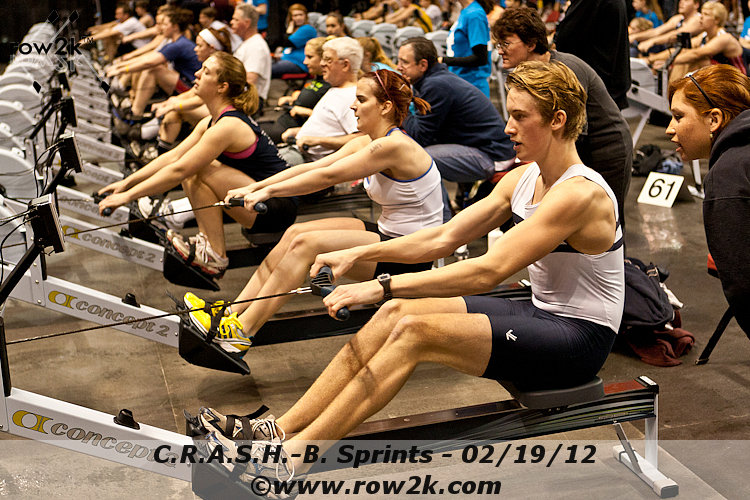 |
| Remera en primer plano tiene problemas técnicos, mientras la segunda remera muestra una mejor posición- |
Problemas técnicos a considerar: Probablemente ha oído hablar de “la manera correcta de
remar”, sin embargo al ver alguien remar frente a uno, posiblemente se sienta algo intimidado
en tratar de corregirle la remada. Como se puede ver en esta foto, muchas veces se encuentra
gente que esta combinando el empuje con la jalada. Los brazos se quiebran durante el empuje de
las piernas mientras la espalda esta cerca de alcanzar el ángulo del final de la remada. Tampoco
es inusual detectar varios empujando con la punta de los pies o finalizando con la rótula del
pié. Este tipo de atletas acaban siendo víctimas de una falta de soporte de la espalda baja. Sus
codos apuntan hacia el piso, con las muñecas en un ángulo de 90° a sus antebrazos. La espalda
esta cerca del piso mientras el mango del ergo es jalado a la altura superior de los pectorales. En
estos casos es muy raro ver que las rodillas están completamente estrechadas, pero en cambio
se encuentran levemente flexionados con los cuádriceps no aplicados. Esta posición final lleva
al remero a regresar el mango…. la espalda, y las rodillas a la toma, todo al mismo tiempo. De
esta manera el musculo flexor de la cadera es mal utilizado para levantar las rodillas, lo cual deja
totalmente fuera de uso al tendón de la corva. La preparación de la parte superior del cuerpo
se retrasa en comparación al tiempo en el que las rodillas se levantan. Esto provoca una parada
de las rodillas en el momento de la compresión máxima y esto lleva a alargar el cuerpo superior
y la extensión de los codos para alcanzar con el mango la máxima cercanía a la rueda de viento.
Consecuencia de esto es que en la remada se contraigan los brazos con una apertura prematura
de la espalda, dejando el empuje de las piernas en un segundo plano.
Abajo tenemos más fotos con las cuales podemos ilustrar lo que describo arriba.
Si eres uno de los remeros en estas fotos, no te sientas avergonzado porque el 99% de los
remeros que han participado en el Crash-B comparten tu técnica. Estoy seguro de lo que afirmo
porque sé de la experiencia personal el desconecte mental que tienen los entrenadores entre lo
que es remo en agua y remo en máquina.
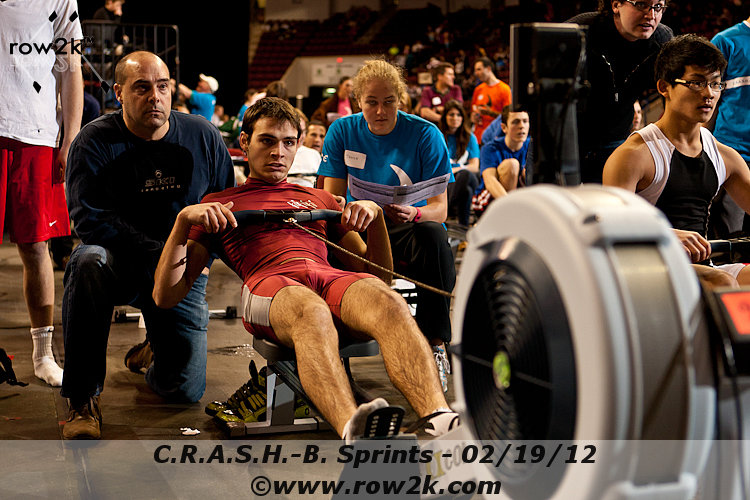 |
| Esta foto ilustra muy bien la remada descripta arriba. Además no entiendo bien que es lo que está pasando con el pié derecho. |
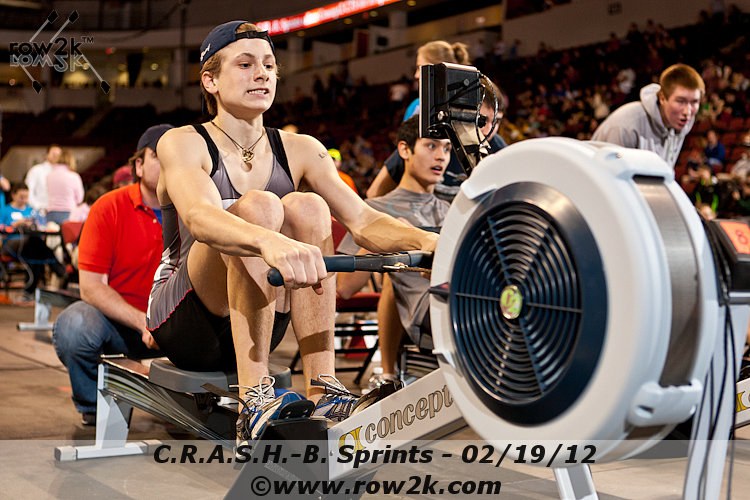 |
| Este es un clara quebrada anticipada de brazos, lo cual retrasa el empuje de piernas, el cuerpo se levanta anticipadamente, mientras que el talón de los pies aún no ha conectado la pedalina. |
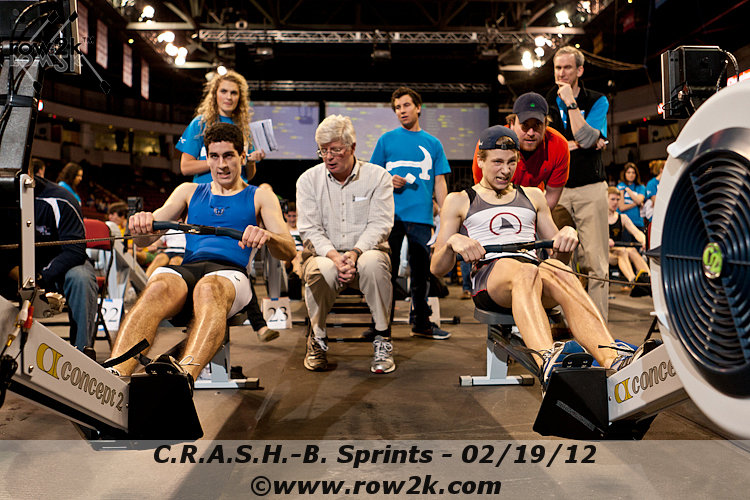 |
| En la derecha el remero se encuentra en la recuperación mientras el de la izquierda esta jalando. La simetría individual es totalmente defectuosa. La forma de ver quien esta jalando y quien está en la recuperación está en las características de la cadena. Tensa en la derecha y suelta en la izquierda |
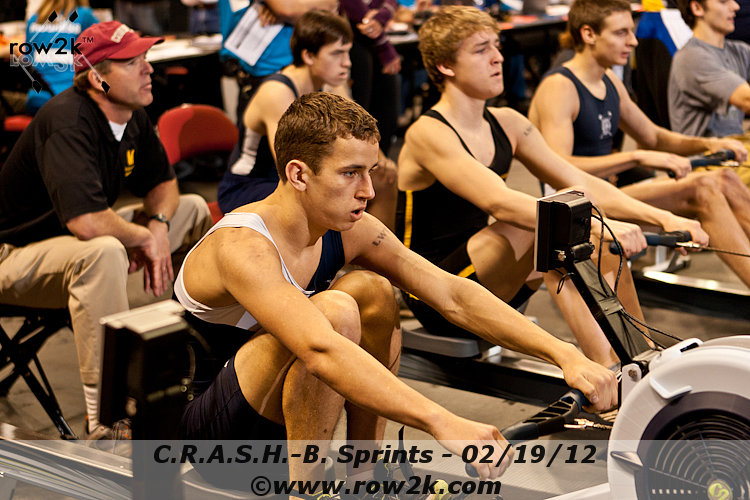 |
| Esta foto no la elegí precisamente por los dos primeros remeros. La mayoría de las fotos tomadas por row2k son de la fase de jaleo por lo cual es difícil encontrar fotos de la fase de recuperación. Echen un vistazo al remero de más a la derecha. El se encuentra en la recuperación combinando todas las partes de su cuerpo para moverse a la toma. Este tipo de remada va a crear un aventón en un bote de conjunto. El atleta en el medio tiene una apertura anticipada de la espalda , está quebrando los brazos al mismo tiempo el ángulo de su cuerpo ya está en posición vertical con lo cual no deja nada para conectar en el último cuarto del empuje de piernas. El joven del frente está rodeando el mango con sus puños con lo cual reduce la habilidad de maximizar el largo efectivo de los brazos en la toma y la sacada. |
Xeno Muller, Olympic gold and silver medalist, indoor rowing, rowing technique.
Feb 21, 2012
CRASH-B and Row2K showcase technical problems "en masse."
|
| Rower in the foreground has technical problems, whereas second rower shows a better hang. |
If you are one of the rowers in these pictures, feel no shame, because 99% of the rowers who took part at CRASH-B share your technique. I am confident of my statement, because I know from personal experience the disconnect that exists in coaches' minds between water rowing and erging.
|
| This picture illustrates well the above described rowing stroke. Also I am not quite sure what is going on with the right foot. |
|
| This is a clear early arm draw, which puts the leg drive on the back burner, the upper body is opening early, while the heel has not yet connected to the foot board. |
|
| On the right, the rower is on the recovery, while the left rower is in the drive phase. The individual symmetry is totally lacking. Key to noticing who is driving and who is on the recovery is the characteristic of the chain. Tight on the left, floppy on the right. |
| ||||
| This picture I chose not necessarily for the first two rowers. Most of the pictures taken by row2k are in the drive phase so it is hard to find shots on the recovery. Have a look at the rower all the way to the right. He is on the recovery, combining every part of his body to move to the catch. Such a rower creates a rush in a team boat. The fellow in the middle has an early opening of back, is breaking the arms at the same time, and the angle of the upper body is already at vertical which leaves nothing to connect in the last quarter of the leg drive. The young rower at the forefront is gripping the handle in his fist reducing his ability to maximize his effective length at the catch and at the finish. Join one of the fastest growing communities of indoor rowers at www.row2go.com and become the fastest rower at www.xenorowingcoach.com Xeno Muller won an Olympic Gold in Atlanta and an Olympic Silver in Sydney, and is the current Olympic Record holder in the 2000m Single Scull. He is also the President of XenoRowingCoach and Row2Go which is quickly becoming THE online community for both indoor and on-the-water rowers providing its members with weekly online workout routines and individualized coaching programs. |
Xeno Muller, Olympic gold and silver medalist, indoor rowing, rowing technique.
Subscribe to:
Posts (Atom)
Mar 2, 2012
When you are an underdog and you start winning.
In 1989, I rowed the single scull for Switzerland at the junior world championship in Szeged Hungary. I knew very little about crew in the United States. I caught myself watching the US junior coxswain give orders to his crew when they got ready to go on the water, setting the boat down, and as they began the pick drill. I loved watching and listening to the commands the coxswain was giving. On the last day of competition I took the shuttle bus back and ended up sitting on row behind
Our rower Matthew won the CRASH-B junior lightweight division
Hello rowers,
Above is a cool clip of our rower Matthew winning CRASH-B. I first met Matthew 2 years ago. He was able to push 6:53 for 2k. After working with him, (him doing all the work, me advising), he ended up winning the hammer last February, by out-sprinting his competition in the final meters, clocking 6:22.1
You can find more information on my coaching at www.xenorowingcoach.com.
Xeno Muller, Olympic gold and silver medalist, indoor rowing, rowing technique.
Feb 29, 2012
When rage drives you to Olympic Gold
|
| En route to 6:44.85 current Olympic record and Atlanta Gold. |
The year was 1993. As a collegiate rower we had an amazing season racing our Brown varsity 8. We completed a two year undefeated run, including winning the Ladies Plate at the Henley Royal Regatta. But unlike the Olympic year before, I was not able to bring sculling and rowing the eight under one roof.
After 6 weeks of intensive training in the double scull, soul searching, and questioning my existence as a rower, we finished the world championships in 8th place. I was not happy. A few hours after our final, I stood at the base of the grandstand, approximately 150 meters from the finish line, and waiting for the final of the men's single scull to come through. There I stood, with a storm of mixed emotions ripping through my chest. My throat started knotting up. I thought of my father. I thought of my great Olympic run the year before. I remember doing a 1000 knee bends in the forest as a junior. I was meant to be racing my single scull, right there on the race course which I was observing as a SPECTATOR. How could I have let this happen? From a state of mixed emotions, one emotion started rising like a tidal wave... RAGE.
Suddenly, my rage changed into a weird sense of helpless observer, who had a hard time believing that his idol, the German Terminator, was being beaten. Porter, Lange, and Chalupa entered their final 750 meters and were in a dogfight for gold. Chalupa had the lead and lost it to Porter. To my complete astonishment, my childhood hero, Thomas Lange, did not win. Victory went to Derek Porter a tall lean Canadian. He was the one capable of beating Thomas Lange.
Here is the link to the 1993 final.
|
| Left to right, Vaclav Chalupa, Derek Porter, Thomas Lange, the next day I met Derek. |
The next day, I watched the rest of the finals. As I made my way to the shuttle, I felt a huge relief. Finally, I was taken away from a place that brought so much grief and anger to me. Little did I know that a new personal chapter in Olympic determination was about to begin.
Steps before boarding the bus, I spotted Derek Porter, who still wore his gold medal around his neck. I was excited to congratulate him, because he helped solve the problem of how to beat an idol, even if it was my idol. I stretched out my hand and said: "Derek, congratulations for winning, and you beat Thomas Lange. Finally, someone could beat him, and you are the one who did it, it was incredible." When I said those words, I wore my heart on my sleeve. "Yeah, thanks," was his response and kept on walking. I felt rejected. By instinct, I turned into a first impression character judge, which is truly unfair to Derek. The vibe I picked up from how he responded, fueled my passion for competition and my view of Derek immediately became subjective and thus I felt that he had an air of superiority that to me spelled out: I am superior to you and anyone else for that matter.
My view of his passive response to my "groupie-ish" behavior hurt me deep down. Without knowing it, Porter, arguably, committed the greatest mistake in his single sculling career. As the saying goes, "don't look down to people who look up to you." That day, I was the one looking up to him. It was that moment in my life, as a single sculler, that the final gold medal ingredient found its way into my racer-brain which galvanized my Olympic determination. I took a deep breath, balled my fists as hard as I could. I felt my entire body tightening up as if I was going to be shot at with a canon ball. Aggressive energy started to flow through my veins and just like that the rage of the day before became RAGE of victory.
As soon as I returned to Brown, I started training on my own. I did thousands of bench rows, squats, lat pull downs, horizontal rows, miles on the erg and water. Not one day would go by without me thinking at least twice about that fateful encounter. Not one day would go by without me thinking of my father who did not live to see the day I would win gold. My Olympic goal was set straight in front of me, like a sight on a target. I was on board of an unstoppable freight train, bound to smash a record on Lake Lanier.
At the world championship in 1994 and 1995, I denied Porter entry to the final. At the 1996 Olympics I overtook him in the last 250 meters to win gold and set the current Olympic record. In 1998, I won silver and I don't remember where he ended up. In 1999, I won another silver, he got bronze. In 2000, I was dying in the last 500 meters, but it was over my dead body that Porter was going to beat me. I won silver and he came in fourth.
Since, I have mellowed out a lot, and for the sake of my wife and four children, I am very happy about it.
|
| From left to right, Derek Porter, Xeno Müller, Thomas Lange 1996 Olympics |
Xeno Muller won an Olympic Gold in Atlanta and an Olympic Silver in Sydney, and is the current Olympic Record holder in the 2000m Single Scull.
Link to the Olympic final of 1996
Xeno Muller, Olympic gold and silver medalist, indoor rowing, rowing technique.
Feb 24, 2012
CRASH-B y Row2K muestran problemas técnicos “en masse “
|
| Remera en primer plano tiene problemas técnicos, mientras la segunda remera muestra una mejor posición- |
Problemas técnicos a considerar: Probablemente ha oído hablar de “la manera correcta de
remar”, sin embargo al ver alguien remar frente a uno, posiblemente se sienta algo intimidado
en tratar de corregirle la remada. Como se puede ver en esta foto, muchas veces se encuentra
gente que esta combinando el empuje con la jalada. Los brazos se quiebran durante el empuje de
las piernas mientras la espalda esta cerca de alcanzar el ángulo del final de la remada. Tampoco
es inusual detectar varios empujando con la punta de los pies o finalizando con la rótula del
pié. Este tipo de atletas acaban siendo víctimas de una falta de soporte de la espalda baja. Sus
codos apuntan hacia el piso, con las muñecas en un ángulo de 90° a sus antebrazos. La espalda
esta cerca del piso mientras el mango del ergo es jalado a la altura superior de los pectorales. En
estos casos es muy raro ver que las rodillas están completamente estrechadas, pero en cambio
se encuentran levemente flexionados con los cuádriceps no aplicados. Esta posición final lleva
al remero a regresar el mango…. la espalda, y las rodillas a la toma, todo al mismo tiempo. De
esta manera el musculo flexor de la cadera es mal utilizado para levantar las rodillas, lo cual deja
totalmente fuera de uso al tendón de la corva. La preparación de la parte superior del cuerpo
se retrasa en comparación al tiempo en el que las rodillas se levantan. Esto provoca una parada
de las rodillas en el momento de la compresión máxima y esto lleva a alargar el cuerpo superior
y la extensión de los codos para alcanzar con el mango la máxima cercanía a la rueda de viento.
Consecuencia de esto es que en la remada se contraigan los brazos con una apertura prematura
de la espalda, dejando el empuje de las piernas en un segundo plano.
Abajo tenemos más fotos con las cuales podemos ilustrar lo que describo arriba.
Si eres uno de los remeros en estas fotos, no te sientas avergonzado porque el 99% de los
remeros que han participado en el Crash-B comparten tu técnica. Estoy seguro de lo que afirmo
porque sé de la experiencia personal el desconecte mental que tienen los entrenadores entre lo
que es remo en agua y remo en máquina.
|
| Esta foto ilustra muy bien la remada descripta arriba. Además no entiendo bien que es lo que está pasando con el pié derecho. |
|
| Este es un clara quebrada anticipada de brazos, lo cual retrasa el empuje de piernas, el cuerpo se levanta anticipadamente, mientras que el talón de los pies aún no ha conectado la pedalina. |
|
| En la derecha el remero se encuentra en la recuperación mientras el de la izquierda esta jalando. La simetría individual es totalmente defectuosa. La forma de ver quien esta jalando y quien está en la recuperación está en las características de la cadena. Tensa en la derecha y suelta en la izquierda |
|
| Esta foto no la elegí precisamente por los dos primeros remeros. La mayoría de las fotos tomadas por row2k son de la fase de jaleo por lo cual es difícil encontrar fotos de la fase de recuperación. Echen un vistazo al remero de más a la derecha. El se encuentra en la recuperación combinando todas las partes de su cuerpo para moverse a la toma. Este tipo de remada va a crear un aventón en un bote de conjunto. El atleta en el medio tiene una apertura anticipada de la espalda , está quebrando los brazos al mismo tiempo el ángulo de su cuerpo ya está en posición vertical con lo cual no deja nada para conectar en el último cuarto del empuje de piernas. El joven del frente está rodeando el mango con sus puños con lo cual reduce la habilidad de maximizar el largo efectivo de los brazos en la toma y la sacada. |
Xeno Muller, Olympic gold and silver medalist, indoor rowing, rowing technique.
Feb 21, 2012
CRASH-B and Row2K showcase technical problems "en masse."
|
| Rower in the foreground has technical problems, whereas second rower shows a better hang. |
If you are one of the rowers in these pictures, feel no shame, because 99% of the rowers who took part at CRASH-B share your technique. I am confident of my statement, because I know from personal experience the disconnect that exists in coaches' minds between water rowing and erging.
|
| This picture illustrates well the above described rowing stroke. Also I am not quite sure what is going on with the right foot. |
|
| This is a clear early arm draw, which puts the leg drive on the back burner, the upper body is opening early, while the heel has not yet connected to the foot board. |
|
| On the right, the rower is on the recovery, while the left rower is in the drive phase. The individual symmetry is totally lacking. Key to noticing who is driving and who is on the recovery is the characteristic of the chain. Tight on the left, floppy on the right. |
| ||||
| This picture I chose not necessarily for the first two rowers. Most of the pictures taken by row2k are in the drive phase so it is hard to find shots on the recovery. Have a look at the rower all the way to the right. He is on the recovery, combining every part of his body to move to the catch. Such a rower creates a rush in a team boat. The fellow in the middle has an early opening of back, is breaking the arms at the same time, and the angle of the upper body is already at vertical which leaves nothing to connect in the last quarter of the leg drive. The young rower at the forefront is gripping the handle in his fist reducing his ability to maximize his effective length at the catch and at the finish. Join one of the fastest growing communities of indoor rowers at www.row2go.com and become the fastest rower at www.xenorowingcoach.com Xeno Muller won an Olympic Gold in Atlanta and an Olympic Silver in Sydney, and is the current Olympic Record holder in the 2000m Single Scull. He is also the President of XenoRowingCoach and Row2Go which is quickly becoming THE online community for both indoor and on-the-water rowers providing its members with weekly online workout routines and individualized coaching programs. |
Xeno Muller, Olympic gold and silver medalist, indoor rowing, rowing technique.
Subscribe to:
Posts (Atom)