Feb 21, 2012

CRASH-B and Row2K showcase technical problems "en masse."

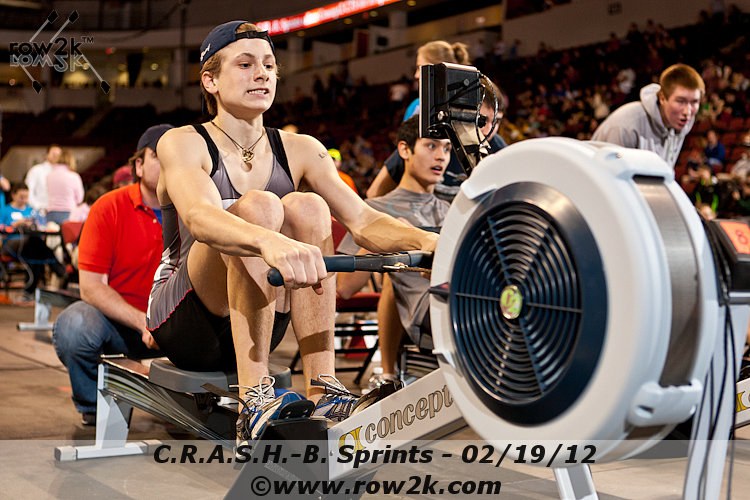
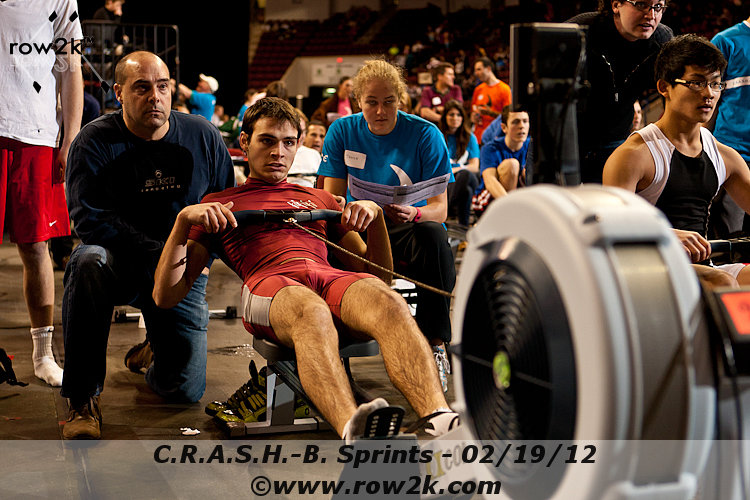
Rower in the foreground has technical problems, whereas second rower shows a better hang.
Technical issues to consider: You may have heard about "the proper way of rowing" however when you see somebody row in front of you, you may find the task of correcting a rowing stroke a bit daunting. As seen on this picture, very often you find people combining pulling with pushing. The arms bend during the leg drive while the back is close to being in its final finish angle. It is also not unusual to spot many toe pushers, or "ball of the foot finishers." These types of athletes are victim to a lack of support in their lower back. Their elbows point straight down to the floor, with wrists at a 90 degree angle to their forearms. The lay back is almost level to the ground with the handle pulled to the upper half of the pectoral muscle. In such instances it is rarely the case that the knees are fully straight, instead they show a slight angle with a quadriceps that is not engaged. Such a finish position leads the rower to return the handle... the lay back, and the knees back to the catch, all at the same time. In this manner, the hip flexor is wrongly used to lift the knees, which completely leaves out the use of the hamstrings. The preparation of the upper body lags behind in comparison to the timing with the rise of the knees, this creates a stop of the knees at the full catch compression and results in a reach of the upper body and elbow extension to get the handle as close to the flywheel as possible. This leads to an early contraction of the arms with a premature opening of the back, putting the leg drive in a secondary position. Here are more pictures I found to illustrate what I am describing above.

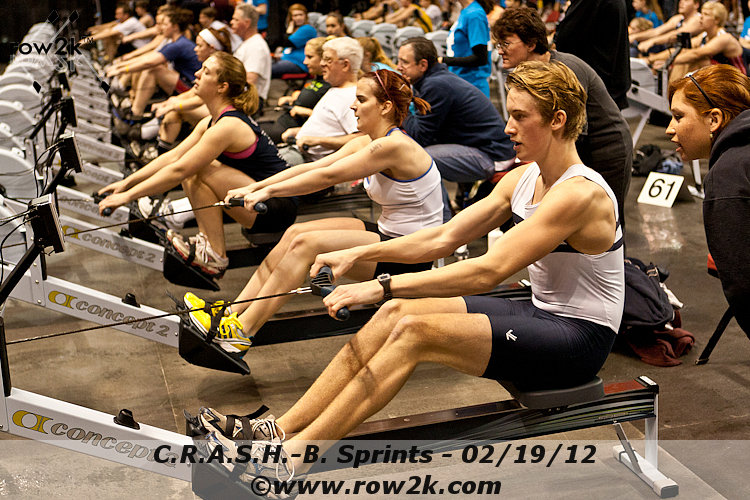
If you are one of the rowers in these pictures, feel no shame, because 99% of the rowers who took part at CRASH-B share your technique.  I am confident of my statement, because I know from personal experience the disconnect that exists in coaches' minds between water rowing and erging. 
This picture illustrates well the above described rowing stroke.  Also I am not quite sure what is going on with the right foot.
This is a clear early arm draw, which puts the leg drive on the back burner, the upper body is opening early, while the heel has not yet connected to the foot board.
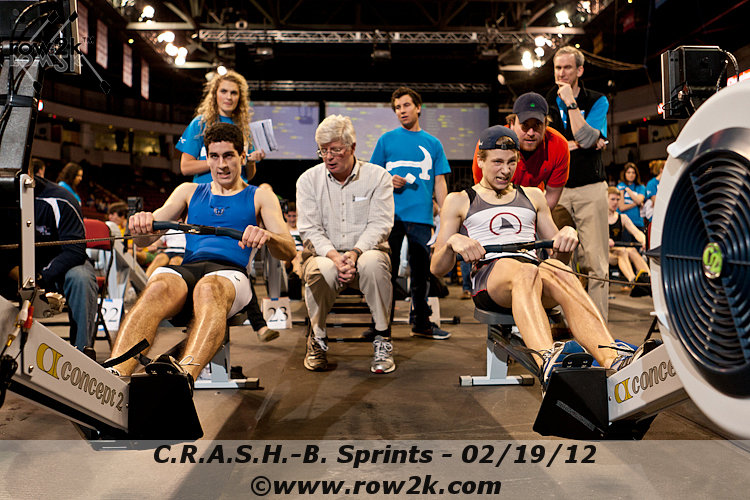
On the right, the rower is on the recovery, while the left rower is in the drive phase.  The individual symmetry is totally lacking.  Key to noticing who is driving and who is on the recovery is the characteristic of the chain.  Tight on the left, floppy on the right.
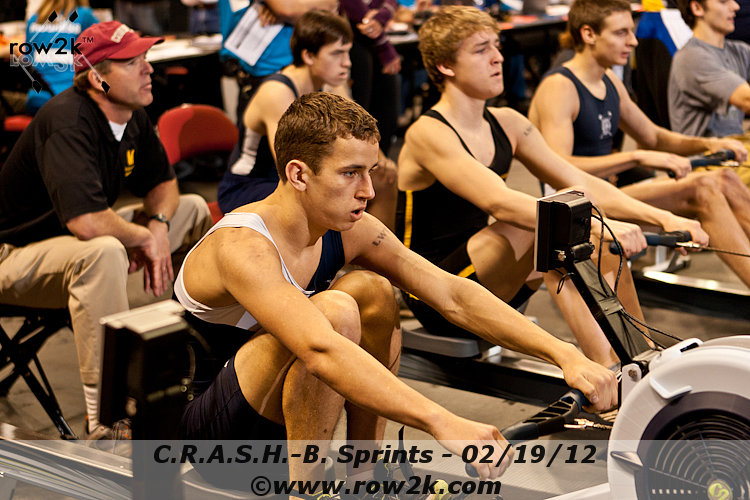
This picture I chose not necessarily for the first two rowers.  Most of the pictures taken by row2k are in the drive phase so it is hard to find shots on the recovery.  Have a look at the rower all the way to the right.  He is on the recovery, combining every part of his body to move to the catch.  Such a rower creates a rush in a team boat.  The fellow in the middle has an early opening of back, is breaking the arms at the same time, and the angle of the upper body is already at vertical which leaves nothing to connect in the last quarter of the leg drive.  The young rower at the forefront is gripping the handle in his fist reducing his ability to maximize his effective length at the catch and at the finish.

Join one of the fastest growing communities of indoor rowers at www.row2go.com and become the fastest rower at www.xenorowingcoach.com
Xeno Muller won an Olympic Gold in Atlanta and an Olympic Silver in Sydney, and is the current Olympic Record holder in the 2000m Single Scull. He is also the President of XenoRowingCoach and Row2Go which is quickly becoming THE online community for both indoor and on-the-water rowers providing its members with weekly online workout routines and individualized coaching programs.


Xeno Muller, Olympic gold and silver medalist, indoor rowing, rowing technique.

Feb 20, 2012

Our rower Matthew won the Hammer at Crash-B!

Congratulations Matthew for winning the CRASH-B Sprint, Indoor Rowing World Championship, in the junior lightweight division in 6:22/2K

2 years ago Matthew tested 6:53/2K, with hard work and smart training he achieved a very tough result.

Xeno Muller, Olympic gold and silver medalist, indoor rowing, rowing technique.

Feb 17, 2012

If rowing is your sport, this book is a must read, Olympic Obsession :-)

 I am currently reading this book. It is fantastic and TIMELESS. The second chapter is about my own Olympic coach, Harry Mahon. With the KINDLE app anyone with a smart phone can read this book anywhere, it is so cool. Perfect to read as we get ready for the 2012 Olympics.
Xeno Muller, Olympic gold and silver medalist, indoor rowing, rowing technique.

Feb 15, 2012

How I met the bench row, a key component to Olympic gold


First day of rowing January 198
I was 13 and a half when I started rowing in Fontainebleau, France.  As a "cadet" rower, we were asked to join the Friday evening strength training session.  The weight room was part of an athletic complex across the street of a famous business school called, Insead.  This school attracted well accomplished US rowers such as, Alyson Townley, Chris Carlson, C.B. Sands-Bohrer, Anne Marden, and John Marden.  This early US rowing interaction presented me with the opportunity to hold Anne Marden's freshly won Olympic silver medal from the Seoul Olympics in my young hand.  It was amazing how big and heavy the medal was.  As I held it,  I remember looking at it long and hard which gave me the impression that the medal grew larger in my hand.  Then a voice inside of me said: "Xeno, you can achieve this, but it is going to cost you, you will suffer."  I tightened my jaw and knew that I was in it for the long haul.

My dad and I the year before Brown
As a young teenager I was a fan of movies such as Rambo, Rocky, Commando, the Running Man and a few others staring these actors...  I wanted to be as buff as Stallone and Schwarzenegger.  Even my father and grandfather enjoyed telling me that a strong body is important in a young man's life and beyond.  So it was no wonder that I was given a piston rowing machine and a punching bag for Christmas the year before I started rowing on the water at the Club D'Aviron Fontainebleau Avon.  When I first set foot in the gym that Friday evening, all I saw were free weights, a couple Smith cages, and monkey bars...  The elder rowers told us to grab four benches that were stacked along the concrete wall.  I had no clue what we were going to do with them.  Maybe we were going to sit down and talk about what we were going to do.  We were told to place three benches parallel to each other and the fourth bench was set on top.  Then an Olympic bar was placed underneath the top bench and I was told to lay belly down and grab the bar and start pulling.  The date was February 15th, 1985.

Shortly before driving to Sydney from Murwillumbah
The company of the bench row lasted 19 years from that evening on.  I did bench rows in Fontainebleau, Zurich, Sarnen, Providence, Boston, and Newport Beach.  There is no doubt in my mind that this specific exercise brought a huge amount of torque to my sculling and sweep rowing stroke.  I excelled at the French national bench row test, which consisted on how many bench pulls with 40kgs one could do in 6 minutes.  Years later, I laid there in the gym of the Newport Aquatic Center, my stopwatch already running and placed on the ground right below me, my finger tips hooked around the bar. As the stop watch reached one minute, I began pulling at a deafening pace, literally, because at the end of every pull the Olympic bar hit the metal frame creating a loud bang.  I thrived on that ear piercing sound.  I felt rage, I was in my element, my mind was screaming to go faster, harder, I wanted to tear everything apart so that my my opponents would get destroyed, they shall regret having chosen to race the single scull.  The metallic banging reminded me of a sledgehammer.  As I progressed through the six minutes, I increasingly felt my lat muscles pulsate with every draw.  My arms became twice as big.  Sweat dripped off my forehead onto the floor.  I kept counting, I wanted to go farther than 240, which meant an above 40 strokes a minute pace. I kept ramming the bar against the bench.  At one minute to go, I demanded that my body released every ounce of energy for the final sprint to complete the six minutes of hell, or was it heaven...  That day I pulled my absolute best, 248 draws at age 28, a month and a half before the Sydney Olympics.

Join one of the fastest growing communities of indoor rowers at www.row2go.com and become the fastest rower at www.xenorowingcoach.com
Xeno Muller won an Olympic Gold in Atlanta and an Olympic Silver in Sydney, and is the current Olympic Record holder in the 2000m Single Scull. 


Xeno Muller, Olympic gold and silver medalist, indoor rowing, rowing technique.
How to enjoy rowing more, row faster, row safely, join us.

Join one of the fastest growing communities of indoor rowers at www.row2go.com and become the fastest rower at www.xenorowingcoach.com
Xeno Muller won an Olympic Gold in Atlanta and an Olympic Silver in Sydney, and is the current Olympic Record holder in the 2000m Single Scull. He is also the President of XenoRowingCoach and Row2Go which is quickly becoming THE online community for both indoor and on-the-water rowers providing its members with weekly online workout routines and individualized coaching programs.
Xeno Muller, Olympic gold and silver medalist, indoor rowing, rowing technique.

Feb 21, 2012

CRASH-B and Row2K showcase technical problems "en masse."

Rower in the foreground has technical problems, whereas second rower shows a better hang.
Technical issues to consider: You may have heard about "the proper way of rowing" however when you see somebody row in front of you, you may find the task of correcting a rowing stroke a bit daunting. As seen on this picture, very often you find people combining pulling with pushing. The arms bend during the leg drive while the back is close to being in its final finish angle. It is also not unusual to spot many toe pushers, or "ball of the foot finishers." These types of athletes are victim to a lack of support in their lower back. Their elbows point straight down to the floor, with wrists at a 90 degree angle to their forearms. The lay back is almost level to the ground with the handle pulled to the upper half of the pectoral muscle. In such instances it is rarely the case that the knees are fully straight, instead they show a slight angle with a quadriceps that is not engaged. Such a finish position leads the rower to return the handle... the lay back, and the knees back to the catch, all at the same time. In this manner, the hip flexor is wrongly used to lift the knees, which completely leaves out the use of the hamstrings. The preparation of the upper body lags behind in comparison to the timing with the rise of the knees, this creates a stop of the knees at the full catch compression and results in a reach of the upper body and elbow extension to get the handle as close to the flywheel as possible. This leads to an early contraction of the arms with a premature opening of the back, putting the leg drive in a secondary position. Here are more pictures I found to illustrate what I am describing above.

If you are one of the rowers in these pictures, feel no shame, because 99% of the rowers who took part at CRASH-B share your technique.  I am confident of my statement, because I know from personal experience the disconnect that exists in coaches' minds between water rowing and erging. 
This picture illustrates well the above described rowing stroke.  Also I am not quite sure what is going on with the right foot.
This is a clear early arm draw, which puts the leg drive on the back burner, the upper body is opening early, while the heel has not yet connected to the foot board.
On the right, the rower is on the recovery, while the left rower is in the drive phase.  The individual symmetry is totally lacking.  Key to noticing who is driving and who is on the recovery is the characteristic of the chain.  Tight on the left, floppy on the right.
This picture I chose not necessarily for the first two rowers.  Most of the pictures taken by row2k are in the drive phase so it is hard to find shots on the recovery.  Have a look at the rower all the way to the right.  He is on the recovery, combining every part of his body to move to the catch.  Such a rower creates a rush in a team boat.  The fellow in the middle has an early opening of back, is breaking the arms at the same time, and the angle of the upper body is already at vertical which leaves nothing to connect in the last quarter of the leg drive.  The young rower at the forefront is gripping the handle in his fist reducing his ability to maximize his effective length at the catch and at the finish.

Join one of the fastest growing communities of indoor rowers at www.row2go.com and become the fastest rower at www.xenorowingcoach.com
Xeno Muller won an Olympic Gold in Atlanta and an Olympic Silver in Sydney, and is the current Olympic Record holder in the 2000m Single Scull. He is also the President of XenoRowingCoach and Row2Go which is quickly becoming THE online community for both indoor and on-the-water rowers providing its members with weekly online workout routines and individualized coaching programs.


Xeno Muller, Olympic gold and silver medalist, indoor rowing, rowing technique.

Feb 20, 2012

Our rower Matthew won the Hammer at Crash-B!

Congratulations Matthew for winning the CRASH-B Sprint, Indoor Rowing World Championship, in the junior lightweight division in 6:22/2K

2 years ago Matthew tested 6:53/2K, with hard work and smart training he achieved a very tough result.

Xeno Muller, Olympic gold and silver medalist, indoor rowing, rowing technique.

Feb 17, 2012

If rowing is your sport, this book is a must read, Olympic Obsession :-)

 I am currently reading this book. It is fantastic and TIMELESS. The second chapter is about my own Olympic coach, Harry Mahon. With the KINDLE app anyone with a smart phone can read this book anywhere, it is so cool. Perfect to read as we get ready for the 2012 Olympics.
Xeno Muller, Olympic gold and silver medalist, indoor rowing, rowing technique.

Feb 15, 2012

How I met the bench row, a key component to Olympic gold


First day of rowing January 198
I was 13 and a half when I started rowing in Fontainebleau, France.  As a "cadet" rower, we were asked to join the Friday evening strength training session.  The weight room was part of an athletic complex across the street of a famous business school called, Insead.  This school attracted well accomplished US rowers such as, Alyson Townley, Chris Carlson, C.B. Sands-Bohrer, Anne Marden, and John Marden.  This early US rowing interaction presented me with the opportunity to hold Anne Marden's freshly won Olympic silver medal from the Seoul Olympics in my young hand.  It was amazing how big and heavy the medal was.  As I held it,  I remember looking at it long and hard which gave me the impression that the medal grew larger in my hand.  Then a voice inside of me said: "Xeno, you can achieve this, but it is going to cost you, you will suffer."  I tightened my jaw and knew that I was in it for the long haul.

My dad and I the year before Brown
As a young teenager I was a fan of movies such as Rambo, Rocky, Commando, the Running Man and a few others staring these actors...  I wanted to be as buff as Stallone and Schwarzenegger.  Even my father and grandfather enjoyed telling me that a strong body is important in a young man's life and beyond.  So it was no wonder that I was given a piston rowing machine and a punching bag for Christmas the year before I started rowing on the water at the Club D'Aviron Fontainebleau Avon.  When I first set foot in the gym that Friday evening, all I saw were free weights, a couple Smith cages, and monkey bars...  The elder rowers told us to grab four benches that were stacked along the concrete wall.  I had no clue what we were going to do with them.  Maybe we were going to sit down and talk about what we were going to do.  We were told to place three benches parallel to each other and the fourth bench was set on top.  Then an Olympic bar was placed underneath the top bench and I was told to lay belly down and grab the bar and start pulling.  The date was February 15th, 1985.

Shortly before driving to Sydney from Murwillumbah
The company of the bench row lasted 19 years from that evening on.  I did bench rows in Fontainebleau, Zurich, Sarnen, Providence, Boston, and Newport Beach.  There is no doubt in my mind that this specific exercise brought a huge amount of torque to my sculling and sweep rowing stroke.  I excelled at the French national bench row test, which consisted on how many bench pulls with 40kgs one could do in 6 minutes.  Years later, I laid there in the gym of the Newport Aquatic Center, my stopwatch already running and placed on the ground right below me, my finger tips hooked around the bar. As the stop watch reached one minute, I began pulling at a deafening pace, literally, because at the end of every pull the Olympic bar hit the metal frame creating a loud bang.  I thrived on that ear piercing sound.  I felt rage, I was in my element, my mind was screaming to go faster, harder, I wanted to tear everything apart so that my my opponents would get destroyed, they shall regret having chosen to race the single scull.  The metallic banging reminded me of a sledgehammer.  As I progressed through the six minutes, I increasingly felt my lat muscles pulsate with every draw.  My arms became twice as big.  Sweat dripped off my forehead onto the floor.  I kept counting, I wanted to go farther than 240, which meant an above 40 strokes a minute pace. I kept ramming the bar against the bench.  At one minute to go, I demanded that my body released every ounce of energy for the final sprint to complete the six minutes of hell, or was it heaven...  That day I pulled my absolute best, 248 draws at age 28, a month and a half before the Sydney Olympics.

Join one of the fastest growing communities of indoor rowers at www.row2go.com and become the fastest rower at www.xenorowingcoach.com
Xeno Muller won an Olympic Gold in Atlanta and an Olympic Silver in Sydney, and is the current Olympic Record holder in the 2000m Single Scull. 


Xeno Muller, Olympic gold and silver medalist, indoor rowing, rowing technique.
How to enjoy rowing more, row faster, row safely, join us.

Join one of the fastest growing communities of indoor rowers at www.row2go.com and become the fastest rower at www.xenorowingcoach.com
Xeno Muller won an Olympic Gold in Atlanta and an Olympic Silver in Sydney, and is the current Olympic Record holder in the 2000m Single Scull. He is also the President of XenoRowingCoach and Row2Go which is quickly becoming THE online community for both indoor and on-the-water rowers providing its members with weekly online workout routines and individualized coaching programs.
Xeno Muller, Olympic gold and silver medalist, indoor rowing, rowing technique.