Mar 31, 2006

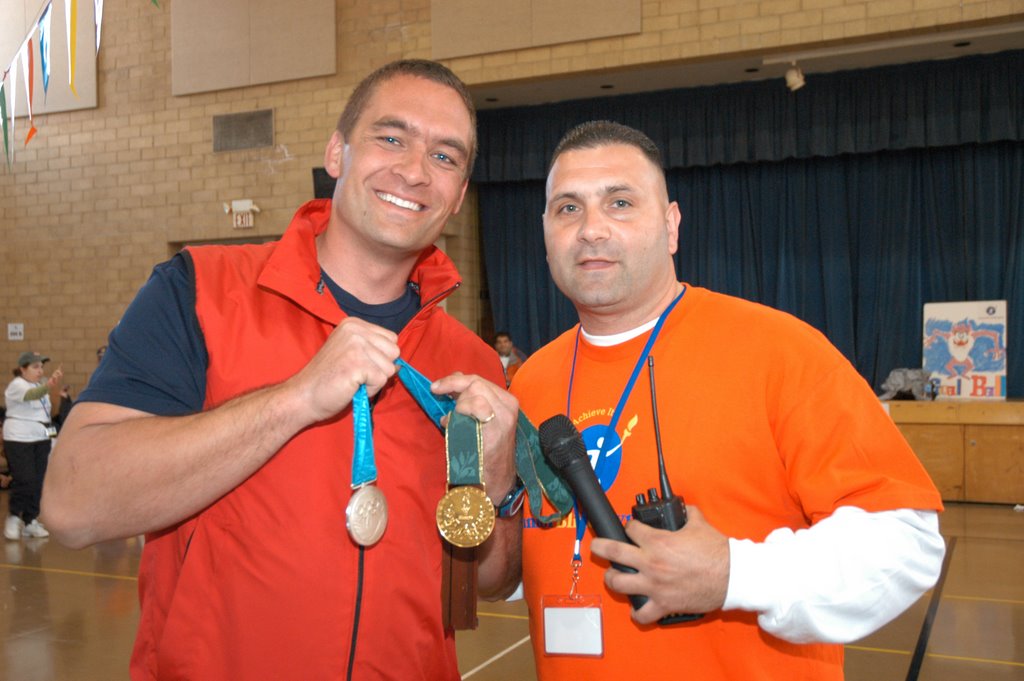
Fotos from the Junior Blind Olympics in Los Angeles

Hello,
I enjoyed every second at the Blind Olympics. I hope to raise funds to start an indoor rowing program.
Sincerely, XENO


Xeno Muller, Olympic gold and silver medalist, indoor rowing, rowing technique.

Aerobic conditioning and anaerobic conditioning.

Here is what we know today.

The main source of power for a 2K sprint comes from the anaerobic capacity. By pushing hard we accumulate lactic acid which makes us weaker farther into our atheltic performance to a point to have to ease up or stop completely.

The aerobic capacity is NOT the main source of power for a 2k sprint race. B U T in order to complete the aerobic cycle, lactic acid is required. It is therefore crucial that training should be geared toward developing the aerobic capacity to FILTER the blood from lactic acid. The larger the aerobic capacity the slower the rise of lactic acid in the body, the longer an athlete can push hard.

This should be a law that US ROWING should propagate througout the USA.

"Anaerobic capacity requires less time to develop. Aerobic capcity requires years. Aerobic capacity is developed below 2 mmols. The aerobic capacity relieves the cardio vascular system from lactic acid, thus enabling the rower to go farther and faster."
Xeno Muller, Olympic gold and silver medalist, indoor rowing, rowing technique.

Mar 26, 2006

This summer we have 2 6-day indoor rowing camps at the IRON OARSMAN

Hello All,

I am planning two six-day training camps this summer. It will be open to all ages, who look to be HIGHLY competitive on the Concept2 rowing machines. The training requirement will be four hours per day and bring a heart rate monitor.

The dates are: July 3-8, and August 1-6, 2006

Indoor rowing technique will be drilled, filmed and analyzed.

The rowers will learn how to administer lactate tests and use the results to tailor their own future training program. Microsoft Excel program will be used to graph the results.

We will train in the weight room and carefully coach lifting technique which is necessary for better rowing performance and injury prevention. This too, will be filmed and analyzed.

We will work on stretching which enhances better rowing technique and injury prevention.

We will use cross training workouts to spice up and complete the conditioning week.

In order to keep the coaching top notch, each week will have a limit of ten participants.

I have not advertised these camps on row2k.com yet. I am presenting this to you first.

If you want to be part of the camp, email me your intention and send me a check to Iron Oarsman, Summer Camp, 440 East 17th Street #5, Costa Mesa, CA 92627. Lodging is not included, if you would like I can provide accomodation information.

The cost is $995.

All the very best and sincerely,
XENO
_________________
Olympic Gold and Silver medalist, 1996 & 2000 men's single scull.
www.cafepress.com/gorow
www.indoor-rowing.blogspot.com
and our official website is www.GOROW.com.
You can call me at 949-400-7630.
5:53 for 2k.
Xeno Muller, Olympic gold and silver medalist, indoor rowing, rowing technique.

What resistance to pick on the Concept2 Rowing machine

Using the Concept2 Indoor Rowing Machine

>Dear Xeno,
> I saw your advice on a rowing forum (and you
> recommended looking at your
> gorow.com site) and wondered if, with your
> experience, you might give me
> some tips. I am 17 yrs old, female and 5' tall with
> kind of short legs for
> my height, so I don't have a natural body type for
> rowing. I am strong and
> aerobically fit, but can't seem to improve my ERG
> times much. The tips I
> get from coaches seem to work much better for the
> taller rowers than they do
> for me. As a matter of fact, when I do what they
> tell me, my times just go
> way up. My best time is only 8:40. I can only even
> get that by rowing with
> a vent setting of between 8 and 10 with a stroke
> rate of around 32 or 33.
> If I drop the vent setting even to 7, I have to keep
> a stroke rate of 36 or
> 38 to even keep a time of 8:40. You mentioned in
> your post to increase the
> torque. I'm not sure what that is, or how one does
> that.
>
> Thanks for any advice that you can give me.
>
> K.

Hello K.
I don't race a 2k at lower than six or seven.
Anything less I do not get enough "torque". The
computer of the rowing machine calculates the change
in speed of the flywheel.
Your strength will always be torque. However, whether
you are five feet or seven feet tall, the technique
does not change.
With speed work you will be able to rate higher. Your
base cadence of 33 is good.
Your choice of resistance is therefore good.
XENO
Xeno Muller, Olympic gold and silver medalist, indoor rowing, rowing technique.

Mar 22, 2006

Visit with rowing machine at the JUNIOR BLIND OLYMPICS in Los Angeles


This is Aerial with Hedda her guide dog.


Aerial Gilbert whom I met in November of 2004 is a blind rower. Two months ago she asked me if I were interested in joining the Junior Blind Olympics in L.A. I said "yes, of course." My family drove the rowing machine to the blind school's campus on Friday night so that the children were able to row until I could free myself from my duty at the Iron Oarsman on Saturday. Aerial was helping the children to row and once me and my family arrived she told me how much the kids LOVED rowing. The experience I got from joining the event was one of kind. I felt very humbeled by the childrens ability to cope and do a superb job running, jumping, rowing, AND having fun doing so. It was very rewarding to be there and give a hand showing an additional activity which blind people can enjoy to the fullest. I was asked to help out during a summer camp in Malibu for older visually impaired teenagers. I had no problem saying yes and I look forward to working with such an enthusiastic group. My family also enjoyed petting the lovely guide dogs who were so attentive to their masters. Count me in for next year!
Thank you Aerial from the Mullers.

Below is more about Aerial:

Director of Volunteers Aerial Gilbert

Aerial Gilbert is the director of volunteers for Guide Dogs for the Blind. She manages a vibrant staff of 500 dedicated volunteers who tackle a variety of jobs from giving campus tours to caring for the organization’s dogs and puppies.

Her own dog, a 3-year-old German Shepherd Guide Dog named “Hedda,” assists her in her daily travels. As a team, they demonstrate the enhanced mobility that is the essence of guide dog use.

Aerial is also an avid athlete. She rows regularly on San Francisco Bay and has competed successfully in the Sausalito Open Water Regatta, the Tahoe Regatta and the 33-mile Annual Catalina Crossing across open ocean. In September 2002, she competed in the first-ever Adaptive Division of the World Rowing Championships in Seville, Spain; her team took home the bronze medal. In August 2003, she competed in the adaptive division of the World Rowing Championships in Milan; her team came in fourth. In Summer 2004, Aerial will again compete with the United States Rowing Team in the World Championships in Banyoles, Spain. If enough teams participate, rowing will be sanctioned as an official Para Olympic sport in the 2008 Olympics in Beijing.

She is a member of the Board of Directors of Sonoma County’s Earle Baum Center of the Blind, a member the Volunteer Center of Marin, the Association for Volunteer Administration, and the American Council of the Blind and Guide Dog Users, Inc. She is a registered nurse with a Bachelor of Science degree in biology.

Through her work with Guide Dogs for the Blind, her personal courage and spirited enthusiasm for life, Aerial has helped many others understand blindness. She shares her personal experiences in public presentations to fraternal organizations, businesses, schools and other groups. She has been featured in numerous publications, including Sunset, Outside and Family Circle as well as on the website: www.incrediblepeople.com.
Xeno Muller, Olympic gold and silver medalist, indoor rowing, rowing technique.

Mar 10, 2006

Thank you Bob for the nice compliments about our Concept2 Indoor Rowing DVDs


I got the DVDs as much for instructional purposes as for
"entertainment" when I'm on the erg.
On both scores I think they are terrific. From an instruction
standpoint for my high school rowers, the indoor rowing workout DVD is worth
the price of the complete set of the four. You talk your way through all
of the fundamentals and the moments where you illustrate some faults
really got my kids attention. I'm sure I'm not the first to tell you
you've fabulous technique and upper body control, and I want my rowers to
emulate you when it comes to upper body control and sequence on the
recovery, keeping the body perfectly quiet on the catch, letting the hands
rise slightly when they approach the catch, keeping the body forward on
the start of the drive, hanging your weight on the oar, bringing on the
upper body swing about 2/3 to 3/4 down the drive, the conveyor belt
concept with the hands down and away (a great image!), etc, etc. It's
interesting when you and Lucas are doing the workout together - your catch
technique seems slightly different. He seems to initiate the drive
quite gently whereas I can see a pronounced "snap" on your shoulders as
you start the drive. I actually prefer the latter with my rowers (girls)
because I think it helps them to get their seats moving fast and their
legs down quicker. The down side is that for novices, this "snappy"
turn-around at the catch causes some of them to shoot their slides, so I
do a fair amount of legs only rowing (well illustrated in your video)
to teach them how to prepare their lower backs as they approach the
catch.

All in all, really good stuff, Xeno. Did you think of the DVD's when
you made them as the kind of instructional tools I'm finding extremely
useful? And thanks for getting #4 in the mail.

Bob
Xeno Muller, Olympic gold and silver medalist, indoor rowing, rowing technique.

Here in the US, high school students can get rowing university scholarships SIMPLY by pulling hard on a Concept2 Rowing Machine.

SPORTS DESK

COLLEGES; Never Rowed? Take a Free Ride

By JULIET MACUR (NYT) 1763 words
Published: May 28, 2004

On the day Ohio State freshmen signed up for extracurricular activities like sororities, paintball and recreational badminton, Amanda Purcell heard a sales pitch. Two women on the university's varsity rowing team begged her to join.
Purcell, a 5-foot-9, 250-pound French horn player and music major who had never played a sport before, said no, but the women persisted. Finally, she decided to give it a try.


Suddenly, she had a new hobby -- and a new way to pay her college education.

A junior now, 60 pounds lighter and physically fit, Purcell has been on scholarship for more than a year and is competing in Ohio State's top varsity boat at this weekend's N.C.A.A. women's rowing championships in Sacramento. She is even thinking of the Olympics.

''I'm still shocked,'' Jim Purcell, Amanda's father, said. ''She was always afraid to touch any sport, but look at her now.''

Purcell and her family quickly learned a fact of life in the 21st century Title IX world: women are getting scholarships in sports they have never tried, perhaps never even heard of.

As an effort to satisfy Title IX legal requirements for gender equity in federally funded institutions, many colleges have added nontraditional sports for women, like rowing. It is a phenomenon particularly true of universities like Ohio State, an institution with a major football program that skews the balance of sports participation and scholarships in the men's favor.

Ohio State elevated its women's rowing program to varsity status nine years ago. Now, as the men's club team runs programs such as Rent-a-Rower ($50 for four hours of chores like raking leaves, cleaning garages or moving furniture to raise money for equipment and travel), the women are fully funded.

The team has an N.C.A.A. maximum 20 scholarships, and 16 women receive full rides. The remaining money is divvied up among other rowers. The team's annual budget is nearly $900,000.

''In the fall, rowing is a sport that you carry 70 to 80 people, then in the spring at least 46 kids get out and race,'' Ohio State's athletic director, Andy Geiger, said. ''It's an expensive sport, but it's worth it. It really does help offset football.''

Rowing has become a popular way to equalize any imbalance between men's and women's sports because it requires high numbers of athletes. A single varsity eight boat requires nine people: eight rowers and a coxswain, a small but vocal person who steers the boat and shouts commands.

Most teams have at least two eight-person boats on varsity and two more on the novice team. Many crews also have four-person boats, which carry four rowers and a coxswain.

It isn't easy, however, to keep rowers on the team. Rowing is a year-round activity, with fall and spring seasons, and weekly races from March through May. Many women who try the sport don't make it through the winter.

Though the National Collegiate Athletic Association puts limits on the number of practice hours, the time commitment is still daunting. Many teams practice twice a day, with a predawn workout on the water that could last several hours. In the afternoon, rowers head to the gym to lift weights or train on the rowing machine.

Blisters form on hands because of friction against oar handles. Pain and soreness develop in nearly every muscle because rowing uses the upper and lower body.

''Sure, you might get a scholarship,'' Geiger said. ''But it's not going to be easy.''

Eighty-five Division I colleges this year had women's rowing teams, a 55 percent jump from 1997, the year women's crew became an N.C.A.A. sport. And now the top teams aren't only the traditional rowing powers like the Ivy League universities and, say, the University of Washington.

Michigan, Virginia and Tennessee are all in the top 10. Ohio State is ranked third going into the championships. Cal is ranked No. 1.

''When we beat Princeton and Brown this year at Princeton, the silence was deafening,'' Ohio State Coach Andy Teitelbaum said. ''But these changes haven't happened overnight. It's taken awhile for us to build our programs.''

With so many programs offering rowing scholarships, recruiting has become instrumental in keeping new programs on top. The problem is that there aren't enough high school rowers to go around.

''We'd be recruiting a kid who'd already have three scholarship offers from Louisville, Texas and Michigan, and we'd be like, 'O.K., this isn't how it used to be,''' said Mike Zimmer, coach of the women's crew at Columbia, which, as an Ivy League university, does not give athletic scholarships but can offer grants and need-based financial aid.

''Now even the women who are on the middle of our list are being chased by a lot of different schools.''

And recruits aren't coming strictly from New England prep schools anymore. They are coming from high schools across the nation, even parts of the country with no history of rowing.

They are also coming from overseas. Ohio State's top varsity boat has rowers from schools called College of Olympic Reserve, Gymnasium Grosse Stadtschule and Red October. Seven of the nine people in the boat are international rowers: five from Germany, one from Russia, one from the Netherlands.

''Rowing has grown so unbelievably fast -- it is where soccer was 10 or 15 years ago -- so the supply and demand is unbelievably off,'' Mark Rothstein, coach of Michigan's women's crew, said. ''But the idea that there aren't enough rowers to go around is changing pretty quickly.''

Still, Rothstein sends a letter to all of Michigan's incoming female freshmen, trying to lure them to the first rowing practice. (He purposely fails to mention that varsity practice begins at 5:45 a.m.)

And at Cal, as at most universities, coaches scour high school rosters for athletes of all kinds who may not want to continue their sport in college. If a woman is tall, aerobically strong and willing to work hard, says Cal Coach Dave O'Neill, chances are she can be a good rower.

''It's not necessarily an easy sport to learn because you have to have certain genetic variables, but it does reward people with a strong work ethic,'' O'Neill said. ''Someone who is a 6-1 swimmer who blew out her shoulder or is sick of being in the pool, now that's the perfect scenario. It's more of a gamble, but it's something that we just have to do.''

Heather Mandoli, a 5-foot-10 athlete who played basketball, soccer and rugby in high school, fits into that category. She scarcely had one month's rowing experience when she was flooded with scholarship offers and wound up at Michigan.

''I thought, a scholarship?'' she said. ''O.K., for basketball, maybe.''

As a high school senior in a small town in British Columbia three hours inland from Vancouver, she won a week's worth of rowing lessons at a start-up rowing club. She didn't actually get on the water in a boat, but she learned her technique on a rowing machine. The machine -- called an ergometer, or erg -- generates a computerized score when set for a specific time or distance.

A few weeks later, Mandoli sent her ergometer score to Canada's national team, and soon she was fielding calls from colleges throughout Canada and the United States, including Michigan, Princeton and Washington.

''After Michigan offered me a scholarship, the first thing I said was, 'You know I can't row, right?''' said Mandoli, who this month was chosen the Big Ten Conference women's rowing athlete of the year. ''They just said, 'We're recruiting you on potential.' That was enough for me.''

Such stories have been enough to promote the growth of high school and recreational rowing programs. In Oakland, Calif., for example, a local water-sports facility started a rowing program this year strictly for public school girls. None of the 21 who signed up could pass the swimming test, and 16 didn't even have bathing suits. Still, DeDe Birch, executive director of the Jack London Aquatic Center, pushed forward.

''Whatever we can do to get these girls a scholarship, we'll do,'' she said. ''Hey, if colleges gave kayaking scholarships, we'd start that team, too.''

None of the talk about scholarship opportunities in rowing had reached Purcell before she signed up for crew that day at Ohio State. She knew nothing about the sport until she showed up for the first practice. But she quickly learned one thing: she was good, particularly on the erg, where her scores were among the best on the team.

But she could not juggle the time commitment with her music studies and her job as a waitress. So she quit the varsity program and joined the club team.

A year later, seeing her potential, her club coach took her to an international rowing machine competition in Boston. Purcell pulled the second-best score of 293 women in the competition and the top collegiate score -- 6 minutes 48.9 seconds for 2,000 meters.

Later that day, she had voicemails and e-mail messages offering scholarships to Fordham, Michigan and San Diego State. She chose to stay at Ohio State, and now the university not only pays her tuition, but it also sends her a monthly check for about $900 for room, board and books.

Purcell's erg scores were so good that she was invited to a national team training camp last summer. There, she realized how far she could go in rowing. Now she wants to make the 2008 Olympic team.

''In the second grade, I tried the viola, but the teachers said I had no musical talent,'' Purcell said. ''Now look at me. I'm a music major. Rowing has kind of been the same thing. Nobody ever knew I'd be good at it. I guess I can thank Title IX for that.''

The testing is done on a CONCEPT2 rowing machine
Xeno Muller, Olympic gold and silver medalist, indoor rowing, rowing technique.

Mar 9, 2006

Indoor Rowing Gloves for Rowperfect and Concept2 rowing machines


If you want soft hands and still want row many kilometers check out the address below.

http://www.newgrip.com/rowing.html
Xeno Muller, Olympic gold and silver medalist, indoor rowing, rowing technique.

Concept2 Rowing machines are in use in the U.K.


North Wales

School rowers claim indoor record Mar 8 2006
By Antony Stone, Daily Post

A JUBILANT secondary school rowing team claimed an indoor world rowing record yesterday after a gruelling 24-hour charity drive.

A team of 10 pupils at Monmouth Comprehensive School Junior Rowing Club clocked up a staggering 215 miles without ever laying eyes on water.

The team, whose members are all under 17, worked in six hour shifts with five minute intensive rowing bouts followed by a 20 minute rest.

Now their 24 hour charitable exploits on a school rowing machine are being checked by the Guinness Book of Records.

The marathon event at the weekend raised cash for the boat club, and more than £6,000 for the trust set up by five times Olympic gold medalist Steve Redgrave.
Xeno Muller, Olympic gold and silver medalist, indoor rowing, rowing technique.

Mar 5, 2006

From SFGate.com, on Indoor Rowing


For indoor rowers, even the wit is dry
Sport's health benefits attract young and old, like Alden, 83
Paul McHugh, Chronicle Outdoors Writer
Thursday, December 2, 2004


Printable Version
Email This Article
Paul Mchugh
Archive
Adventures at Tahoe - Top skiers faced challenges from neophytes...
03/02/2006
OUTDOORS - MAIN EVENTS: Observe and participate - From cycling t...
03/02/2006
The not-so-tall tale of a trailblazer - He was gaudy, but not a ...
02/23/2006

In the beginning, there was rowing on water, a lovely, collegial sport. Yet, an activity not without difficulty -- including tide, waves, wind and cold, wintry weather.

Then, along came virtual rowing. Using exercise machines called ergometers, this was performed on terra firma and often indoors. True, on machines, one doesn't get to admire any soaring seagulls. However, sinking is pretty much absent as a hazard. Rowers used these rigs to augment their training, especially during winter months.

But in recent years, these gizmos have dramatically evolved in terms of efficiency and ease of use. The newest machines allow athletes to smoothly mimic their waterborne motions.

An unanticipated result is that use of rowing machines has broken free of its aquatic parent to become a sport in its own right. Indoor rowing now has its own disciplines, stars, leagues, rating system and international contests.

On Dec. 18, three Californians will be in Amsterdam on a 12-member U.S. team entered in the European Indoor Rowing Championships: Don Alden, Chris Pomer and Joan Van Blom.

"In the mid-1980s, I began to row again after a long absence. My club had a machine, but no one used it much. Just wasn't all that sophisticated," says Alden of Sacramento.

"But Concept2 developed rowing machines with little on-board computers. They gave you the data to see how you would do in a race, including where you'd finish. That marvelous, little black box has made all the difference.

"I bought my machine in 1990. And now I'm on my second. They keep getting better," Alden says.

Alden also keeps improving. At age 83, he'll take a fresh crack at beating the seniors he thoroughly thumped in England two years ago, at a prior international championship. The playing field will come courtesy of the computerized machines, which have proven just as popular in Europe as the United States. Arrange them in a line-up, link their computers to a large video screen or a Jumbotron, and everybody in the gym or arena can scream for a favorite as they watch virtual sculls scoot toward a finish line across a virtual lagoon.

Alden also pursues a victory of greater importance. A college rower for Cal in his youth, he saw his maritime fun disrupted by the Army in World War II, then totally ravaged by his long career as a bridge engineer in the California desert. He credits a post-retirement reunion with rowing with his return to robust good health.

"I was overweight, not feeling too energetic when I retired 20 years ago, " Alden says. "But I made friends with people at the Lake Natoma Rowing Association. They helped me get rowing again. I immediately took off about 20 pounds, and developed a lot more energy.

"It can do that for anyone. Rowing exercises all muscles, from your toes to the back of your neck. And it's very low-impact. Because you just slide back and forth on your butt as you sweat, that completely removes shock to your hips, knees and ankles."

He may star on the machines, but in summer Alden still spends at least four days a week on water. He sees the machines primarily as a training tool and rainy-day refuge -- though there are some indoor buffs who've never set an oar blade in actual fluid.

Even as they praise its benefits, indoor rowers stay keenly aware of the goofy aspect of their enterprise. In fact, they actually celebrate it. In doing so, they remain loyal to their roots.

It began as an organized sport shortly after President Carter announced a U.S. boycott of the 1980 Olympics in the Moscow, to protest the USSR invasion of Afghanistan. A boisterous group of ex-Olympians and other competitive rowers who dubbed themselves the CRASH-Bs (Charles River All-Star Has-Beens) initiated the first contest on then-new Concept2 machines in 1982. It began with the national anthem played on a kazoo. Then a starter with a megaphone, standing in a rowboat stranded on a gym floor, guided 75 participants in their dry regatta.

Now, the U.S. National Championship, still called the CRASH-Bs and held annually in Boston, draws 2,200 participants from all over the world. It and 20 qualifying preliminaries around the U.S. attracted 11,000 participants in 2003. (The next Bay Area satellite race takes place Jan. 23 at Burlingame High School; see www.concept2.com/rowing/racing/calendar.asp, for details.)

"This is a sport that doesn't take itself too seriously," says Robert Brody, the indoor race coordinator for Concept2. "Everything's tongue-in-cheek. At least, until we sit down on the machines. Then it turns very serious. Our event commodore says, this takes a beautiful sport, outdoor rowing, and boils it down to its lowest common denominator -- pain."

Concept2 was founded in 1976 by a pair of brothers, engineers who also happened to be competitive rowers, Dick and Pete Dreissigacker. Their initial products for rowers were composite racing oars. Their debut rowing machine used a bicycle wheel transformed into a fan flywheel for movement resistance (older ergometers used clunky resistance mechanisms like pistons) and a simple odometer for record keeping.

Their brand-new model D, for home use or competition, is built on an aluminum I-beam rail with a stainless steel seat track. It's two feet wide, nearly eight feet long, and weighs 60 pounds. Its PM3 monitor/computer can track workouts or contests. Rowers can even race against their own performance from a previous workout. Contest efforts take place on a virtual course, commonly using rowing's standard 2,000-meter distance. Top times in most age groups are below eight minutes -- which demands a hearty, anaerobic sprint. It's no wonder that pain can become a factor.

But, naturally, there are many more denominators in this activity. One is camaraderie.

"I began rowing on sculls for a women's team in college," says Joan Van Blom, 52, of Long Beach. "I wasn't competitive in high school. But I was looking for some physical activity, as well as a social avenue."

After serving on three U.S. Olympic squads (and winning a silver medal twice), Van Blom found her social avenue jammed with friends, at both indoor and aquatic events. She even met her husband at one.

"I think indoor rowing and the online regattas will only increase in popularity," Van Blom says. "People want ways to trim off weight and stay healthy. This is one of the best ways. You can even do it in your 90s."

Chris Pomer, 16, of Sacramento, has been using aquatic and indoor rowing to shape his body and health since he was 11. Now, standing well over six feet tall, he weighs a muscular 225.

"Once, I was a kind of fat, TV-watching kid," Pomer says. "Rowing made me a lot stronger, mentally much more confident. I hope to do well on the junior national team, then go to a good Ivy League rowing school, or Cal or University of Washington. I want to row in a Olympics before I'm done with competing. But I think I'll probably row my whole life long."

E-mail Paul McHugh at pmchugh@sfchronicle.com.

Page D - 10
Xeno Muller, Olympic gold and silver medalist, indoor rowing, rowing technique.

Indoor rowing is great for people with physical disabilities.

Every day we are enjoying working out at the Iron Oarsman Rowing Studio.
For me it is great fun to meet new people who embrace the sport and become part of the rowing team.

Our atmosphere is very friendly and inclusive. Beginners feel part of the group as soon as the put their first step across the threshold of the I.O.

I am proud of the dedication our rowers have to stay fit and healthy for themselves but also for the people who love them.

Now, my goal is to broaden our group and inform future rowers with physical disabilities that rowing can be a sport they can practice and enjoy. Thanks to the “SLIDE” by concept2, we utilize exercises during which we only use one arm and one leg to row. This enhances better rowing technique. Therefore our rowing would be perfect for people who may not have the full function of one of their limbs.

So if you know of someone who has a physical disability, inform him or her that indoor rowing is an option (use of the slide is advised) for a great workout.

All the very best I wish you all

XENO
Xeno Muller, Olympic gold and silver medalist, indoor rowing, rowing technique.

Mar 2, 2006

From Crash-B world championship:

I thought this was a particularly new way to use the indoor rowing machine.
If anyone out there has more information on this that would be great.

"Adaptive rowing was given a spotlight when four British competitors rowed on very tricked out ergs that provided electric stimulus to their quads on the drive, and to their hamstrings on the recovery, creating the impulse for the back and forth of the rowing motion. If I get it right (their coach/trainer is a British academic, and had the accented mumble to match), each charge was 150 volts of electricity – not inconsequential. "
Xeno Muller, Olympic gold and silver medalist, indoor rowing, rowing technique.

Mar 31, 2006

Fotos from the Junior Blind Olympics in Los Angeles

Hello,
I enjoyed every second at the Blind Olympics. I hope to raise funds to start an indoor rowing program.
Sincerely, XENO


Xeno Muller, Olympic gold and silver medalist, indoor rowing, rowing technique.

Aerobic conditioning and anaerobic conditioning.

Here is what we know today.

The main source of power for a 2K sprint comes from the anaerobic capacity. By pushing hard we accumulate lactic acid which makes us weaker farther into our atheltic performance to a point to have to ease up or stop completely.

The aerobic capacity is NOT the main source of power for a 2k sprint race. B U T in order to complete the aerobic cycle, lactic acid is required. It is therefore crucial that training should be geared toward developing the aerobic capacity to FILTER the blood from lactic acid. The larger the aerobic capacity the slower the rise of lactic acid in the body, the longer an athlete can push hard.

This should be a law that US ROWING should propagate througout the USA.

"Anaerobic capacity requires less time to develop. Aerobic capcity requires years. Aerobic capacity is developed below 2 mmols. The aerobic capacity relieves the cardio vascular system from lactic acid, thus enabling the rower to go farther and faster."
Xeno Muller, Olympic gold and silver medalist, indoor rowing, rowing technique.

Mar 26, 2006

This summer we have 2 6-day indoor rowing camps at the IRON OARSMAN

Hello All,

I am planning two six-day training camps this summer. It will be open to all ages, who look to be HIGHLY competitive on the Concept2 rowing machines. The training requirement will be four hours per day and bring a heart rate monitor.

The dates are: July 3-8, and August 1-6, 2006

Indoor rowing technique will be drilled, filmed and analyzed.

The rowers will learn how to administer lactate tests and use the results to tailor their own future training program. Microsoft Excel program will be used to graph the results.

We will train in the weight room and carefully coach lifting technique which is necessary for better rowing performance and injury prevention. This too, will be filmed and analyzed.

We will work on stretching which enhances better rowing technique and injury prevention.

We will use cross training workouts to spice up and complete the conditioning week.

In order to keep the coaching top notch, each week will have a limit of ten participants.

I have not advertised these camps on row2k.com yet. I am presenting this to you first.

If you want to be part of the camp, email me your intention and send me a check to Iron Oarsman, Summer Camp, 440 East 17th Street #5, Costa Mesa, CA 92627. Lodging is not included, if you would like I can provide accomodation information.

The cost is $995.

All the very best and sincerely,
XENO
_________________
Olympic Gold and Silver medalist, 1996 & 2000 men's single scull.
www.cafepress.com/gorow
www.indoor-rowing.blogspot.com
and our official website is www.GOROW.com.
You can call me at 949-400-7630.
5:53 for 2k.
Xeno Muller, Olympic gold and silver medalist, indoor rowing, rowing technique.

What resistance to pick on the Concept2 Rowing machine

Using the Concept2 Indoor Rowing Machine

>Dear Xeno,
> I saw your advice on a rowing forum (and you
> recommended looking at your
> gorow.com site) and wondered if, with your
> experience, you might give me
> some tips. I am 17 yrs old, female and 5' tall with
> kind of short legs for
> my height, so I don't have a natural body type for
> rowing. I am strong and
> aerobically fit, but can't seem to improve my ERG
> times much. The tips I
> get from coaches seem to work much better for the
> taller rowers than they do
> for me. As a matter of fact, when I do what they
> tell me, my times just go
> way up. My best time is only 8:40. I can only even
> get that by rowing with
> a vent setting of between 8 and 10 with a stroke
> rate of around 32 or 33.
> If I drop the vent setting even to 7, I have to keep
> a stroke rate of 36 or
> 38 to even keep a time of 8:40. You mentioned in
> your post to increase the
> torque. I'm not sure what that is, or how one does
> that.
>
> Thanks for any advice that you can give me.
>
> K.

Hello K.
I don't race a 2k at lower than six or seven.
Anything less I do not get enough "torque". The
computer of the rowing machine calculates the change
in speed of the flywheel.
Your strength will always be torque. However, whether
you are five feet or seven feet tall, the technique
does not change.
With speed work you will be able to rate higher. Your
base cadence of 33 is good.
Your choice of resistance is therefore good.
XENO
Xeno Muller, Olympic gold and silver medalist, indoor rowing, rowing technique.

Mar 22, 2006

Visit with rowing machine at the JUNIOR BLIND OLYMPICS in Los Angeles


This is Aerial with Hedda her guide dog.


Aerial Gilbert whom I met in November of 2004 is a blind rower. Two months ago she asked me if I were interested in joining the Junior Blind Olympics in L.A. I said "yes, of course." My family drove the rowing machine to the blind school's campus on Friday night so that the children were able to row until I could free myself from my duty at the Iron Oarsman on Saturday. Aerial was helping the children to row and once me and my family arrived she told me how much the kids LOVED rowing. The experience I got from joining the event was one of kind. I felt very humbeled by the childrens ability to cope and do a superb job running, jumping, rowing, AND having fun doing so. It was very rewarding to be there and give a hand showing an additional activity which blind people can enjoy to the fullest. I was asked to help out during a summer camp in Malibu for older visually impaired teenagers. I had no problem saying yes and I look forward to working with such an enthusiastic group. My family also enjoyed petting the lovely guide dogs who were so attentive to their masters. Count me in for next year!
Thank you Aerial from the Mullers.

Below is more about Aerial:

Director of Volunteers Aerial Gilbert

Aerial Gilbert is the director of volunteers for Guide Dogs for the Blind. She manages a vibrant staff of 500 dedicated volunteers who tackle a variety of jobs from giving campus tours to caring for the organization’s dogs and puppies.

Her own dog, a 3-year-old German Shepherd Guide Dog named “Hedda,” assists her in her daily travels. As a team, they demonstrate the enhanced mobility that is the essence of guide dog use.

Aerial is also an avid athlete. She rows regularly on San Francisco Bay and has competed successfully in the Sausalito Open Water Regatta, the Tahoe Regatta and the 33-mile Annual Catalina Crossing across open ocean. In September 2002, she competed in the first-ever Adaptive Division of the World Rowing Championships in Seville, Spain; her team took home the bronze medal. In August 2003, she competed in the adaptive division of the World Rowing Championships in Milan; her team came in fourth. In Summer 2004, Aerial will again compete with the United States Rowing Team in the World Championships in Banyoles, Spain. If enough teams participate, rowing will be sanctioned as an official Para Olympic sport in the 2008 Olympics in Beijing.

She is a member of the Board of Directors of Sonoma County’s Earle Baum Center of the Blind, a member the Volunteer Center of Marin, the Association for Volunteer Administration, and the American Council of the Blind and Guide Dog Users, Inc. She is a registered nurse with a Bachelor of Science degree in biology.

Through her work with Guide Dogs for the Blind, her personal courage and spirited enthusiasm for life, Aerial has helped many others understand blindness. She shares her personal experiences in public presentations to fraternal organizations, businesses, schools and other groups. She has been featured in numerous publications, including Sunset, Outside and Family Circle as well as on the website: www.incrediblepeople.com.
Xeno Muller, Olympic gold and silver medalist, indoor rowing, rowing technique.

Mar 10, 2006

Thank you Bob for the nice compliments about our Concept2 Indoor Rowing DVDs


I got the DVDs as much for instructional purposes as for
"entertainment" when I'm on the erg.
On both scores I think they are terrific. From an instruction
standpoint for my high school rowers, the indoor rowing workout DVD is worth
the price of the complete set of the four. You talk your way through all
of the fundamentals and the moments where you illustrate some faults
really got my kids attention. I'm sure I'm not the first to tell you
you've fabulous technique and upper body control, and I want my rowers to
emulate you when it comes to upper body control and sequence on the
recovery, keeping the body perfectly quiet on the catch, letting the hands
rise slightly when they approach the catch, keeping the body forward on
the start of the drive, hanging your weight on the oar, bringing on the
upper body swing about 2/3 to 3/4 down the drive, the conveyor belt
concept with the hands down and away (a great image!), etc, etc. It's
interesting when you and Lucas are doing the workout together - your catch
technique seems slightly different. He seems to initiate the drive
quite gently whereas I can see a pronounced "snap" on your shoulders as
you start the drive. I actually prefer the latter with my rowers (girls)
because I think it helps them to get their seats moving fast and their
legs down quicker. The down side is that for novices, this "snappy"
turn-around at the catch causes some of them to shoot their slides, so I
do a fair amount of legs only rowing (well illustrated in your video)
to teach them how to prepare their lower backs as they approach the
catch.

All in all, really good stuff, Xeno. Did you think of the DVD's when
you made them as the kind of instructional tools I'm finding extremely
useful? And thanks for getting #4 in the mail.

Bob
Xeno Muller, Olympic gold and silver medalist, indoor rowing, rowing technique.

Here in the US, high school students can get rowing university scholarships SIMPLY by pulling hard on a Concept2 Rowing Machine.

SPORTS DESK

COLLEGES; Never Rowed? Take a Free Ride

By JULIET MACUR (NYT) 1763 words
Published: May 28, 2004

On the day Ohio State freshmen signed up for extracurricular activities like sororities, paintball and recreational badminton, Amanda Purcell heard a sales pitch. Two women on the university's varsity rowing team begged her to join.
Purcell, a 5-foot-9, 250-pound French horn player and music major who had never played a sport before, said no, but the women persisted. Finally, she decided to give it a try.


Suddenly, she had a new hobby -- and a new way to pay her college education.

A junior now, 60 pounds lighter and physically fit, Purcell has been on scholarship for more than a year and is competing in Ohio State's top varsity boat at this weekend's N.C.A.A. women's rowing championships in Sacramento. She is even thinking of the Olympics.

''I'm still shocked,'' Jim Purcell, Amanda's father, said. ''She was always afraid to touch any sport, but look at her now.''

Purcell and her family quickly learned a fact of life in the 21st century Title IX world: women are getting scholarships in sports they have never tried, perhaps never even heard of.

As an effort to satisfy Title IX legal requirements for gender equity in federally funded institutions, many colleges have added nontraditional sports for women, like rowing. It is a phenomenon particularly true of universities like Ohio State, an institution with a major football program that skews the balance of sports participation and scholarships in the men's favor.

Ohio State elevated its women's rowing program to varsity status nine years ago. Now, as the men's club team runs programs such as Rent-a-Rower ($50 for four hours of chores like raking leaves, cleaning garages or moving furniture to raise money for equipment and travel), the women are fully funded.

The team has an N.C.A.A. maximum 20 scholarships, and 16 women receive full rides. The remaining money is divvied up among other rowers. The team's annual budget is nearly $900,000.

''In the fall, rowing is a sport that you carry 70 to 80 people, then in the spring at least 46 kids get out and race,'' Ohio State's athletic director, Andy Geiger, said. ''It's an expensive sport, but it's worth it. It really does help offset football.''

Rowing has become a popular way to equalize any imbalance between men's and women's sports because it requires high numbers of athletes. A single varsity eight boat requires nine people: eight rowers and a coxswain, a small but vocal person who steers the boat and shouts commands.

Most teams have at least two eight-person boats on varsity and two more on the novice team. Many crews also have four-person boats, which carry four rowers and a coxswain.

It isn't easy, however, to keep rowers on the team. Rowing is a year-round activity, with fall and spring seasons, and weekly races from March through May. Many women who try the sport don't make it through the winter.

Though the National Collegiate Athletic Association puts limits on the number of practice hours, the time commitment is still daunting. Many teams practice twice a day, with a predawn workout on the water that could last several hours. In the afternoon, rowers head to the gym to lift weights or train on the rowing machine.

Blisters form on hands because of friction against oar handles. Pain and soreness develop in nearly every muscle because rowing uses the upper and lower body.

''Sure, you might get a scholarship,'' Geiger said. ''But it's not going to be easy.''

Eighty-five Division I colleges this year had women's rowing teams, a 55 percent jump from 1997, the year women's crew became an N.C.A.A. sport. And now the top teams aren't only the traditional rowing powers like the Ivy League universities and, say, the University of Washington.

Michigan, Virginia and Tennessee are all in the top 10. Ohio State is ranked third going into the championships. Cal is ranked No. 1.

''When we beat Princeton and Brown this year at Princeton, the silence was deafening,'' Ohio State Coach Andy Teitelbaum said. ''But these changes haven't happened overnight. It's taken awhile for us to build our programs.''

With so many programs offering rowing scholarships, recruiting has become instrumental in keeping new programs on top. The problem is that there aren't enough high school rowers to go around.

''We'd be recruiting a kid who'd already have three scholarship offers from Louisville, Texas and Michigan, and we'd be like, 'O.K., this isn't how it used to be,''' said Mike Zimmer, coach of the women's crew at Columbia, which, as an Ivy League university, does not give athletic scholarships but can offer grants and need-based financial aid.

''Now even the women who are on the middle of our list are being chased by a lot of different schools.''

And recruits aren't coming strictly from New England prep schools anymore. They are coming from high schools across the nation, even parts of the country with no history of rowing.

They are also coming from overseas. Ohio State's top varsity boat has rowers from schools called College of Olympic Reserve, Gymnasium Grosse Stadtschule and Red October. Seven of the nine people in the boat are international rowers: five from Germany, one from Russia, one from the Netherlands.

''Rowing has grown so unbelievably fast -- it is where soccer was 10 or 15 years ago -- so the supply and demand is unbelievably off,'' Mark Rothstein, coach of Michigan's women's crew, said. ''But the idea that there aren't enough rowers to go around is changing pretty quickly.''

Still, Rothstein sends a letter to all of Michigan's incoming female freshmen, trying to lure them to the first rowing practice. (He purposely fails to mention that varsity practice begins at 5:45 a.m.)

And at Cal, as at most universities, coaches scour high school rosters for athletes of all kinds who may not want to continue their sport in college. If a woman is tall, aerobically strong and willing to work hard, says Cal Coach Dave O'Neill, chances are she can be a good rower.

''It's not necessarily an easy sport to learn because you have to have certain genetic variables, but it does reward people with a strong work ethic,'' O'Neill said. ''Someone who is a 6-1 swimmer who blew out her shoulder or is sick of being in the pool, now that's the perfect scenario. It's more of a gamble, but it's something that we just have to do.''

Heather Mandoli, a 5-foot-10 athlete who played basketball, soccer and rugby in high school, fits into that category. She scarcely had one month's rowing experience when she was flooded with scholarship offers and wound up at Michigan.

''I thought, a scholarship?'' she said. ''O.K., for basketball, maybe.''

As a high school senior in a small town in British Columbia three hours inland from Vancouver, she won a week's worth of rowing lessons at a start-up rowing club. She didn't actually get on the water in a boat, but she learned her technique on a rowing machine. The machine -- called an ergometer, or erg -- generates a computerized score when set for a specific time or distance.

A few weeks later, Mandoli sent her ergometer score to Canada's national team, and soon she was fielding calls from colleges throughout Canada and the United States, including Michigan, Princeton and Washington.

''After Michigan offered me a scholarship, the first thing I said was, 'You know I can't row, right?''' said Mandoli, who this month was chosen the Big Ten Conference women's rowing athlete of the year. ''They just said, 'We're recruiting you on potential.' That was enough for me.''

Such stories have been enough to promote the growth of high school and recreational rowing programs. In Oakland, Calif., for example, a local water-sports facility started a rowing program this year strictly for public school girls. None of the 21 who signed up could pass the swimming test, and 16 didn't even have bathing suits. Still, DeDe Birch, executive director of the Jack London Aquatic Center, pushed forward.

''Whatever we can do to get these girls a scholarship, we'll do,'' she said. ''Hey, if colleges gave kayaking scholarships, we'd start that team, too.''

None of the talk about scholarship opportunities in rowing had reached Purcell before she signed up for crew that day at Ohio State. She knew nothing about the sport until she showed up for the first practice. But she quickly learned one thing: she was good, particularly on the erg, where her scores were among the best on the team.

But she could not juggle the time commitment with her music studies and her job as a waitress. So she quit the varsity program and joined the club team.

A year later, seeing her potential, her club coach took her to an international rowing machine competition in Boston. Purcell pulled the second-best score of 293 women in the competition and the top collegiate score -- 6 minutes 48.9 seconds for 2,000 meters.

Later that day, she had voicemails and e-mail messages offering scholarships to Fordham, Michigan and San Diego State. She chose to stay at Ohio State, and now the university not only pays her tuition, but it also sends her a monthly check for about $900 for room, board and books.

Purcell's erg scores were so good that she was invited to a national team training camp last summer. There, she realized how far she could go in rowing. Now she wants to make the 2008 Olympic team.

''In the second grade, I tried the viola, but the teachers said I had no musical talent,'' Purcell said. ''Now look at me. I'm a music major. Rowing has kind of been the same thing. Nobody ever knew I'd be good at it. I guess I can thank Title IX for that.''

The testing is done on a CONCEPT2 rowing machine
Xeno Muller, Olympic gold and silver medalist, indoor rowing, rowing technique.

Mar 9, 2006

Indoor Rowing Gloves for Rowperfect and Concept2 rowing machines


If you want soft hands and still want row many kilometers check out the address below.

http://www.newgrip.com/rowing.html
Xeno Muller, Olympic gold and silver medalist, indoor rowing, rowing technique.

Concept2 Rowing machines are in use in the U.K.


North Wales

School rowers claim indoor record Mar 8 2006
By Antony Stone, Daily Post

A JUBILANT secondary school rowing team claimed an indoor world rowing record yesterday after a gruelling 24-hour charity drive.

A team of 10 pupils at Monmouth Comprehensive School Junior Rowing Club clocked up a staggering 215 miles without ever laying eyes on water.

The team, whose members are all under 17, worked in six hour shifts with five minute intensive rowing bouts followed by a 20 minute rest.

Now their 24 hour charitable exploits on a school rowing machine are being checked by the Guinness Book of Records.

The marathon event at the weekend raised cash for the boat club, and more than £6,000 for the trust set up by five times Olympic gold medalist Steve Redgrave.
Xeno Muller, Olympic gold and silver medalist, indoor rowing, rowing technique.

Mar 5, 2006

From SFGate.com, on Indoor Rowing


For indoor rowers, even the wit is dry
Sport's health benefits attract young and old, like Alden, 83
Paul McHugh, Chronicle Outdoors Writer
Thursday, December 2, 2004


Printable Version
Email This Article
Paul Mchugh
Archive
Adventures at Tahoe - Top skiers faced challenges from neophytes...
03/02/2006
OUTDOORS - MAIN EVENTS: Observe and participate - From cycling t...
03/02/2006
The not-so-tall tale of a trailblazer - He was gaudy, but not a ...
02/23/2006

In the beginning, there was rowing on water, a lovely, collegial sport. Yet, an activity not without difficulty -- including tide, waves, wind and cold, wintry weather.

Then, along came virtual rowing. Using exercise machines called ergometers, this was performed on terra firma and often indoors. True, on machines, one doesn't get to admire any soaring seagulls. However, sinking is pretty much absent as a hazard. Rowers used these rigs to augment their training, especially during winter months.

But in recent years, these gizmos have dramatically evolved in terms of efficiency and ease of use. The newest machines allow athletes to smoothly mimic their waterborne motions.

An unanticipated result is that use of rowing machines has broken free of its aquatic parent to become a sport in its own right. Indoor rowing now has its own disciplines, stars, leagues, rating system and international contests.

On Dec. 18, three Californians will be in Amsterdam on a 12-member U.S. team entered in the European Indoor Rowing Championships: Don Alden, Chris Pomer and Joan Van Blom.

"In the mid-1980s, I began to row again after a long absence. My club had a machine, but no one used it much. Just wasn't all that sophisticated," says Alden of Sacramento.

"But Concept2 developed rowing machines with little on-board computers. They gave you the data to see how you would do in a race, including where you'd finish. That marvelous, little black box has made all the difference.

"I bought my machine in 1990. And now I'm on my second. They keep getting better," Alden says.

Alden also keeps improving. At age 83, he'll take a fresh crack at beating the seniors he thoroughly thumped in England two years ago, at a prior international championship. The playing field will come courtesy of the computerized machines, which have proven just as popular in Europe as the United States. Arrange them in a line-up, link their computers to a large video screen or a Jumbotron, and everybody in the gym or arena can scream for a favorite as they watch virtual sculls scoot toward a finish line across a virtual lagoon.

Alden also pursues a victory of greater importance. A college rower for Cal in his youth, he saw his maritime fun disrupted by the Army in World War II, then totally ravaged by his long career as a bridge engineer in the California desert. He credits a post-retirement reunion with rowing with his return to robust good health.

"I was overweight, not feeling too energetic when I retired 20 years ago, " Alden says. "But I made friends with people at the Lake Natoma Rowing Association. They helped me get rowing again. I immediately took off about 20 pounds, and developed a lot more energy.

"It can do that for anyone. Rowing exercises all muscles, from your toes to the back of your neck. And it's very low-impact. Because you just slide back and forth on your butt as you sweat, that completely removes shock to your hips, knees and ankles."

He may star on the machines, but in summer Alden still spends at least four days a week on water. He sees the machines primarily as a training tool and rainy-day refuge -- though there are some indoor buffs who've never set an oar blade in actual fluid.

Even as they praise its benefits, indoor rowers stay keenly aware of the goofy aspect of their enterprise. In fact, they actually celebrate it. In doing so, they remain loyal to their roots.

It began as an organized sport shortly after President Carter announced a U.S. boycott of the 1980 Olympics in the Moscow, to protest the USSR invasion of Afghanistan. A boisterous group of ex-Olympians and other competitive rowers who dubbed themselves the CRASH-Bs (Charles River All-Star Has-Beens) initiated the first contest on then-new Concept2 machines in 1982. It began with the national anthem played on a kazoo. Then a starter with a megaphone, standing in a rowboat stranded on a gym floor, guided 75 participants in their dry regatta.

Now, the U.S. National Championship, still called the CRASH-Bs and held annually in Boston, draws 2,200 participants from all over the world. It and 20 qualifying preliminaries around the U.S. attracted 11,000 participants in 2003. (The next Bay Area satellite race takes place Jan. 23 at Burlingame High School; see www.concept2.com/rowing/racing/calendar.asp, for details.)

"This is a sport that doesn't take itself too seriously," says Robert Brody, the indoor race coordinator for Concept2. "Everything's tongue-in-cheek. At least, until we sit down on the machines. Then it turns very serious. Our event commodore says, this takes a beautiful sport, outdoor rowing, and boils it down to its lowest common denominator -- pain."

Concept2 was founded in 1976 by a pair of brothers, engineers who also happened to be competitive rowers, Dick and Pete Dreissigacker. Their initial products for rowers were composite racing oars. Their debut rowing machine used a bicycle wheel transformed into a fan flywheel for movement resistance (older ergometers used clunky resistance mechanisms like pistons) and a simple odometer for record keeping.

Their brand-new model D, for home use or competition, is built on an aluminum I-beam rail with a stainless steel seat track. It's two feet wide, nearly eight feet long, and weighs 60 pounds. Its PM3 monitor/computer can track workouts or contests. Rowers can even race against their own performance from a previous workout. Contest efforts take place on a virtual course, commonly using rowing's standard 2,000-meter distance. Top times in most age groups are below eight minutes -- which demands a hearty, anaerobic sprint. It's no wonder that pain can become a factor.

But, naturally, there are many more denominators in this activity. One is camaraderie.

"I began rowing on sculls for a women's team in college," says Joan Van Blom, 52, of Long Beach. "I wasn't competitive in high school. But I was looking for some physical activity, as well as a social avenue."

After serving on three U.S. Olympic squads (and winning a silver medal twice), Van Blom found her social avenue jammed with friends, at both indoor and aquatic events. She even met her husband at one.

"I think indoor rowing and the online regattas will only increase in popularity," Van Blom says. "People want ways to trim off weight and stay healthy. This is one of the best ways. You can even do it in your 90s."

Chris Pomer, 16, of Sacramento, has been using aquatic and indoor rowing to shape his body and health since he was 11. Now, standing well over six feet tall, he weighs a muscular 225.

"Once, I was a kind of fat, TV-watching kid," Pomer says. "Rowing made me a lot stronger, mentally much more confident. I hope to do well on the junior national team, then go to a good Ivy League rowing school, or Cal or University of Washington. I want to row in a Olympics before I'm done with competing. But I think I'll probably row my whole life long."

E-mail Paul McHugh at pmchugh@sfchronicle.com.

Page D - 10
Xeno Muller, Olympic gold and silver medalist, indoor rowing, rowing technique.

Indoor rowing is great for people with physical disabilities.

Every day we are enjoying working out at the Iron Oarsman Rowing Studio.
For me it is great fun to meet new people who embrace the sport and become part of the rowing team.

Our atmosphere is very friendly and inclusive. Beginners feel part of the group as soon as the put their first step across the threshold of the I.O.

I am proud of the dedication our rowers have to stay fit and healthy for themselves but also for the people who love them.

Now, my goal is to broaden our group and inform future rowers with physical disabilities that rowing can be a sport they can practice and enjoy. Thanks to the “SLIDE” by concept2, we utilize exercises during which we only use one arm and one leg to row. This enhances better rowing technique. Therefore our rowing would be perfect for people who may not have the full function of one of their limbs.

So if you know of someone who has a physical disability, inform him or her that indoor rowing is an option (use of the slide is advised) for a great workout.

All the very best I wish you all

XENO
Xeno Muller, Olympic gold and silver medalist, indoor rowing, rowing technique.

Mar 2, 2006

From Crash-B world championship:

I thought this was a particularly new way to use the indoor rowing machine.
If anyone out there has more information on this that would be great.

"Adaptive rowing was given a spotlight when four British competitors rowed on very tricked out ergs that provided electric stimulus to their quads on the drive, and to their hamstrings on the recovery, creating the impulse for the back and forth of the rowing motion. If I get it right (their coach/trainer is a British academic, and had the accented mumble to match), each charge was 150 volts of electricity – not inconsequential. "
Xeno Muller, Olympic gold and silver medalist, indoor rowing, rowing technique.